
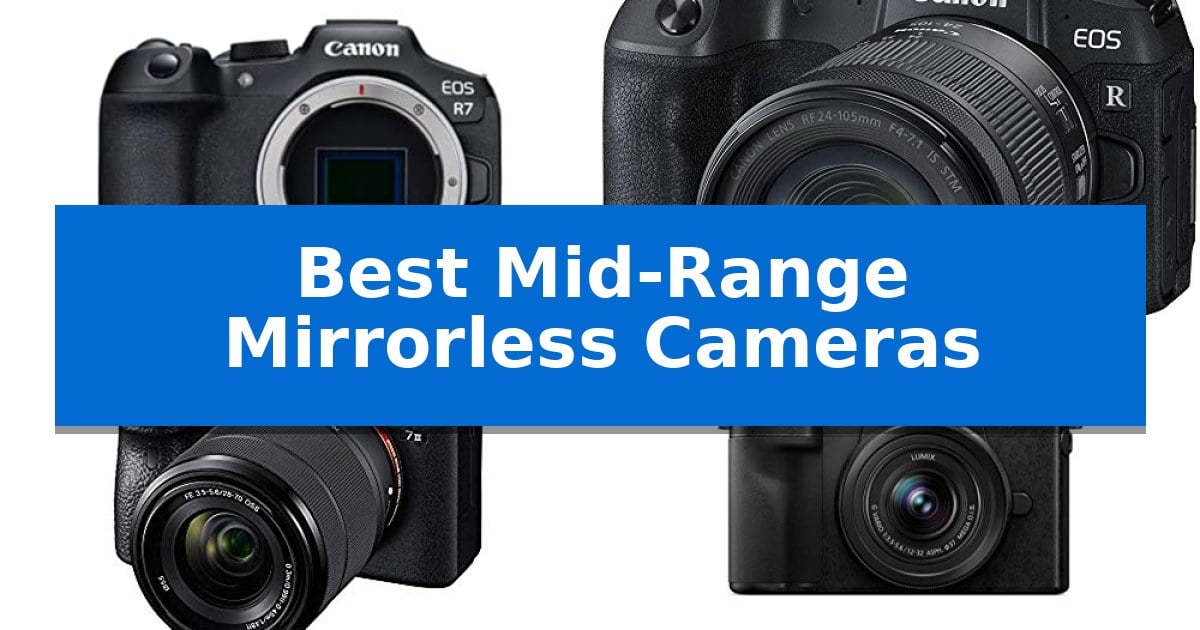
Choosing the right camera often feels like a compromise between professional-grade bulk and entry-level limitations. The Best Mid-Range Mirrorless Cameras bridge this gap, offering advanced features like high-resolution sensors and sophisticated autofocus systems in bodies designed for agility.
Whether you are a content creator needing reliable video tools or a traveler seeking a lightweight full-frame setup, these cameras provide the versatility to grow with your skills. We have analyzed the latest options to help you identify which system aligns with your specific creative requirements.
You may also want to compare Best Mid-Range Mini-LED TV, Best Mid-Range Microphones, and Best Mid-Range Microphone.
Best Mid-Range Mirrorless Cameras
Quick Comparison
| Product | Best For | Key Strength | Score |
|---|---|---|---|
| Canon EOS R7 Mirrorless Camera | Best Overall | High-speed continuous shooting up to 30 fps with electronic shutter. | 4.9 |
| Canon EOS RP Mirrorless Camera | Full-frame entry for travel | Compact and lightweight design for enhanced portability. | 4.7 |
| Sony Alpha a7 III Mirrorless Camera | Versatile full-frame hybrid | Advanced 24.2MP BSI full-frame sensor for high image quality. | 4.6 |
| Panasonic LUMIX G100 Mirrorless Camera | Optimized audio for vloggers | Advanced 360-degree tracking microphone for clear audio in diverse settings. | 4.7 |
| FUJIFILM X-E5 Mirrorless Digital Camera | Analog control meets modern sensor | High-resolution 40.2MP sensor for detailed imaging. | 4.3 |
How We Chose
- Sensor type and resolution for image clarity
- Autofocus speed and subject tracking reliability
- In-body image stabilization performance
- Video resolution and recording capabilities
- Portability and ergonomic handling
1 Canon EOS R7 Mirrorless Camera — High-speed performance for action
Capturing fast-moving subjects requires a camera that can keep pace, and the Canon EOS R7 Mirrorless Camera is built specifically for this demand. It features a high-speed mechanical shutter capable of 15 fps and an electronic shutter reaching 30 fps, ensuring that split-second action is never missed.
At the heart of the system is a 32.5-megapixel APS-C CMOS sensor, which provides the resolution necessary for detailed telephoto work. This sensor is paired with Dual Pixel CMOS AF technology, utilizing 651 AF zones that cover approximately 100% of the frame to maintain focus on moving subjects like athletes or wildlife.
For those who prioritize stability, the 5-Axis In-body Image Stabilization (IBIS) system works to minimize shake during handheld shooting. This stabilization is particularly beneficial for video, where the camera supports professional-grade 4K recording with Movie Servo AF for continuous subject tracking.
The design emphasizes portability without sacrificing usability, featuring a compact and lightweight body with a firm grip. It includes an extra battery pack, extending recording sessions beyond 30 minutes, making it a practical choice for creators who need reliable performance in a variety of environments.
Best for: Photographers and content creators who need high-speed autofocus and stabilization for sports, wildlife, or vlogging.
Skip if: Users who require a full-frame sensor for specific low-light or depth-of-field requirements will find this APS-C model less suitable.
PROS
- High-speed continuous shooting up to 30 fps with electronic shutter.
- Advanced Dual Pixel CMOS AF with 100% frame coverage.
- 5-Axis In-body Image Stabilization for steady handheld capture.
- Professional-grade 4K video with subject tracking.
CONS
- APS-C sensor format may not meet the needs of users requiring full-frame performance.
2 Canon EOS RP Mirrorless Camera — Full-frame entry for travel
Stepping into the world of full-frame photography often involves balancing portability with sensor size, and the Canon EOS RP Mirrorless Camera addresses this by packing a full-frame sensor into a notably compact and lightweight body. Designed for those who prioritize mobility without sacrificing image quality, this camera serves as a versatile entry point for travelers and content creators who need a reliable system that does not weigh them down during long days of shooting.
The camera comes paired with a versatile RF24-105mm lens, which provides a wide zoom range suitable for various subjects, from expansive landscapes to detailed portraits. A standout feature is the Optical Image Stabilization, offering up to 5 stops of shake correction to help maintain clarity in handheld shots. For those focused on macro photography, the system supports a maximum magnification of 0.5x with a minimum focusing distance of 0.43 feet when using the Center Focus Macro mode.
Beyond still photography, the Canon EOS RP Mirrorless Camera is equipped for modern digital workflows. It supports 4K UHD 2160p video capture and offers a clean HDMI output for external recording. Users can also leverage the EOS Utility Webcam Beta Software on Mac or Windows to transform the camera into a high-quality webcam, making it a functional tool for streaming or virtual meetings.
While the compact design is ideal for travel, it is important to consider the trade-offs inherent in such a small form factor. The camera is built to be an accessible gateway to the RF lens ecosystem, prioritizing ease of use and portability for photographers who want to transition from smaller sensors to full-frame performance without the bulk of traditional DSLR systems.
Best for: Travelers and vloggers who need a lightweight, full-frame camera system that is easy to carry and simple to set up for high-quality video or stills.
Skip if: Professional photographers requiring dual card slots, high-speed burst rates for sports, or extensive physical controls found on larger, more specialized bodies.
PROS
- Compact and lightweight design for enhanced portability.
- Versatile RF24-105mm lens included for a wide variety of shooting scenarios.
- Integrated Optical Image Stabilization with up to 5 stops of correction.
- Supports 4K UHD video and functions as a high-quality webcam via software.
CONS
- Compact body size may feel less ergonomic for users with larger hands.
- Limited physical controls compared to higher-end professional mirrorless models.
3 Sony Alpha a7 III Mirrorless Camera — Versatile full-frame hybrid
The Sony Alpha a7 III Mirrorless Camera centers on an advanced 24.2MP BSI full-frame image sensor designed to balance high-resolution output with rapid data processing. By utilizing a back-illuminated architecture, this sensor achieves a 1.8X readout speed, which supports consistent performance across diverse shooting scenarios.
For photographers requiring precision, the system integrates 693 phase-detection and 425 contrast AF points, covering approximately 93% of the image area. This wide coverage assists in maintaining focus tracking during action, complemented by a burst rate of up to 10fps using either the silent or mechanical shutter. The camera provides a broad sensitivity range from ISO 50 to 204,800, alongside a 15-stop dynamic range for handling complex lighting conditions.
The included 28-70mm lens provides a versatile focal range for various subjects, from landscapes to portraits. The body design incorporates a 3-inch LCD for composition and menu navigation, while the internal processing supports 14-bit uncompressed RAW files, ensuring high data retention for post-processing workflows.
This system is a comprehensive kit, shipping with the NP-FZ100 rechargeable battery, AC adapter, and essential accessories like the eyepiece cup and shoulder strap. Its full-frame sensor and robust autofocus array make it a capable tool for those transitioning into professional-grade mirrorless photography.
Best for: Photographers who need a versatile, high-resolution full-frame system with advanced autofocus tracking for both stills and fast-paced subjects.
Skip if: Users who prioritize a lightweight, compact form factor for casual travel or those who do not require the specific depth and dynamic range of a full-frame sensor.
PROS
- Advanced 24.2MP BSI full-frame sensor for high image quality.
- 693 phase-detection AF points providing extensive 93% frame coverage.
- 10fps continuous shooting with reliable AE/AF tracking.
- Broad ISO 50-204,800 range for low-light flexibility.
CONS
- Heavier footprint compared to smaller APS-C or Micro Four Thirds mirrorless systems.
- Complex menu system may require a learning curve for new users.
4 Panasonic LUMIX G100 Mirrorless Camera — Optimized audio for vloggers
Capturing high-quality content requires more than just a smartphone, and the Panasonic LUMIX G100 Mirrorless Camera is built to bridge that gap with its specialized advanced 360-degree sound system. This camera features a high-performance microphone with tracking audio that automatically adjusts to record clearly in various environments, from crowded spaces to one-on-one interviews.
Designed for versatility, the Panasonic LUMIX G100 Mirrorless Camera utilizes the Micro Four Thirds interchangeable lens system, allowing users to swap optics as their creative needs evolve. It comes equipped with a 12-32mm lens and supports 5-Axis Hybrid I.S. to help maintain steady footage during handheld recording, making it a practical choice for those who move while they shoot.
Beyond its primary role as a camera, this device functions as a webcam when connected to a computer, providing a professional visual upgrade for livestreams and video calls. It includes intelligent auto (iA) mode for simplified operation, while advanced users can utilize manual modes and V-Log L recording for greater control over their final output.
The camera is engineered for efficient workflows, featuring facial recognition and frame markers that assist with social media aspect ratios. Its lightweight design is optimized for one-handed use, and it offers seamless integration for transferring and sharing content directly to a smartphone.
Best for: Content creators and vloggers who need a portable, lightweight camera with integrated high-quality audio tracking.
Skip if: Professional videographers requiring full-frame sensors or advanced weather-sealed bodies for extreme outdoor conditions.
PROS
- Advanced 360-degree tracking microphone for clear audio in diverse settings.
- Micro Four Thirds system compatibility allows for a wide range of interchangeable lenses.
- 5-Axis Hybrid I.S. provides stabilization for handheld video recording.
- Webcam functionality enables easy integration into professional livestreams.
CONS
- Compact sensor size may limit performance in extremely low-light conditions compared to larger sensor formats.
5 FUJIFILM X-E5 Mirrorless Digital Camera — Analog control meets modern sensor
The FUJIFILM X-E5 Mirrorless Digital Camera brings a distinct, rangefinder-inspired aesthetic to the mid-range market, featuring a premium machined aluminum top-plate that prioritizes tactile control. By integrating a dedicated, customizable Film Simulation dial, it offers immediate access to creative color profiles, allowing photographers to adjust their visual output directly on the camera body without navigating complex digital menus.
At its core, the camera utilizes a 40.2-megapixel X-Trans 5 HR sensor paired with the X-Processor 5, a combination that enables advanced AI-powered subject detection for improved autofocus accuracy. This imaging engine also supports a lower base ISO of 125, providing greater dynamic range for high-resolution stills, while the inclusion of a two-step digital teleconverter offers additional framing flexibility by cropping into the sensor.
For those shooting in challenging light, the integrated in-body image stabilization (IBIS) system provides up to seven stops of compensation at the center of the frame. This hardware enhancement is designed to mitigate camera shake during handheld photography, ensuring sharper results across a wide variety of lighting conditions.
Designed for versatility, the FUJIFILM X-E5 supports the extensive X Mount ecosystem, providing compatibility with over 40 interchangeable lenses. Its compact, lightweight form factor mimics the portability of fixed-lens cameras while maintaining the creative freedom of a modular system, making it a practical choice for photographers who value both portability and lens selection.
Best for: Photographers who want a compact, rangefinder-style body with the flexibility of interchangeable lenses and advanced AI-assisted autofocus.
Skip if: Users who require a larger, more ergonomic grip for heavy telephoto lenses or those who prioritize video-centric features over analog-style tactile controls.
PROS
- High-resolution 40.2MP sensor for detailed imaging.
- Customizable Film Simulation dial for fast creative adjustments.
- In-body image stabilization (IBIS) providing up to seven stops of compensation.
- AI-powered subject detection for enhanced autofocus performance.
CONS
- Compact rangefinder design may feel less balanced with larger, heavier lenses.
Best Mid-Range Mirrorless Cameras Buying Guide
Sensor Size and Image Quality
The sensor is the heart of your camera, and choosing between APS-C and full-frame sensors significantly impacts your results. Full-frame sensors generally offer better low-light performance and shallower depth of field, which is ideal for portraiture and professional studio work.
Conversely, APS-C sensors allow for more compact lens designs and often provide greater reach for telephoto photography. Consider whether your primary subjects require the light-gathering capability of a larger sensor or the portability of a smaller format.
Autofocus and Subject Tracking
Modern mirrorless systems rely heavily on advanced autofocus algorithms to ensure sharp results. Look for cameras that feature dedicated subject detection, which can identify and track people, animals, or vehicles in real-time.
Reliable tracking is essential for action photography and vlogging. A system with high-density focus zones across the frame provides the flexibility to compose your shots creatively without worrying about focus accuracy.
In-Body Image Stabilization (IBIS)
In-body image stabilization is a critical feature for handheld shooting, especially when using lenses without their own stabilization. It compensates for minor camera shake, allowing you to shoot at slower shutter speeds in low light.
For videographers, effective stabilization is even more important to achieve smooth, professional-looking footage without the need for a bulky gimbal. Check if the camera's stabilization system is rated for multiple stops of correction.
Video Capabilities and Vlogging
If video is a priority, look for high-resolution output like 4K recording and features such as subject tracking during video capture. Some models also include specialized audio features or longer recording times to suit content creators.
Consider the availability of external ports for microphones and the ease of transferring footage to your smartphone for quick editing. A camera that functions well as a high-quality webcam can also add significant value to your setup.
Ergonomics and Build
The physical design of the camera affects how long you can shoot comfortably. A deep, firm grip is often preferred for stability, while a lightweight body is better for all-day travel or street photography.
Look for intuitive placement of dials and buttons that allow you to adjust settings without taking your eye off the viewfinder. Weather sealing or a robust aluminum top-plate can also provide peace of mind if you frequently shoot in challenging environments.
Frequently Asked Questions
Is a full-frame camera always better than an APS-C camera?
Not necessarily. While full-frame sensors offer advantages in low light and depth of field, APS-C cameras are often smaller, lighter, and more affordable, making them excellent for travel and action photography.
What is the benefit of IBIS?
In-body image stabilization helps reduce blur caused by camera shake, allowing for sharper handheld photos and smoother video footage, particularly in low-light conditions.
Can I use my old lenses with these cameras?
Compatibility depends on the lens mount. Many mirrorless systems offer adapters that allow you to use legacy lenses, but you should check the specific manufacturer's mount system for compatibility.
Which camera is best for vlogging?
Cameras with flip-out screens, reliable autofocus tracking, and high-quality built-in microphones are generally best for vlogging. Features like 4K video and compact size are also highly beneficial.
Do I need a high-resolution sensor?
Higher resolution is useful if you plan to crop your images heavily or print them in large formats. For social media and standard web use, a moderate megapixel count is usually more than sufficient.
Conclusion: Our Top Pick
Selecting the right camera depends on your specific needs, whether you prioritize high-speed action, travel-friendly portability, or creative control. After reviewing the available options, the Canon EOS R7 Mirrorless Camera stands out as a versatile choice for those who need a balance of speed and image quality.
With its high-speed shooting capabilities, advanced autofocus, and effective in-body stabilization, the Canon EOS R7 Mirrorless Camera provides a robust platform for both sports and content creation. Its compact design ensures it remains a practical companion for various shooting scenarios.