
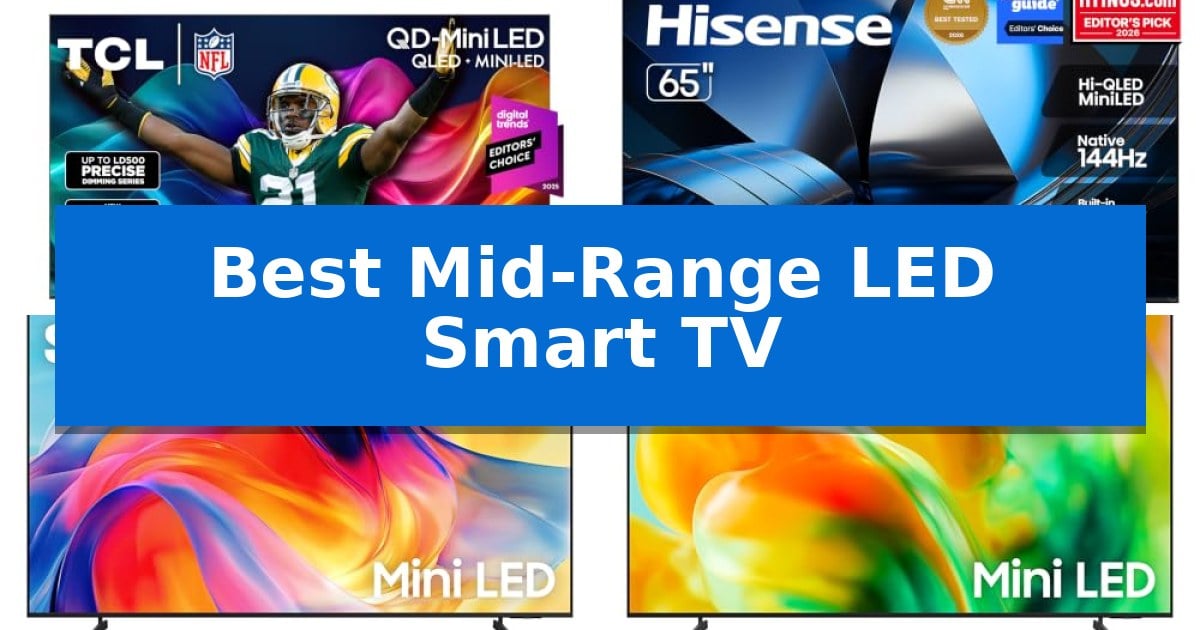
Finding the right balance between high-end features and budget-conscious pricing is the primary challenge when shopping for a new display. A Best Mid-Range LED Smart TV should deliver significant upgrades in contrast and motion handling without the premium price tag of flagship OLED panels.
Whether you are upgrading your living room for sports, competitive gaming, or cinematic streaming, the current market offers sophisticated options that utilize advanced backlighting. We have analyzed the latest 2026 models to help you navigate the technical specifications and identify which display best fits your viewing environment.
You may also want to compare Best Mid-Range Laser Printer Engraving Machines, Best Mid-Range Laser Printer, and Best Mid-Range Laptops to Buy.
Best Mid-Range LED Smart TV
Quick Comparison
| Product | Best For | Key Strength | Score |
|---|---|---|---|
| TCL QM6K Series QLED Mini LED TV | Best Overall | 144Hz native refresh rate for smooth motion in sports and gaming. | 4.9 |
| Hisense U6 Pro Series Mini-LED TV | Bright Room Performance | Native 144Hz refresh rate for smooth motion in gaming and sports. | 4.7 |
| Samsung M70H Series Mini LED TV | Advanced AI Picture Processing | Mini LED Processor 4K provides superior contrast and brightness. | 4.6 |
| Samsung M80H Series Mini LED TV | Smooth Motion for Sports | NQ4 AI Gen2 Processor for real-time content enhancement | 4.8 |
| TCL QM8L Series Mini LED TV | High-Contrast Cinematic Visuals | 4000+ discrete dimming zones for superior contrast control. | 4.6 |
How We Chose
- Contrast and Black Level Performance: Assessing the effectiveness of local dimming zones and Mini-LED backlighting.
- Motion Handling: Evaluating native refresh rates and motion processing capabilities for sports and gaming.
- Color Accuracy: Reviewing the integration of Quantum Dot technology for vibrant, lifelike color reproduction.
- Smart Platform Usability: Checking the responsiveness and content discovery features of the integrated operating systems.
- Gaming Features: Confirming support for high refresh rates, variable refresh rates, and low-latency modes.
1 TCL QM6K Series QLED Mini LED TV — Balanced Value for Gaming
Achieving a balance between high-end gaming features and everyday streaming utility, the TCL 65 Inch QM6K Series QLED Mini LED 4K HDR Smart Google TV utilizes QD-Mini LED technology to deliver precise brightness and contrast. By combining Quantum Dot color with an advanced local dimming system, this model aims to eliminate haloing while maintaining deep black levels and vibrant color accuracy for diverse content types.
For those prioritizing fluid motion, the TCL 65 Inch QM6K Series QLED Mini LED 4K HDR Smart Google TV features a 144Hz native refresh rate paired with Motion Rate 480. This configuration is specifically engineered to minimize motion blur during fast-paced sports broadcasts and high-frame-rate gaming sessions, ensuring clarity during rapid on-screen action.
The integration of Google TV with Gemini simplifies content discovery by allowing users to interact with the interface to find tailored recommendations, reducing time spent navigating menus. Supporting major HDR formats including Dolby Vision, HDR10+, HDR10, and HLG, the display ensures that 4K content is rendered with dynamic contrast and detail across various streaming platforms.
Designed for versatility, the TCL 65 Inch QM6K Series QLED Mini LED 4K HDR Smart Google TV incorporates Dolby Atmos Audio to complement its visual capabilities. With its IMAX Enhanced certification, the hardware is tuned to provide a cinematic experience, making it a functional centerpiece for both dedicated gaming setups and general home entertainment environments.
Best for: Gamers and sports enthusiasts who require high refresh rates and precise contrast control in a mid-range 65-inch form factor.
Skip if: Users who require a smaller screen size or those who do not prioritize high-refresh-rate gaming features may find a more basic 4K model sufficient.
PROS
- 144Hz native refresh rate for smooth motion in sports and gaming.
- QD-Mini LED technology provides superior brightness and contrast.
- TCL Halo Control System effectively reduces blooming and enhances shadow detail.
- Comprehensive HDR support including Dolby Vision and HDR10+.
CONS
- Large 65-inch footprint may not be suitable for smaller living spaces.
- Advanced features like 144Hz may be underutilized by casual viewers who only stream standard content.
2 Hisense U6 Pro Series Mini-LED TV — Bright Room Performance
Achieving a balanced home theater experience requires a display that handles both bright living rooms and high-intensity gaming without compromise. The Hisense 65" U6 Pro Series Mini-LED ULED 4K UHD HDR Gaming AI Smart Fire TV utilizes Mini-LED backlighting with hundreds of precise light zones to deliver deep contrast and vivid color, ensuring that content remains sharp even in well-lit environments.
For gamers and sports enthusiasts, the Hisense 65" U6 Pro Series Mini-LED TV features a native 144Hz refresh rate and Motion Rate 480, which work to keep fast-moving action fluid and clear. The integration of the Hi-View AI Engine allows the display to automatically adapt its picture settings based on the content type, whether you are watching a cinematic movie or engaging in competitive gaming.
Design and audio are also prioritized in this model. The unibody slim design creates an edge-to-edge aesthetic that fits seamlessly into modern spaces, while the built-in subwoofer provides enhanced low-end audio performance. The inclusion of IMAX Enhanced certification and support for Dolby Vision IQ and HDR10+ Adaptive ensures that the visual and auditory experience is optimized for a variety of media.
Navigating your favorite content is streamlined through the Fire TV interface, which provides personalized recommendations and voice control via Alexa+. The display is also Pantone Validated, ensuring that colors—from skin tones to game environments—are rendered with high accuracy for a more realistic viewing experience.
Best for: Gamers and movie enthusiasts who need a high-refresh-rate display that performs well in bright, naturally lit rooms.
Skip if: Users who prefer a different smart ecosystem or those who require a smaller screen size than the 65-inch footprint.
PROS
- Native 144Hz refresh rate for smooth motion in gaming and sports.
- Mini-LED backlighting provides superior contrast and brightness control.
- Anti-reflection and glare-free display technology for bright rooms.
- Built-in subwoofer for more immersive audio output.
CONS
- Large 65-inch form factor may not fit in smaller entertainment setups.
3 Samsung M70H Series Mini LED TV — Advanced AI Picture Processing
The Samsung M70H Series Mini LED TV utilizes a specialized Mini LED Processor 4K to manage brightness and contrast, ensuring deeper blacks and more vivid highlights for a refined visual experience. This 43-inch display is engineered to balance high-end picture quality with smart features, making it a versatile choice for those seeking a modern upgrade to their home entertainment setup.
Equipped with Pure Color Spectrum technology, the screen is capable of rendering one billion colors, which enhances the realism of diverse content types. The inclusion of Supreme Mini LED Dimming further refines the image by providing precise control over contrast, ensuring that details remain clear even in complex, high-contrast scenes.
For those who prioritize fluid motion, the Motion Xcelerator + DLG 120Hz technology optimizes refresh rates to keep fast-paced action sharp. This is complemented by a dedicated Gaming Hub, which aggregates console and cloud gaming services into a single interface, simplifying access to interactive entertainment.
The device also integrates practical streaming solutions through Endless Free Content, providing access to over 2,700 streaming options and 750 subscription-free channels via Samsung TV Plus. Additionally, the Soccer Mode feature offers specialized settings designed to enhance motion clarity and color vibrancy, specifically tailored for sports viewing.
Best for: This TV is best for users who want a compact, feature-rich display that balances high-end Mini LED picture quality with integrated gaming and free streaming services.
Skip if: Skip this model if you require a larger screen size beyond 43 inches or if your primary use case involves professional-grade color grading that necessitates a larger form factor.
PROS
- Mini LED Processor 4K provides superior contrast and brightness.
- Gaming Hub centralizes console and cloud gaming access.
- Motion Xcelerator + DLG 120Hz ensures fluid motion for sports and gaming.
- Includes 2,700+ free streaming options via Samsung TV Plus.
CONS
- 43-inch size may be too small for large living room setups.
- Fixed screen size limits options for those seeking larger displays.
4 Samsung M80H Series Mini LED TV — Smooth Motion for Sports
Achieving a cinematic experience at home often hinges on the quality of your display's processing power. The Samsung 75-Inch Class M80H Series utilizes the advanced NQ4 AI Gen2 Processor to analyze and enhance content in real time, ensuring that everything from fast-paced sports to dramatic films appears sharp and lifelike.
This model stands out for its Mini LED with AI Mode, which pairs high-efficiency lighting with intelligent scene analysis to boost clarity, color, and contrast. For those who prioritize fluid motion, the Motion Xcelerator 144Hz provides ultra-smooth performance, while Variable Refresh Rate technology works to eliminate stutter and tearing during intense gaming sessions.
Visual fidelity is further supported by Pure Spectrum Color, which delivers one billion colors for increased realism. The inclusion of Auto HDR Remastering allows the TV to intelligently transform standard SDR content into HDR-like quality, providing brighter highlights and clearer details without requiring native HDR sources.
Whether you are streaming or gaming, the 4K AI Upscaling ensures that lower-resolution content is sharpened to match the screen's capabilities. With its combination of intelligent processing and high-refresh-rate support, this Samsung M80H Series Mini LED TV serves as a versatile hub for modern home entertainment.
Best for: Home entertainment enthusiasts who prioritize smooth motion for sports and gaming alongside AI-enhanced picture quality.
Skip if: Users who require a smaller screen size or those who do not need high-refresh-rate gaming features like 144Hz.
PROS
- NQ4 AI Gen2 Processor for real-time content enhancement
- 144Hz refresh rate with VRR for smooth gaming
- Mini LED technology for improved brightness and contrast
- 4K AI Upscaling to improve lower-resolution content
CONS
- Large 75-inch footprint may not fit all living spaces
5 TCL QM8L Series Mini LED TV — High-Contrast Cinematic Visuals
The TCL 75 Inch QM8L Series SQD-Mini LED QLED 4K Smart Google TV distinguishes itself through its advanced SQD-Mini LED technology, which utilizes the TCL Halo Control System to deliver precise dimming and high-contrast visuals. This model is engineered for those who prioritize deep blacks and bright highlights, featuring up to 4000+ discrete dimming zones and a peak brightness of 6,000 nits to ensure a vivid, realistic picture.
Beyond its display capabilities, the television integrates the TCL Ultra Color Filter, which uses fine 5-nanometer particles to achieve high color accuracy. The AI-Powered Experience suite enhances content in real-time, providing AI Upscaling for resolution, AI Motion for fluid action, and AI Contrast for dynamic depth. These features work in tandem to optimize the viewing experience across various types of media.
For gamers, the TCL Game Pack offers a robust set of tools including Game Accelerator 288 VRR, AMD FreeSync Premium Pro, and a dedicated Game Bar. These specifications are designed to minimize latency and provide a responsive interface for high-frame-rate gaming. The inclusion of Google TV with Gemini further streamlines content discovery by allowing users to interact directly with the interface to find tailored recommendations.
The audio performance is supported by a home theater system featuring Audio by Bang & Olufsen, with the option to expand via wireless subwoofers and satellite speakers. While the 75-inch form factor provides an expansive canvas for cinematic content, its 7000:1 static contrast ratio ensures that the display maintains clarity even in challenging lighting conditions, making it a versatile centerpiece for modern entertainment setups.
Best for: Home theater enthusiasts and gamers who require high peak brightness, precise dimming zones, and advanced motion handling for a cinematic experience.
Skip if: Users with limited wall or media console space who may find the 75-inch footprint and 67-pound weight too large for their specific room layout.
PROS
- 4000+ discrete dimming zones for superior contrast control.
- 6,000 nits peak brightness for high-impact HDR performance.
- TCL Game Pack with 144Hz support and AMD FreeSync Premium Pro.
- AI-Powered Experience for automated picture and sound optimization.
CONS
- Large 75-inch form factor requires significant installation space.
- Heavy 67-pound weight necessitates a sturdy mounting solution or stand.
Best Mid-Range LED Smart TV Buying Guide
Understanding Mini-LED and QLED Technology
Mini-LED technology represents a significant shift in how LED TVs manage light. By using thousands of tiny LEDs instead of a few large ones, these TVs can achieve much more precise control over brightness and shadow detail. This results in deeper blacks and higher peak brightness, which is essential for high-dynamic-range (HDR) content.
When combined with Quantum Dot (QLED) layers, these TVs produce a wider color gamut. The Quantum Dots convert light into highly saturated colors, ensuring that reds, greens, and blues appear vibrant and accurate. For a Best Mid-Range LED Smart TV, this combination is the gold standard for achieving a cinematic image.
The Importance of Refresh Rates for Motion
A native 144Hz refresh rate is becoming the standard for mid-range displays that prioritize performance. This high refresh rate is critical for live sports, where fast-moving objects like a ball or a player can blur on lower-end 60Hz panels. It ensures that motion remains fluid and sharp during rapid camera pans.
Gamers also benefit significantly from higher refresh rates. When paired with features like Variable Refresh Rate (VRR) and low-latency game modes, the TV can synchronize its output with a console or PC, eliminating screen tearing and stuttering during intense gameplay sessions.
Smart TV Ecosystems and Content Discovery
The operating system is the interface through which you interact with your content. Modern smart platforms like Google TV or Fire TV now integrate AI-driven discovery tools that learn your preferences. This reduces the time spent scrolling through menus and helps you find movies or shows tailored to your interests.
When choosing a TV, consider the ecosystem you are already invested in. If you use smart home devices, ensure the TV supports the relevant voice assistants or smart home protocols. A well-integrated smart platform should be fast, intuitive, and capable of receiving regular software updates.
Optimizing for Bright and Dark Rooms
Your room's lighting conditions should dictate your TV choice. If you have a bright room with many windows, look for a display with high peak nits and anti-reflection coatings. These features prevent glare from washing out the image and ensure that the picture remains visible even in direct sunlight.
For darker rooms, focus on the number of local dimming zones. More zones mean less 'blooming'—the halo effect that occurs when bright objects appear against dark backgrounds. A TV with robust local dimming will provide a more immersive experience for movies and late-night viewing.
HDR Formats and Cinematic Audio
High Dynamic Range (HDR) formats like Dolby Vision and HDR10+ are essential for modern streaming. These formats provide frame-by-frame or scene-by-scene instructions to the TV, optimizing brightness and color for the specific content being played. Ensure your chosen model supports the formats used by your preferred streaming services.
Audio is often the overlooked component of the home theater experience. While built-in speakers have improved, look for support for Dolby Atmos to enable immersive sound. Some models even include built-in subwoofers or support for external wireless audio systems to enhance the depth of your soundstage.
Frequently Asked Questions
What is the difference between QLED and Mini-LED?
QLED refers to the color-enhancing Quantum Dot layer, while Mini-LED refers to the backlighting system. Many modern TVs use both to achieve high brightness and accurate colors.
Do I need 144Hz if I don't play games?
While essential for gaming, a 144Hz native refresh rate also significantly improves the clarity of fast-paced live sports and action movies by reducing motion blur.
How many dimming zones do I need?
There is no single number, but generally, more zones provide better contrast and less haloing around bright objects in dark scenes.
Can I use these TVs in a bright room?
Yes, especially models with high peak brightness and anti-reflection coatings. These features help maintain image quality even when ambient light is high.
What is AI upscaling?
AI upscaling uses a processor to analyze lower-resolution content and intelligently fill in details to make it look closer to 4K quality.
Conclusion: Our Top Pick
After reviewing the current market, the TCL QM6K Series QLED Mini LED TV stands out as the most balanced choice for those seeking premium performance without the flagship price. Its combination of QD-Mini LED technology and a 144Hz refresh rate makes it exceptionally versatile for both high-stakes gaming and cinematic streaming.
We recommend this model because it effectively addresses the common trade-offs in the mid-range segment, providing superior contrast and motion handling that typically require a much higher investment. If you are looking for a reliable, high-performance display that excels in diverse lighting conditions, this is our top pick.