
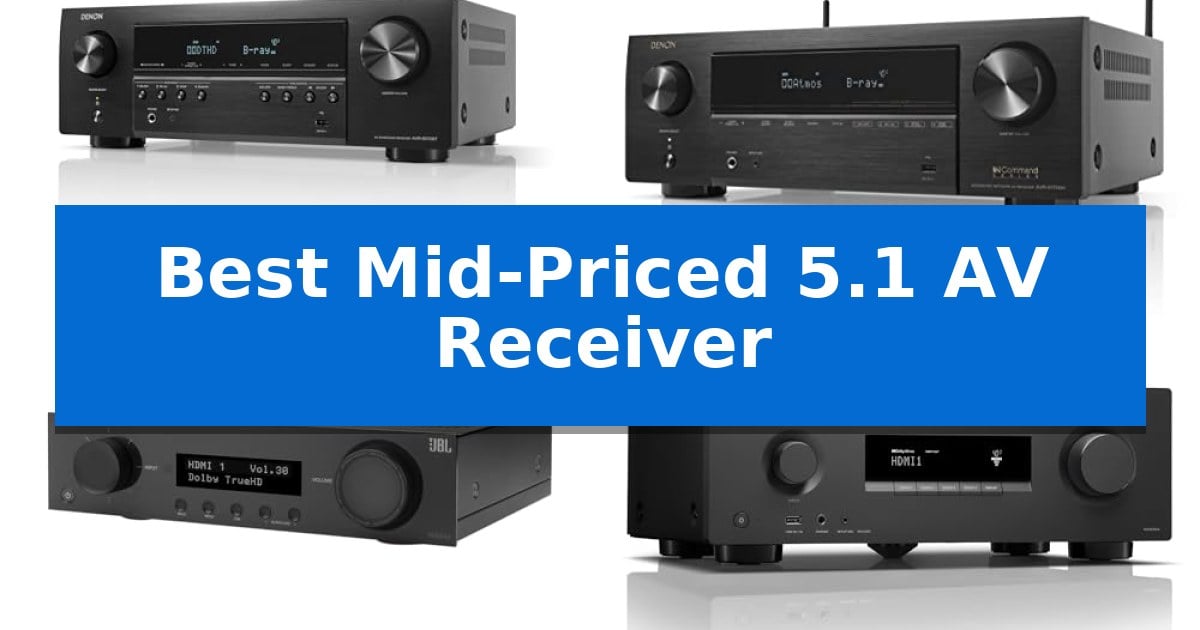
Building a home theater system requires a reliable hub that can manage your video sources and power your speakers effectively. Finding the Best Mid-Priced 5.1 AV Receiver involves balancing modern connectivity standards with the amplification power needed for a truly immersive audio experience.
Whether you are upgrading your gaming setup with 8K video support or simply looking to improve your movie night audio, the right receiver acts as the foundation of your entertainment. We have analyzed five distinct models to help you identify which unit best aligns with your specific room layout and device requirements.
You may also want to compare Best Mid-Priced 5.1 4K AV Receivers, Best Mid-Priced 4K TV for Gaming, and Best Mid-Priced 4K TV.
Best Mid-Priced 5.1 AV Receiver
Quick Comparison
| Product | Best For | Key Strength | Score |
|---|---|---|---|
| Denon AVR-S570BT AV Receiver | Best Overall | Supports 8K and 4K/120Hz video pass-through for high-end gaming. | 4.9 |
| Denon AVR-X1700H AV Receiver | Advanced Multi-Room Audio | Advanced 8K HDMI video section with 4K/120Hz pass-through support. | 4.5 |
| JBL MA310 AV Receiver | High-Fidelity Cinema Sound | 4K video pass-through for high-definition visual integration. | 4.4 |
| Yamaha RX300A AV Receiver | Immersive Atmos Performance | Supports 4K120 and 8K60 video for next-gen gaming and high-resolution displays. | 4.6 |
| Yamaha RX-V385 AV Receiver | Reliable Entry-Level Power | YPAO auto-calibration for simplified room sound optimization | 4.9 |
How We Chose
- Video standards including 8K and 4K/120Hz pass-through support.
- Audio format decoding capabilities such as Dolby Atmos and DTS:X.
- Input and output connectivity, specifically HDMI 2.1 and eARC support.
- Ease of setup and room calibration tools for optimized sound.
- Wireless streaming options like Bluetooth and multi-room integration.
1 Denon AVR-S570BT AV Receiver — Streamlined 8K Setup
The Denon AVR-S570BT AV Receiver serves as a central hub for modern home theater setups, prioritizing high-resolution video pass-through with its four dedicated 8K HDMI inputs. Designed to handle the demands of current gaming consoles and high-definition media, this receiver supports 8K/60Hz and 4K/120Hz signal processing, ensuring compatibility with advanced display standards.
Performance is anchored by a 5.1 channel configuration that delivers 70W per channel, providing enough power for immersive surround sound in standard living spaces. The unit integrates support for high-fidelity audio formats including Dolby TrueHD and DTS HD Master, while its suite of HDR technologies—such as Dolby Vision, HDR10+, and Dynamic HDR—maintains visual integrity from source to screen.
Usability is a core focus, highlighted by the inclusion of an on-screen HD Setup Assistant that simplifies the initial configuration process. Users can manage the system through a connected Smart TV remote via HDMI-CEC or utilize the dedicated Denon Remote App for mobile control. For casual listening, the built-in Bluetooth functionality allows for direct wireless streaming from various mobile audio sources.
Connectivity remains robust for a mid-priced unit, featuring eARC support to streamline audio transmission between the receiver and a television using a single cable. While it offers a comprehensive feature set for 8K video and multi-channel audio, users should ensure their speaker layout aligns with the 5.1 channel limitation before integrating it into larger, multi-zone home theater environments.
Best for: Home theater enthusiasts seeking an affordable, future-ready receiver that supports 8K video and advanced gaming features.
Skip if: Users requiring more than 5.1 channels or those looking for advanced multi-room streaming features beyond standard Bluetooth connectivity.
PROS
- Supports 8K and 4K/120Hz video pass-through for high-end gaming.
- Includes HD Setup Assistant for intuitive installation.
- Features eARC for simplified audio connectivity with modern TVs.
- Offers versatile control via mobile app or standard TV remotes.
CONS
- Limited to 5.1 channel audio configurations.
- Relies on Bluetooth rather than advanced network-based streaming protocols.
2 Denon AVR-X1700H AV Receiver — Advanced Multi-Room Audio
The Denon AVR-X1700H AV Receiver provides a robust foundation for home theater setups by combining a high-performance 7-channel amplifier with advanced 8K video processing. Designed to handle modern entertainment demands, it supports 8K/60Hz and 4K/120Hz pass-through, ensuring compatibility with high-resolution gaming consoles and displays while offering 8K upscaling across all six HDMI inputs.
Audio immersion is a core strength of this unit, which features support for Dolby Atmos, DTS:X, and DTS Virtual:X. For those without dedicated height speakers, the receiver includes Dolby Atmos Height Virtualization Technology to simulate an overhead soundstage. The inclusion of HEOS Built-in allows for multi-room, multi-source streaming, enabling users to play music from services like Spotify or Amazon Music HD in different zones simultaneously.
Usability is prioritized through an award-winning on-screen quick setup guide that simplifies the connection process and EQ optimization. The rear panel features color-coded terminals to assist with cable management. Integration into a smart home is streamlined via Alexa voice control and compatibility with other major voice agents, alongside IP control capabilities for professional automation systems.
Connectivity options are extensive, featuring six HDMI inputs, one eARC-enabled output, and dedicated inputs for digital, analog, and coaxial sources. A built-in phono input allows for direct turntable connection, while two subwoofer pre-outs provide flexibility for bass management. The unit is backed by a 3-year limited warranty, reflecting its role as a versatile hub for diverse media collections.
Best for: Home theater enthusiasts seeking a versatile 7.2-channel hub with 8K video support and multi-room streaming capabilities.
Skip if: Users requiring more than seven channels of amplification or those with specialized high-end audio requirements that exceed standard pre-out configurations.
PROS
- Advanced 8K HDMI video section with 4K/120Hz pass-through support.
- Multi-room streaming via HEOS, AirPlay 2, and Bluetooth.
- Comprehensive voice control compatibility with Alexa and Siri.
- Dedicated phono input for vinyl playback.
CONS
- Limited to 7.2 channels, which may not suit larger home theater configurations.
- Single HDMI output may restrict users with complex multi-display setups.
3 JBL MA310 AV Receiver — High-Fidelity Cinema Sound
Achieving a balanced home theater setup requires a central hub capable of managing modern high-definition sources without unnecessary complexity. The JBL MA310 5.2 Channel AV Receiver provides a foundational 60 watts per channel across five channels, specifically engineered to deliver high-fidelity audio while supporting 4K video pass-through for a cohesive cinema experience.
Connectivity is streamlined through four HDMI inputs and one HDMI output, which includes ARC support for simplified communication with smart TVs and peripheral devices like gaming consoles or streaming boxes. This receiver handles native 5-channel decoding of Dolby and DTS formats, ensuring that your surround sound configuration functions as intended for movie playback.
Beyond wired connections, the unit integrates Bluetooth v5.1 with Low Energy support, allowing for wireless music streaming from mobile devices. Its design focuses on a clean, functional aesthetic that fits into standard media cabinets, measuring approximately 17 inches in length and 4 inches in height, making it a practical choice for those prioritizing space efficiency alongside performance.
Choosing this receiver means opting for a dedicated 5.2-channel solution that prioritizes essential home theater standards. While it lacks the channel count for expansive multi-room or height-channel setups, its focus on core high-fidelity audio and reliable video integration makes it a straightforward component for a standard living room environment.
Best for: Users seeking a dedicated 5.2-channel receiver for standard home theater setups with 4K video and wireless streaming capabilities.
Skip if: Users who require advanced multi-room audio, height channels for Dolby Atmos, or more than four HDMI inputs for complex equipment arrays.
PROS
- 4K video pass-through for high-definition visual integration.
- Bluetooth v5.1 with Low Energy for efficient wireless audio streaming.
- Native 5-channel decoding for standard Dolby and DTS surround sound formats.
- Compact dimensions suitable for standard media console storage.
CONS
- Limited to 5.2 channels, excluding support for immersive height-channel audio formats.
- Four HDMI inputs may be insufficient for users with extensive collections of gaming consoles and media players.
4 Yamaha RX300A AV Receiver — Immersive Atmos Performance
Achieving a balanced home theater setup requires a central hub that handles both high-resolution video and immersive audio without unnecessary complexity. The Yamaha RX300A 5.2-Channel Home Theater AV Receiver provides a foundation for this by supporting Dolby Atmos and DTS Virtual:X, ensuring a dimensional soundstage that adapts to your specific room environment.
This receiver is built to manage modern entertainment demands with 4K120 and 8K60 video support, making it a capable choice for high-refresh-rate gaming and ultra-high-definition media. With HDMI eARC and advanced dynamic range technologies like Dolby Vision and HDR10+, it maintains signal integrity across multiple connected devices, while the included setup microphone automatically calibrates audio output based on your room's unique acoustics.
Usability is prioritized through an intuitive Quick Guide and an on-screen settings menu that simplifies the initial configuration of speakers and inputs. For wireless convenience, Bluetooth Multipoint allows you to pair two source devices simultaneously, enabling quick switching between music, podcasts, or audiobooks without needing to re-pair.
The unit offers flexible speaker configurations, including 3.1.2-channel setups with up-firing or in-ceiling height speakers to enhance vertical audio presence. Users can further streamline their experience by utilizing the four Scene buttons, which allow for the storage and instant recall of custom presets for different listening situations or content types.
Best for: Home theater enthusiasts looking for a versatile, mid-priced receiver that supports modern 8K video standards and immersive Dolby Atmos audio.
Skip if: Users requiring more than 5.2 channels or those needing advanced multi-zone audio distribution beyond a standard single-room setup.
PROS
- Supports 4K120 and 8K60 video for next-gen gaming and high-resolution displays.
- Includes automatic room correction via an included setup microphone.
- Features Bluetooth Multipoint for seamless switching between two source devices.
- Offers flexible speaker layouts including support for 3.1.2-channel Dolby Atmos.
CONS
- Limited to a 5.2-channel configuration, which may not suit larger home theater spaces.
- Requires manual configuration for advanced audio preferences beyond the provided Scene presets.
5 Yamaha RX-V385 AV Receiver — Reliable Entry-Level Power
Achieving a balanced home theater setup often begins with the Yamaha RX-V385 AV Receiver, a unit designed to deliver 5.1-channel powerful surround sound while maintaining a compact footprint. This receiver serves as a central hub for modern media, supporting 4K Ultra HD content along with HDR10, Dolby Vision, and Hybrid Log-Gamma to ensure high-fidelity video pass-through.
The device simplifies the setup process through YPAO auto-calibration technology, which analyzes room acoustics to optimize audio output automatically. For users who prioritize convenience, the inclusion of Bluetooth for wireless connectivity allows for seamless streaming from mobile devices, while HDMI 2.1 with HDCP 2.2 support ensures compatibility with current high-definition sources.
Connectivity is a primary focus, featuring a 4-in/1-out HDMI configuration that utilizes HDMI CEC for streamlined control of connected components. The receiver also includes an Audio Delay function, adjustable from 0 to 500 ms, providing the flexibility needed to synchronize sound perfectly with on-screen action.
Measuring 17.13 inches in width and weighing 16.3 pounds, the Yamaha RX-V385 AV Receiver is built for standard media cabinets. While it provides robust features for a 5.1 configuration, users should note that it is limited to this specific channel layout, making it a focused choice for those who do not require expansion into 7.1 or overhead Atmos channels.
Best for: Home theater enthusiasts looking for a reliable, straightforward 5.1-channel receiver with essential 4K video support and automated room calibration.
Skip if: Users who require advanced multi-room audio, 7.1-channel surround sound, or support for immersive object-based audio formats like Dolby Atmos.
PROS
- YPAO auto-calibration for simplified room sound optimization
- Comprehensive 4K Ultra HD and HDR video format support
- Integrated Bluetooth for convenient wireless audio streaming
- HDMI 2.1 with HDCP 2.2 compliance for modern device compatibility
CONS
- Limited to 5.1-channel output without expansion options
- Lacks support for advanced immersive audio formats like Dolby Atmos
Best Mid-Priced 5.1 AV Receiver Buying Guide
Understanding HDMI Standards
Modern AV receivers rely heavily on HDMI 2.1 to handle high-bandwidth signals. If you own a modern gaming console or an 8K television, ensuring your receiver supports 8K/60Hz or 4K/120Hz pass-through is essential to avoid bottlenecks in your video chain.
Look for eARC (Enhanced Audio Return Channel) support, which allows your TV to send high-quality, uncompressed audio back to the receiver over a single HDMI cable. This simplifies your cable management while maintaining high-fidelity sound.
Amplification and Speaker Channels
While a 5.1 system is the standard for surround sound, some receivers offer 7.2 channel capabilities that allow for future expansion. Consider the wattage per channel to ensure the receiver can adequately drive your specific speakers without distortion.
Check if the receiver supports Dolby Atmos or DTS:X, which provide height-based audio cues. Even if you only have a 5.1 setup today, choosing a receiver with height virtualization can simulate an immersive experience without adding extra ceiling speakers.
Room Calibration Technology
Every room has unique acoustics that can negatively impact sound quality. Built-in room calibration software uses an included microphone to measure your room's dimensions and speaker placement, automatically adjusting EQ settings for the best performance.
These automated systems, such as YPAO or proprietary setup assistants, are invaluable for users who are not audio engineers. They take the guesswork out of balancing levels and distances, ensuring clear dialogue and balanced surround effects.
Wireless Connectivity and Streaming
Modern receivers are more than just amplifiers; they are media hubs. Bluetooth is standard, but look for Bluetooth Multipoint if you want to switch between multiple source devices seamlessly without constant re-pairing.
For those interested in whole-home audio, features like HEOS or similar multi-room streaming platforms allow you to sync music across different zones. Ensure the receiver integrates with your preferred streaming services like Spotify or Tidal.
Control and Integration
Consider how you prefer to control your system. Many receivers now offer mobile app integration for iOS and Android, allowing you to adjust settings or change inputs directly from your phone.
If you use a smart home ecosystem, look for voice control compatibility with Alexa or Siri. This allows for hands-free adjustments, making it easier to switch between movie, music, and gaming modes without searching for a remote.
Frequently Asked Questions
What is the difference between 5.1 and 7.2 channel receivers?
A 5.1 receiver supports five speakers and one subwoofer. A 7.2 receiver supports seven speakers and two subwoofers, providing more flexibility for larger rooms or more complex surround sound configurations.
Do I need 8K support if I only have a 4K TV?
Not immediately, but an 8K-ready receiver ensures your system remains compatible if you upgrade your display in the future. It also often implies support for newer gaming features like VRR and ALLM.
How does eARC benefit my setup?
eARC allows high-bitrate audio formats like Dolby TrueHD and DTS-HD Master Audio to be sent from your TV to your receiver, ensuring you get the best possible sound quality from your streaming apps or connected devices.
Can I use my existing speakers with these receivers?
Most modern AV receivers are compatible with standard passive speakers. Ensure your speakers' impedance (measured in Ohms) matches the receiver's supported range, which is typically listed in the product manual.
Is professional installation required for these receivers?
Most mid-priced receivers include intuitive on-screen setup assistants that guide you through the process, making professional installation unnecessary for most home users.
Conclusion: Our Top Pick
When selecting the right unit, the Denon AVR-S570BT AV Receiver stands out as the most balanced choice for those seeking a streamlined 8K setup. Its combination of four HDMI 2.1 inputs and an easy-to-use setup assistant makes it highly accessible for users who want modern performance without unnecessary complexity.
While other models in this list offer advanced multi-room features or higher channel counts, the Denon AVR-S570BT provides the essential tools for a high-quality 5.1 home theater experience. It is an ideal starting point for anyone looking to modernize their audio-visual chain while maintaining a mid-range budget.