
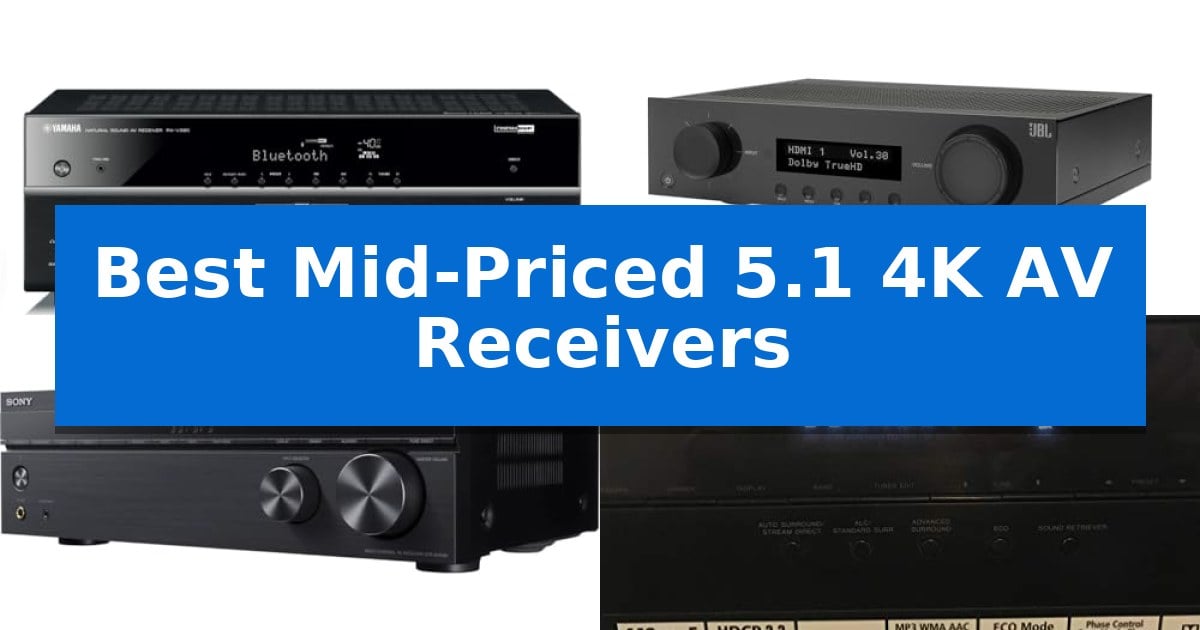
Building a home theater system requires a reliable hub that can manage high-resolution video and immersive audio without exceeding your budget. The Best Mid-Priced 5.1 4K AV Receivers provide the essential connectivity and power needed to drive a standard surround sound setup while ensuring your 4K content looks as sharp as intended.
Finding the right unit involves balancing input options, power output, and user-friendly calibration tools. Whether you are upgrading from a basic soundbar or replacing an aging receiver, these models offer the necessary technical standards to integrate seamlessly with modern smart TVs, gaming consoles, and streaming devices.
You may also want to compare Best Mid-Priced 4K TV for Gaming, Best Mid-Priced 4K TV, and Best Mid-Priced 3D Printer.
Best Mid-Priced 5.1 4K AV Receivers
Quick Comparison
| Product | Best For | Key Strength | Score |
|---|---|---|---|
| Yamaha RX-V385 AV Receiver | Best Overall | YPAO auto-calibration for simplified room-specific audio tuning | 4.9 |
| JBL MA310 AV Receiver | Modern Design for Home Cinema | Native 5-channel decoding for Dolby and DTS formats | 4.8 |
| Sony STRDH590 AV Receiver | Virtual Surround Sound Capability | S-Force PRO Virtual Front Surround enables surround sound effects with limited speaker placement. | 4.5 |
| Pioneer VSX-530-K AV Receiver | Simplified Setup and Connectivity | Ultra HD Pass-through with HDCP 2.2 ensures compatibility with modern 4K video sources. | 4.8 |
| Yamaha RX-V383BL AV Receiver | Reliable High Dynamic Range Support | YPAO sound optimization for automated room tuning | 4.4 |
How We Chose
- Video Compatibility: Ensuring support for 4K Ultra HD pass-through, HDR10, and HDCP 2.2 standards.
- Audio Performance: Evaluating channel count and native decoding support for Dolby and DTS formats.
- Connectivity Options: Assessing the number of HDMI inputs, ARC/eARC support, and wireless streaming convenience.
- Setup and Calibration: Looking for automated room correction technologies that simplify speaker balancing.
- Build and Design: Considering the physical dimensions and interface layout for standard home theater racks.
1 Yamaha RX-V385 AV Receiver — Best for Auto-Calibration
Achieving a balanced home theater setup requires a reliable foundation for your signal routing. The Yamaha RX-V385 AV Receiver provides a dedicated 5.1-channel surround sound experience, centered around its proprietary YPAO auto-calibration technology. This system automatically analyzes your room's acoustics and adjusts audio parameters to ensure an optimized listening environment without requiring manual intervention.
For visual fidelity, the unit supports 4K Ultra HD content, including HDR10, Dolby Vision, and Hybrid Log-Gamma. These standards ensure that high-dynamic-range video signals pass through to your display with appropriate color and contrast metadata. The receiver is equipped with HDMI 2.1 connectivity, featuring HDCP 2.2 compliance across its four inputs and one output, which facilitates compatibility with modern media players and gaming consoles.
Wireless integration is handled through built-in Bluetooth connectivity, allowing for direct audio streaming from mobile devices. The receiver also features HDMI CEC support, which enables simplified control of connected devices through a single remote. With an adjustable audio delay setting ranging from 0 to 500 ms, users can fine-tune lip-sync performance to match their specific display and speaker configuration.
Measuring 17.13 inches in width and weighing 16.3 pounds, the receiver maintains a standard form factor suitable for most media consoles. It is backed by a 2-year warranty, providing long-term support for its internal components and processing capabilities.
Best for: Home theater enthusiasts seeking an entry-level 5.1 receiver with automated room calibration and modern 4K HDR passthrough.
Skip if: Users requiring advanced multi-room audio zones, high-wattage amplification for large floor-standing speakers, or support for object-based audio formats like Dolby Atmos.
PROS
- YPAO auto-calibration for simplified room-specific audio tuning
- 4K Ultra HD support with HDR10 and Dolby Vision
- Bluetooth wireless streaming capability
- HDMI 2.1 connectivity with HDCP 2.2
CONS
- Limited to 5.1 channels, excluding support for overhead audio formats
2 JBL MA310 AV Receiver — Modern Design for Home Cinema
The JBL MA310 AV Receiver serves as a centralized hub for home entertainment, offering a 5.2-channel configuration designed to balance audio performance with 4K video support. This unit provides a straightforward foundation for users looking to manage multiple media sources, including smart TVs, gaming consoles, and streaming devices through its 4 HDMI inputs and single output with ARC capability.
Engineered for both music and cinematic applications, the receiver features native 5-channel decoding for Dolby and DTS formats. This ensures compatibility with standard multi-channel audio tracks, providing a high-fidelity output for home cinema setups. The inclusion of Bluetooth v5.1 + Low Energy allows for wireless audio streaming, adding flexibility for those who wish to play music from mobile devices without additional cabling.
Measuring approximately 17 inches in length and weighing about 11.2 pounds, the JBL MA310 AV Receiver maintains a compact footprint suitable for standard media consoles. Its design prioritizes ease of integration, focusing on essential connectivity needs for modern home theaters. The device is backed by a 1-year manufacturer warranty, providing a baseline of support for its core functionality.
When selecting a receiver, consider the balance between channel count and power requirements. While this model provides 60 watts per channel, it is best suited for standard room sizes where a 5.2 setup meets the user's speaker configuration. The focus here is on reliable, high-fidelity signal processing and seamless source switching rather than complex, high-channel-count processing.
Best for: Users seeking a compact, reliable 5.2-channel receiver for standard 4K home theater and music streaming setups.
Skip if: Users requiring advanced multi-room audio, high-channel-count Dolby Atmos configurations, or more than four HDMI source inputs.
PROS
- Native 5-channel decoding for Dolby and DTS formats
- Bluetooth v5.1 for wireless music streaming
- 4K video support with ARC integration
- Compact dimensions for easy shelf placement
CONS
- Limited to 5.2 channels, excluding support for advanced object-based audio formats
- Four HDMI inputs may be insufficient for complex setups with many devices
3 Sony STRDH590 AV Receiver — Virtual Surround Sound Capability
Achieving a cinematic experience in a smaller living space often requires balancing hardware footprint with audio capability. The Sony STRDH590 AV Receiver addresses this by integrating S-Force PRO Virtual Front Surround technology, which is engineered to simulate a multi-channel surround sound environment using only a two-speaker setup. This makes it a practical choice for those who want to enhance their media playback without the complexity of installing rear speakers.
Designed for modern visual standards, this 5.2 channel receiver supports 4K HDR pass-through with HDCP 2.2, ensuring that high-resolution video signals from your source devices are transmitted to your display without degradation. With a total power output of 725W, it provides sufficient drive for a variety of home theater speaker configurations, while the inclusion of Bluetooth Standby allows for convenient wireless control and music streaming directly from your mobile device.
The unit features a functional array of inputs, including four HDMI inputs and one output with Audio Return Channel (ARC), simplifying the connection between your TV and external components. For legacy or specialized audio needs, it also provides four stereo RCA audio inputs and both optical and coaxial digital audio outputs. The inclusion of a 1/4-inch headphone jack offers a private listening option for late-night viewing.
Measuring 17 inches wide and 5.25 inches high, the Sony STRDH590 AV Receiver fits standard media consoles while maintaining a clean, black aesthetic. It is a versatile hub for a home theater setup, balancing essential connectivity with modern audio processing features for a streamlined entertainment experience.
Best for: Users seeking a compact, 4K-compatible receiver that can simulate surround sound in rooms where rear speaker placement is not feasible.
Skip if: Users who require advanced multi-room audio zones, high-end room calibration software, or more than four HDMI source inputs.
PROS
- S-Force PRO Virtual Front Surround enables surround sound effects with limited speaker placement.
- 4K HDR pass-through with HDCP 2.2 support ensures compatibility with modern high-definition displays.
- Bluetooth Standby allows for remote power-on and streaming convenience from mobile devices.
- Versatile connectivity including four HDMI inputs and multiple digital audio outputs.
CONS
- Limited HDMI input count may restrict users with many source devices.
- Lacks advanced multi-room audio or network streaming features found in higher-end models.
4 Pioneer VSX-530-K AV Receiver — Simplified Setup and Connectivity
The Pioneer VSX-530-K AV Receiver is engineered to serve as a central hub for modern home theater systems, specifically prioritizing Ultra HD Pass-through with HDCP 2.2. This feature ensures that the unit can handle 4K/60p video signals, allowing users to route high-resolution content from modern media players or gaming consoles to their displays without signal degradation. It is a practical choice for those who need reliable video handling within a standard 5.1 channel configuration.
Connectivity is streamlined through built-in Bluetooth with aptX, which enables high-quality wireless audio streaming from mobile devices. By integrating this technology directly into the receiver, users can bypass the need for external adapters or complex wiring when playing music from smartphones or tablets. This makes the unit a convenient solution for users who want to combine traditional surround sound with the ease of modern wireless audio access.
Installation and daily operation are designed for efficiency, focusing on Simplified Connection and Setup. This approach reduces the time required to configure inputs and outputs, making it accessible for users who prefer a straightforward setup process. With physical dimensions of 17.1 inches in width and 6.6 inches in height, the receiver fits comfortably into most standard media consoles, providing a compact footprint for a 5.1 system.
While the Pioneer VSX-530-K AV Receiver supports high-definition audio formats like Dolby True HD, it is intentionally limited to a 5.1 channel output. This makes it an ideal fit for users seeking a balanced, reliable, and uncomplicated audio-video foundation, rather than those requiring expansive multi-room audio or object-based surround sound formats.
Best for: Users seeking a straightforward 5.1 channel receiver with reliable 4K video pass-through and integrated Bluetooth for wireless audio streaming.
Skip if: Users requiring advanced multi-room audio, Dolby Atmos support, or more than five channels for complex surround sound configurations.
PROS
- Ultra HD Pass-through with HDCP 2.2 ensures compatibility with modern 4K video sources.
- Built-in Bluetooth with aptX provides high-quality wireless audio streaming.
- Simplified Connection and Setup makes the initial installation process efficient.
CONS
- Limited to 5.1 channels, which may not satisfy users looking for expansive surround sound setups.
- Lacks advanced features like multi-room audio or object-based surround sound formats.
5 Yamaha RX-V383BL AV Receiver — Reliable High Dynamic Range Support
Integrating a home theater setup requires a reliable foundation, and the Yamaha RX-V383BL AV Receiver provides a straightforward solution for managing 5.1 channel surround sound in a modern living space. This unit is designed to handle high-resolution video signals, ensuring your display receives the intended quality from your media sources.
At the core of its functionality is 4K Ultra HD pass-through with HDCP 2.2 support, which allows for seamless compatibility with current high-definition content standards. The receiver also features High Dynamic Range (HDR) and BT.2020 compatibility, enabling a wider range of brightness and color depth when paired with compatible televisions and media players.
For audio calibration, the Yamaha RX-V383BL AV Receiver utilizes YPAO sound optimization. This automated tuning system analyzes the acoustics of your room and adjusts the output to provide a balanced listening experience. Additionally, the inclusion of Bluetooth for wireless music streaming offers a convenient way to play audio directly from mobile devices without requiring physical cable connections.
The unit is built to provide consistent power for your speakers, featuring 110 W per channel at 8 ohms. Its compact design, measuring approximately 17.125 inches in width and 6 inches in height, allows it to fit into most standard media consoles while maintaining the necessary airflow for operation.
Best for: Home theater enthusiasts seeking a reliable, entry-level 5.1 receiver with essential 4K HDR pass-through and automated room calibration.
Skip if: Users requiring advanced multi-room audio, Dolby Atmos, or more than five channels of amplification will need a more robust receiver.
PROS
- YPAO sound optimization for automated room tuning
- 4K Ultra HD pass-through with HDCP 2.2 support
- Bluetooth connectivity for wireless audio streaming
- HDR and BT.2020 compatibility for modern video standards
CONS
- Limited to 5.1 channels, which may not suit larger home theater setups
- No advanced object-based audio support like Dolby Atmos or DTS:X
Best Mid-Priced 5.1 4K AV Receivers Buying Guide
Understanding 4K Pass-Through and HDR
A critical feature for any modern receiver is its ability to handle 4K video signals without degrading image quality. 4K pass-through ensures that your high-resolution video from a streaming box or console reaches your display with full clarity, supporting standards like HDR10 and Dolby Vision.
When shopping, verify that the receiver supports HDCP 2.2, which is the copy-protection standard required for most 4K content. Without this, you may encounter black screens or reduced resolution when connecting newer media players to your television.
The Importance of Auto-Calibration
Room acoustics significantly impact how your speakers sound. Auto-calibration technology, such as Yamaha's YPAO, uses a microphone to measure the distance and volume of your speakers relative to your seating position.
This process automatically adjusts the timing and frequency response to create a balanced soundstage. For users who are not audio experts, this feature is essential for achieving a professional-sounding setup without manual configuration.
Connectivity and Wireless Streaming
Modern receivers serve as the central hub for all your devices. Look for units with enough HDMI inputs to accommodate your gaming console, cable box, and streaming devices simultaneously.
Integrated Bluetooth is a standard convenience that allows you to stream music directly from your smartphone or tablet. Some newer models also support low-energy Bluetooth, which helps maintain a more stable connection for wireless audio playback.
Channel Configuration and Power
A 5.1-channel system consists of five speakers and one subwoofer, providing the foundation for immersive surround sound. When selecting a receiver, ensure the power output per channel is sufficient for your speaker size and room dimensions.
While wattage is important, it is also vital to check the impedance compatibility. Most mid-priced receivers are designed to work with standard 6-ohm or 8-ohm speakers, but checking the specifications ensures you do not overload the amplifier.
Placement and Ventilation
AV receivers generate heat during operation, especially when driving multiple channels at high volumes. Always ensure your receiver is placed in an area with adequate airflow to prevent overheating.
Before purchasing, measure your media cabinet dimensions. Many receivers are quite deep, and you must account for the space required for HDMI cables and power cords protruding from the back of the unit.
Frequently Asked Questions
What does 5.1 channel mean?
A 5.1 channel setup includes five speakers (front left, front right, center, and two surround speakers) plus one subwoofer for low-frequency effects.
Can I use my old speakers with a new 4K receiver?
Yes, as long as the impedance and power requirements of your speakers are compatible with the receiver's specifications, they will work fine.
Do I need special cables for 4K?
You should use high-speed HDMI cables that are rated for 4K/60p to ensure the signal is transmitted without data loss or flickering.
What is the benefit of HDMI ARC?
HDMI ARC (Audio Return Channel) allows your TV to send audio back to the receiver using the same HDMI cable used for video, simplifying your cable setup.
How often should I run the auto-calibration?
You should run the calibration process whenever you move your speakers, change your furniture layout, or add new components to your home theater.
Conclusion: Our Top Pick
Selecting the right receiver depends on your specific layout and the number of devices you need to connect. For most users, the Yamaha RX-V385 AV Receiver stands out as the most versatile choice due to its robust YPAO auto-calibration and comprehensive support for modern 4K video standards.
While other models offer unique features like virtual surround sound or specific design aesthetics, the Yamaha provides a reliable, all-around performance that simplifies the setup process. Ensure you verify your speaker impedance and available cabinet space before finalizing your purchase to guarantee a perfect fit for your home cinema.