
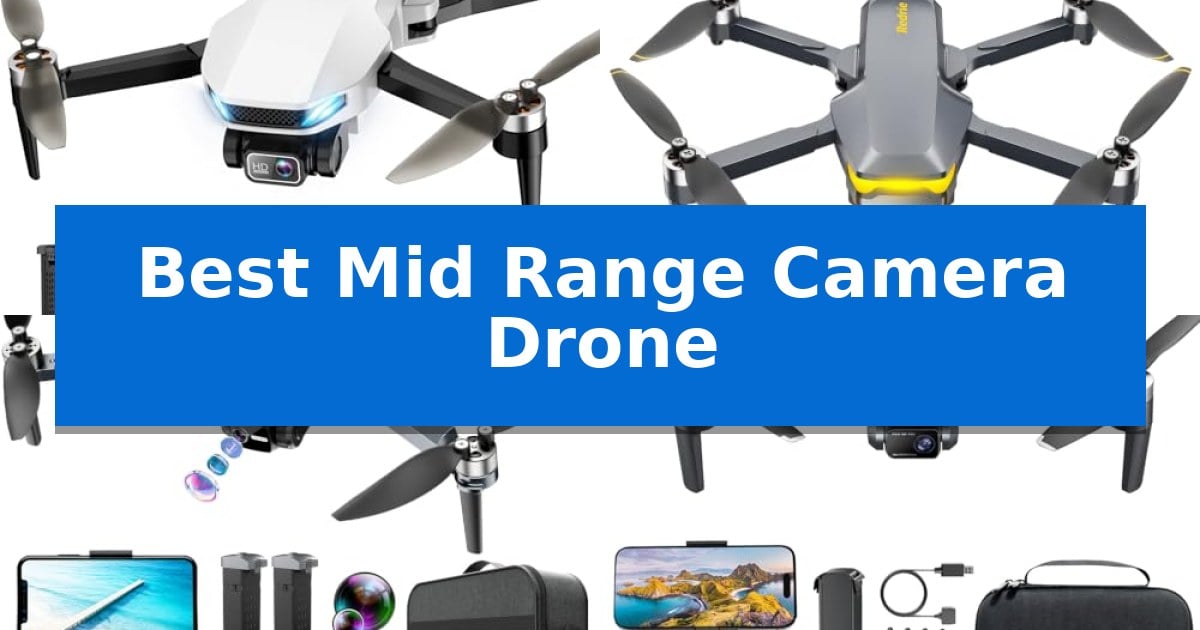
Finding the right aerial platform requires balancing flight stability, camera quality, and ease of use. A Best Mid Range Camera Drone should provide enough advanced features to capture professional-looking footage while remaining accessible enough for pilots who are still developing their skills.
Whether you are looking to document outdoor adventures or simply want a reliable tool for aerial photography, selecting the right model depends on understanding how features like GPS positioning, flight time, and motor type impact your experience. We have analyzed the current market to help you identify which drone aligns with your specific flying needs.
You may also want to compare Best Mics for Vocal Recording, Best Mics for Recording Vocals, and Best Mics for Recording Videos.
Best Mid Range Camera Drone
Quick Comparison
| Product | Best For | Key Strength | Score |
|---|---|---|---|
| BLINORY HK55 GPS Camera Drone | Best Overall | Ultra-lightweight design under 250g removes registration requirements. | 4.9 |
| REDRIE HK33 4K Camera Drone | Stable Footage with 2-Axis Gimbal | Under 250g weight eliminates the need for FAA registration. | 4.8 |
| PROONOS X38 GPS Camera Drone | Extended Range for Scenic Exploration | 3-axis gimbal for enhanced image and video stability. | 4.8 |
| ALWSCOME EC110 GPS Camera Drone | Precise Hovering for Steady Shots | Under 249g design eliminates the need for FAA registration. | 4.3 |
| PRAGYM ZYWRJ003 Camera Drone | Integrated Screen for Phone-Free Control | Integrated 4.5-inch screen eliminates the need for smartphone app connectivity. | 4.3 |
How We Chose
- Flight Stability: We prioritize models with GPS and optical flow positioning to ensure steady hovering and precise control.
- Camera Performance: We evaluate the resolution and stabilization features, such as gimbals and shock absorption, to ensure clear, shake-free footage.
- Operational Reliability: We look for brushless motors and smart safety features like automatic return-to-home to minimize the risk of loss or damage.
- Ease of Use: We assess features like one-key takeoff, headless mode, and intuitive controller interfaces that simplify the learning curve for new pilots.
- Portability and Compliance: We consider the weight and folding design to ensure the drone is travel-friendly and meets regulatory standards.
1 BLINORY HK55 GPS Camera Drone — Reliable GPS for Worry-Free Flying
The BLINORY HK55 GPS Camera Drone simplifies aerial photography by weighing less than 250 grams, which eliminates the need for FAA or Remote ID registration. This compact, foldable design makes it a practical choice for users who prioritize portability during outdoor activities like hiking or camping.
Equipped with a 90° electrically adjustable 4K camera and built-in shock absorption, the drone is engineered to capture stable footage. It utilizes 5GHz FPV transmission to stream video directly to your smartphone, allowing for immediate viewing and sharing. The inclusion of a powerful brushless motor contributes to a smoother flight experience and lower noise levels compared to standard brushed motors.
Navigation and safety are managed through precise GPS positioning and an Optical Flow hover system. These features enable the drone to maintain stability in the air and execute an automatic return-to-home function if the signal is lost, the battery runs low, or it moves out of range. Beginners can also utilize one-button takeoff and landing, along with headless mode, to simplify flight control.
The package includes two modular batteries that provide a combined flight time of 32 minutes. For creative shooting, the drone offers automated flight modes such as Follow Me, Waypoint Flight, and Point of Interest, which allow the device to handle the filming process while the user focuses on their activity.
Best for: Beginners and outdoor enthusiasts who need a lightweight, portable drone with automated flight modes and GPS-assisted safety features.
Skip if: Users who require professional-grade camera stabilization or extended flight times beyond the capacity of the included modular batteries.
PROS
- Ultra-lightweight design under 250g removes registration requirements.
- GPS-enabled safety features include automatic return-to-home.
- Brushless motor provides increased durability and quieter operation.
- Automated flight modes like Follow Me and Waypoint Flight simplify creative filming.
CONS
- Limited total flight time of 32 minutes across two batteries.
- Relies on smartphone app for full FPV functionality and media storage.
2 REDRIE HK33 4K Camera Drone — Stable Footage with 2-Axis Gimbal
Capturing expansive aerial footage is simplified by the REDRIE HK33 4K Camera Drone, which features a 2-axis gimbal and an F2.15 large aperture lens to stabilize shots and manage light. Designed for portability, this device weighs under 250g, meaning it does not require FAA registration for recreational use in the United States.
The drone is powered by upgraded brushless motors that provide increased thrust and reduced noise during flight. For navigation and safety, it includes built-in GPS with an automatic return function that triggers if the signal is lost or the battery level drops. Users can utilize smart flight modes such as GPS Follow, Route Planning, and Fly Around to automate complex camera movements.
Connectivity is managed via 5G WiFi FPV transmission, allowing for low-latency video streaming to a mobile device. The system supports a video transmission range of up to 300m and a total signal range of 500m. To ensure extended operation, the package includes three rechargeable batteries, providing a total flight time of 60–70 minutes.
The REDRIE HK33 4K Camera Drone is a practical choice for beginners, featuring a foldable body and a dedicated carrying case for transport. The camera angle is remote-controlled up to 90°, allowing for quick adjustments mid-flight to frame landscapes or family activities effectively.
Best for: Beginners and hobbyists seeking an affordable, portable drone with extended flight time and automated GPS flight modes.
Skip if: Professional videographers requiring high-end obstacle avoidance sensors or a 3-axis gimbal for cinematic-grade stabilization.
PROS
- Under 250g weight eliminates the need for FAA registration.
- Three included batteries provide 60–70 minutes of total flight time.
- 2-axis gimbal helps reduce shaky footage during flight.
- Brushless motors offer improved durability and quieter operation.
CONS
- 500m signal range is limited compared to professional-grade long-range drones.
- 2-axis gimbal provides less stabilization than 3-axis alternatives.
3 PROONOS X38 GPS Camera Drone — Extended Range for Scenic Exploration
Capturing aerial footage requires a balance of flight stability and ease of use, and the PROONOS X38 GPS Camera Drone addresses this with a dedicated 3-axis gimbal for smooth video capture. This mid-range option is designed to simplify the transition from ground-based photography to aerial exploration, offering a suite of automated flight modes that assist in maintaining steady shots.
The drone utilizes brushless motors to provide wind resistance, while GPS and optical flow positioning work in tandem to lock the aircraft's location. For those new to piloting, the beginner mode and headless mode reduce the learning curve, allowing for safer operation during initial flights. The inclusion of one-key takeoff and landing further streamlines the process, minimizing the complexity often associated with manual flight control.
Equipped with a 4K camera featuring a 110° wide-angle lens, the device allows for a 90° electronically adjustable lens angle to capture varied perspectives. Users can monitor their flight through a stable video transmission link that reaches up to 985 feet, while the total flight range extends to 1640 feet. The package includes two batteries, which are essential for extending flight time during longer sessions.
Practicality is a key design focus, evidenced by the sturdy protective case that facilitates safe storage and transport. The Return-to-Home functionality serves as a critical safety feature, automatically triggering if the drone loses signal or reaches a low battery threshold. This combination of safety protocols and flight performance makes it a functional choice for those surveying rooftops or capturing panoramic scenery.
Best for: Beginners and hobbyists looking for a stable, GPS-enabled drone with automated flight modes and a 3-axis gimbal for scenic photography.
Skip if: Professional videographers requiring higher-end sensor performance, professional-grade transmission stability, or obstacle avoidance sensors beyond basic GPS positioning.
PROS
- 3-axis gimbal for enhanced image and video stability.
- GPS and optical flow positioning for precise location locking.
- Two batteries included for extended flight sessions.
- Automated flight modes including Follow Me and Circle Fly.
CONS
- Manual lens adjustment requires careful handling to avoid damage.
- Limited transmission range compared to professional-grade systems.
4 ALWSCOME EC110 GPS Camera Drone — Precise Hovering for Steady Shots
Capturing aerial footage without the administrative burden of regulatory paperwork is a primary advantage of the ALWSCOME EC110 GPS Camera Drone. Weighing under 249g, this model bypasses the need for FAA registration, making it a highly accessible entry point for those looking to explore drone photography.
The drone features a 120° wide-angle lens capable of capturing 4K resolution images and 2048*1152 video. Its 90° adjustable camera tilt allows for versatile framing, while the powerful brushless motor ensures stable flight performance. To maintain steady shots, the device utilizes optical flow positioning for precise hovering, which helps reduce shake during recording.
Connectivity and ease of use are central to its design. It employs 5G high-speed transmission for real-time HD video streaming up to 500 meters, minimizing lag. The GPS-assisted flight system provides a reliable auto-return function that triggers when the battery is low or the signal is lost, ensuring the drone returns to its home point automatically.
For those interested in automated filming, the ALWSCOME EC110 GPS Camera Drone includes an Auto Follow mode that tracks subjects, alongside app-based features like multipoint flight and 360° surrounding flight. With a maximum control range of approximately 2,296 feet, it offers significant freedom for outdoor travel and action-oriented photography.
Best for: Beginners and travelers seeking a lightweight, registration-free drone with automated flight modes for casual aerial photography.
Skip if: Professional videographers requiring high-bitrate video, advanced obstacle avoidance sensors, or flight performance in heavy wind conditions.
PROS
- Under 249g design eliminates the need for FAA registration.
- GPS-enabled auto-return provides safety and peace of mind.
- Brushless motor offers robust and stable flight performance.
- 5G transmission enables smooth, real-time HD video monitoring.
CONS
- Limited video resolution compared to professional-grade 4K drones.
- Transmission range may be affected by environmental interference.
5 PRAGYM ZYWRJ003 Camera Drone — Integrated Screen for Phone-Free Control
Capturing aerial footage without the complexity of smartphone integration is the primary advantage of the PRAGYM ZYWRJ003 Camera Drone, which features a dedicated 4.5-inch screen built directly into the controller. This design choice allows pilots to monitor real-time FPV footage immediately upon power-up, removing the need for external app downloads or mobile device pairing.
The drone is equipped with a 4K camera featuring a 90-degree adjustable lens, providing flexibility for framing shots of landscapes or inspecting elevated areas like rooftops. For flight stability, the unit utilizes GPS positioning for outdoor environments and Optical Flow sensors to maintain a steady hover when flying indoors. Beginners can utilize automated features such as One-Key Takeoff and Landing, Headless Mode, and three distinct speed modes to manage the flight experience.
Safety and endurance are addressed through a combination of smart flight modes and power management. The drone includes three Return-to-Home functions—Low Battery, Signal Loss, and One-Key Return—to assist in retrieval. Power is supplied by two 7.4V 1600mAh batteries, offering a combined flight time of up to 60 minutes. The inclusion of brushless motors is intended to provide efficient operation and reduced noise during flight.
Weighing under 249g, this foldable quadcopter is designed for portability, making it suitable for transport during outdoor activities. Its compact frame and integrated control system cater to users who prioritize a streamlined setup without the reliance on secondary hardware.
Best for: Beginners and travelers who prefer an all-in-one flight system with a dedicated screen that eliminates the need for smartphone connectivity.
Skip if: Professional photographers requiring advanced sensor sizes, high-bitrate video recording, or obstacle avoidance sensors not present in this model.
PROS
- Integrated 4.5-inch screen eliminates the need for smartphone app connectivity.
- Under 249g weight removes the requirement for FAA registration.
- Dual battery system provides up to 60 minutes of total flight time.
- Brushless motors offer efficient and quieter operation.
CONS
- Lacks advanced obstacle avoidance sensors found in higher-end models.
- Fixed camera specifications may limit professional-grade creative control.
Best Mid Range Camera Drone Buying Guide
Understanding Flight Stability Systems
Modern drones rely on a combination of GPS and optical flow sensors to maintain position. GPS allows the drone to lock onto satellites, ensuring it stays in a fixed location even when there is a breeze, while optical flow sensors use downward-facing cameras to track the ground, providing stability during indoor flights or in areas where GPS signals are weak.
For beginners, these systems are essential. They prevent the drone from drifting unexpectedly, allowing you to focus on framing your shot rather than constantly correcting the flight path. Always ensure your chosen model includes both systems for the most reliable performance in various environments.
The Importance of Brushless Motors
When shopping for a Best Mid Range Camera Drone, look specifically for brushless motors. Unlike brushed motors, which rely on physical contact to generate rotation, brushless motors use electronic commutation. This design results in less friction, which means the motors run cooler, last longer, and operate with significantly less noise.
Beyond longevity, brushless motors provide the high-torque performance needed to handle wind gusts effectively. This increased power translates to a smoother flight experience, which is critical for capturing high-quality, stable video footage without the jitter often associated with cheaper, underpowered motors.
Camera Stabilization and Resolution
While many drones advertise 4K resolution, the quality of your video depends heavily on stabilization. A 2-axis or 3-axis gimbal physically levels the camera, compensating for the drone's tilt and movement. This is far more effective than electronic image stabilization (EIS) alone, as it prevents the 'jello' effect in your footage.
Consider how you intend to share your content. If you are filming for social media, a model with 5G real-time transmission is vital. This technology allows for low-latency, high-definition streaming to your phone, ensuring you can frame your shots accurately in real-time without the lag common in older transmission systems.
Flight Time and Battery Management
Flight time is one of the most significant limitations in aerial photography. Most mid-range drones offer between 20 to 30 minutes of flight per charge. Because charging can take several hours, it is highly recommended to choose a package that includes modular spare batteries.
Having extra batteries allows you to swap out a depleted unit in seconds, effectively doubling or tripling your time in the air. When managing your batteries, always follow the manufacturer's guidelines for storage and charging to maintain their health and ensure they provide consistent power throughout their lifespan.
Regulatory Compliance and Weight
In many regions, drones weighing under 250 grams occupy a special regulatory category. These lightweight models often do not require the same level of registration as heavier drones, making them an excellent choice for casual users and travelers who want to avoid complex paperwork.
Always verify the local laws in your area before flying. Even if a drone does not require registration, you are still responsible for flying safely, avoiding restricted airspace, and respecting the privacy of others. A compact, foldable design is not just for convenience; it ensures you can easily transport your gear while staying compliant with travel regulations.
Frequently Asked Questions
Do I need FAA registration for these drones?
Most of the drones listed weigh under 250 grams, which typically exempts them from FAA registration for recreational use in the United States. However, regulations can change, so always check the latest guidelines from your local aviation authority.
What is the difference between GPS and Optical Flow?
GPS uses satellite signals to maintain a fixed position outdoors, while optical flow uses a camera to track patterns on the ground, helping the drone hover steadily indoors or in areas with poor GPS coverage.
Can I fly these drones in windy conditions?
While drones with brushless motors offer better wind resistance, it is generally advised to avoid flying in high winds. Always check your local weather forecast, as strong gusts can exceed the drone's ability to stabilize itself.
How do I view the camera feed?
Most models connect to a smartphone app via 5G Wi-Fi to display the live feed. Some models, like the PRAGYM ZYWRJ003, include a built-in screen on the controller, which eliminates the need for a separate phone connection.
What happens if the drone loses signal?
Most GPS-equipped drones feature an automatic 'Return-to-Home' function. If the signal is lost, the battery gets too low, or you press the return button, the drone will use its GPS coordinates to fly back to its takeoff point.
Conclusion: Our Top Pick
When selecting the BLINORY HK55 GPS Camera Drone, you are choosing a model that prioritizes safety and reliability through its integrated GPS auto-return and stable brushless motor system. It offers a well-rounded feature set that is particularly beneficial for beginners who want to capture 4K footage without the stress of managing a complex, unstable aircraft.
While other models offer unique advantages like integrated screens or multi-axis gimbals, the overall balance of flight time, ease of use, and robust safety features makes this the most dependable choice for those entering the world of aerial photography. It provides the essential tools needed to explore the skies with confidence.