
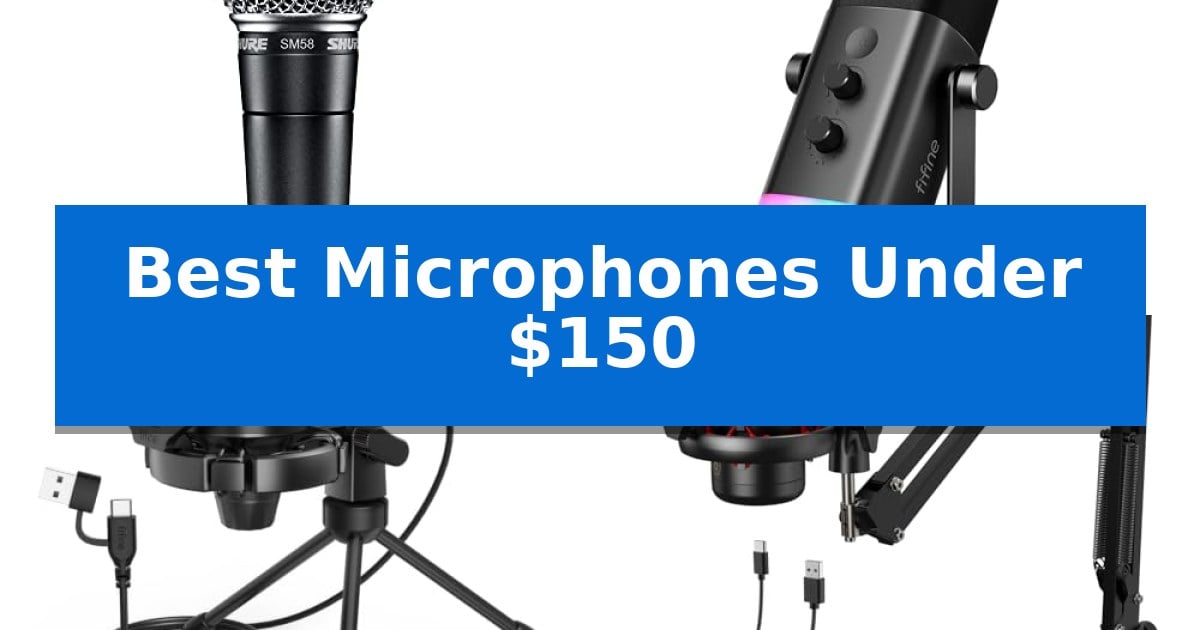
Finding high-quality audio equipment doesn't have to break the bank. Whether you are a podcaster, gamer, or live performer, the market is filled with capable options that deliver professional results without the premium price tag. We have analyzed the Best Microphones Under $150 to help you navigate the essential features that matter most for your specific recording environment.
Choosing the right microphone involves balancing connectivity, pickup patterns, and build quality. From rugged dynamic mics built for the stage to versatile USB-enabled condensers for your desktop, this guide highlights the top contenders currently available. We focus on clarity, ease of use, and the specific use cases that make each model a standout choice for your audio setup.
You may also want to compare Best Microphones Under $100 with 3.5mm Jack, Best Microphones Under $100 for Podcasting, and Best Microphones Under $100.
Best Microphones Under $150
Quick Comparison
| Product | Best For | Key Strength | Score |
|---|---|---|---|
| Shure SM58 Dynamic Vocal Microphone | Best Overall | Rugged metal construction ensures long-term durability for touring and frequent use. | 4.9 |
| FIFINE AmpliGame AM8 Dynamic Microphone | Versatile Hybrid USB and XLR | Hybrid connectivity supporting both USB and XLR interfaces. | 4.5 |
| FIFINE AmpliGame A6V Condenser Microphone | Best Value for Gaming Setups | Plug and play compatibility with PC and consoles. | 4.7 |
| TONOR TC310+ Condenser Microphone Kit | Complete All-in-One Streaming Solution | All-in-one kit includes a metal boom arm and mounting hardware. | 4.8 |
| FIFINE K6 Dynamic Karaoke Microphone | Reliable Choice for Live Events | Rugged metal construction ensures long-term durability. | 4.4 |
How We Chose
- Connectivity and Compatibility: Assessing whether the microphone uses XLR, USB, or hybrid connections to fit your existing hardware.
- Polar Pattern Performance: Evaluating how well the microphone isolates your voice while rejecting unwanted background noise.
- Build Quality and Durability: Checking for rugged construction and materials suitable for either studio or mobile use.
- Integrated Features: Identifying value-added components like onboard mute buttons, gain controls, or included accessories like boom arms and shock mounts.
- Frequency Response: Analyzing the microphone's ability to capture accurate and balanced vocal ranges for professional-sounding recordings.
1 Shure SM58 Dynamic Vocal Microphone — Industry Standard for Live Vocals
Achieving professional-grade vocal reproduction on a budget often leads to the Shure SM58 Pro XLR Dynamic Vocal Microphone, a device engineered with a finely tuned frequency response that provides a subtle midrange lift. This design choice ensures that vocals remain warm and articulate, allowing them to cut through a mix without requiring complex equalization.
The microphone utilizes a precision cardioid pickup pattern to focus exclusively on the sound source directly in front of the capsule. By effectively minimizing background noise and feedback, this pattern provides a clean, accurate signal, which is essential for both live performance environments and home studio recording setups.
Built for longevity, the Shure SM58 Pro XLR Dynamic Vocal Microphone features a rugged metal construction and a reinforced stand adapter. This road-ready durability ensures the hardware can withstand the physical demands of frequent transport and professional use, while the integrated spherical grille and built-in filter work to reduce plosives and breath noise without needing external pop guards.
As an XLR-based dynamic microphone, it offers a reliable solution for various audio tasks, from podcasting to broadcast. Its consistent performance across diverse environments makes it a versatile tool for creators who prioritize build quality and vocal clarity in their recording chain.
Best for: Vocalists, podcasters, and live performers who require a durable, industry-standard dynamic microphone for consistent vocal clarity.
Skip if: Users who require a USB-based plug-and-play connection, as this microphone requires an XLR interface and an external audio preamp or interface to function.
PROS
- Rugged metal construction ensures long-term durability for touring and frequent use.
- Precision cardioid pickup pattern effectively isolates vocals while rejecting off-axis noise.
- Integrated pop protection reduces plosives and wind noise without extra accessories.
- Finely tuned frequency response provides a warm, professional vocal sound.
CONS
- XLR-only connectivity requires a separate audio interface or mixer for operation.
2 FIFINE AmpliGame AM8 Dynamic Microphone — Versatile Hybrid USB and XLR
The FIFINE AmpliGame AM8 Dynamic Microphone offers a versatile solution for creators by providing both USB and XLR connectivity in a single unit. This hybrid design allows users to plug directly into a computer for immediate use or integrate the microphone into a professional audio interface setup for advanced recording needs.
Engineered with a cardioid polar pattern, the microphone focuses on capturing sound from the front while rejecting off-axis noise. It features a frequency response of 50Hz-16KHz, which is tuned to deliver balanced vocal clarity. The inclusion of a tap-to-mute button with an LED indicator provides a convenient way to manage privacy during live streams, though these digital controls are exclusive to the USB connection mode.
For users focused on aesthetics, the device includes a controllable RGB ring with three modes and over ten color options. The built-in headphone jack allows for real-time monitoring, while the dedicated gain knob provides tactile control over input levels. These features, combined with the memory function that saves lighting preferences, make it a practical choice for desktop gaming and podcasting environments.
The physical design incorporates 3/8'' and 5/8'' metal threads, ensuring compatibility with most standard microphone stands without requiring additional adapters. The package includes a noise-canceling windscreen to help mitigate unwanted hums, and the overall construction is designed to fit seamlessly into home studio setups or portable recording kits.
Best for: Content creators and gamers who want a flexible microphone that can start as a simple USB plug-and-play device and later upgrade to an XLR interface setup.
Skip if: Users who require advanced digital features like RGB lighting or tap-to-mute while using an XLR connection, as these functions are only active in USB mode.
PROS
- Hybrid connectivity supporting both USB and XLR interfaces.
- Built-in headphone monitoring with volume control.
- Integrated tap-to-mute with LED status indicator.
- Universal mounting with built-in 3/8'' and 5/8'' threads.
CONS
- Limited functionality when using the XLR connection, as RGB and mute buttons become inactive.
3 FIFINE AmpliGame A6V Condenser Microphone — Best Value for Gaming Setups
Equipped with a 192kHz sampling rate and a cardioid polar pattern, the FIFINE AmpliGame A6V USB Gaming Microphone is designed to isolate vocal input while minimizing background noise interference. This condenser microphone features a quick mute button that toggles the gradient RGB lighting off, providing a clear visual indicator of your status during streaming or gaming sessions.
The device includes a handy gain knob for intuitive volume adjustments, allowing users to maintain consistent audio levels without needing external software. Its plug and play design ensures compatibility with PC, Mac, and PS4/PS5 consoles via a 6.6ft detachable USB cable, facilitating a straightforward setup for Discord, Twitch, or podcasting.
Durability and stability are addressed through the included anti-vibration shock mount and a stable tripod stand with rubber feet. The detachable pop filter is specifically included to reduce plosives during high-energy speech, helping to maintain audio clarity during intense gaming moments.
While the FIFINE AmpliGame A6V offers a comprehensive feature set for streamers, it is a dedicated USB microphone. Users requiring XLR connectivity or advanced interface integration for professional studio recording may find the fixed USB connection and lack of phantom power support limiting for their specific hardware chains.
Best for: Gamers and streamers seeking a plug-and-play microphone with integrated lighting and essential accessories like a shock mount and pop filter.
Skip if: Users who require XLR connectivity, professional-grade audio interfaces, or advanced signal processing options beyond basic gain control.
PROS
- Plug and play compatibility with PC and consoles.
- Integrated gain control and quick mute button.
- Includes shock mount, pop filter, and tripod stand.
- Gradient RGB lighting for aesthetic customization.
CONS
- Fixed USB connectivity limits professional audio interface integration.
- Limited to cardioid polar pattern only.
4 TONOR TC310+ Condenser Microphone Kit — Complete All-in-One Streaming Solution
Achieving clear, professional-grade audio for streaming and gaming requires equipment that balances sensitivity with ease of use. The TONOR TC310+ Condenser Microphone Kit simplifies this process by integrating a premium core and expert tuning directly into a compact, all-in-one package designed for immediate deployment.
This microphone stands out for its integrated control suite, which includes tap-to-mute functionality and a dedicated gain control dial located on the top of the unit. These features allow content creators to make real-time adjustments without navigating complex software menus, ensuring that audio levels remain consistent during live broadcasts.
Beyond audio performance, the kit emphasizes visual customization through its vibrant RGB lighting. Users can toggle between four distinct modes—including static colors and gradients—and adjust brightness levels to match their desk aesthetic or reduce eye strain during long sessions. The included metal-made boom arm provides a stable mounting solution, featuring a sturdy clamp that accommodates desk thicknesses up to 2.36 inches.
The TONOR TC310+ Condenser Microphone Kit is built for versatility, utilizing a standard USB connection for plug-and-play compatibility with PCs. By bundling the microphone with an adjustable boom arm and mounting hardware, it provides a comprehensive setup for users looking to improve their vocal clarity without the need for additional accessories.
Best for: Content creators and gamers seeking an all-in-one, plug-and-play audio solution with integrated lighting and physical controls.
Skip if: Users who require an XLR-based microphone setup or those who prefer a dedicated desktop stand rather than a boom arm mount.
PROS
- All-in-one kit includes a metal boom arm and mounting hardware.
- Physical gain control and tap-to-mute buttons for quick adjustments.
- Customizable RGB lighting with four distinct modes and brightness control.
- High-fidelity audio reproduction via premium internal chips.
CONS
- Boom arm mounting requires a desk edge compatible with the clamp design.
- USB-only connectivity limits use with professional audio interfaces.
5 FIFINE K6 Dynamic Karaoke Microphone — Reliable Choice for Live Events
Capturing clear audio for live events requires gear that balances durability with consistent signal quality. The FIFINE K6 Dynamic Karaoke Microphone is built with a rugged metal construction and an integrated pop filter to mitigate plosives, making it a reliable choice for presenters and performers who need a dependable handheld solution.
Designed for versatility in live environments, this microphone features a cardioid pickup pattern that focuses on the sound source while minimizing background feedback. It operates across a 50 to 18 kHz frequency range, providing a flat response suitable for both spoken word and instrument amplification. Because it is a dynamic microphone, it requires no external power, simplifying the setup for stages, conferences, or outdoor events.
The FIFINE K6 Dynamic Karaoke Microphone connects via a 14.8ft detachable XLR to 1/4" cable, allowing for significant movement during a performance. The inclusion of an external on/off switch provides immediate control over audio output without needing to adjust the mixer or amplifier settings. Its design is specifically tailored for equipment featuring a 6.35mm (1/4") mic jack, ensuring a secure and stable connection.
While this microphone excels in live sound reinforcement, it is important to note its specific connectivity requirements. It is designed exclusively for 1/4" inputs and is not compatible with 3.5mm connections, even when using an adapter. This focus on standard professional audio interfaces ensures high-quality, low-distortion signal transmission for those using dedicated audio mixers or amplifier speakers.
Best for: Live event presenters and performers who require a durable, wired dynamic microphone for use with 1/4" audio interfaces or amplifiers.
Skip if: Users who need to connect their microphone to a 3.5mm computer jack or mobile device, as this unit is strictly incompatible with those interfaces.
PROS
- Rugged metal construction ensures long-term durability.
- Cardioid pickup pattern effectively minimizes feedback in live settings.
- No power requirement simplifies setup for various live applications.
- 14.8ft detachable cable provides ample range for movement.
CONS
- Strictly 1/4" connection only, limiting compatibility with common 3.5mm devices.
Best Microphones Under $150 Buying Guide
Understanding Microphone Types
The two primary categories you will encounter are dynamic and condenser microphones. Dynamic microphones are generally more rugged and better at handling high sound pressure levels, making them ideal for live performances or untreated rooms where background noise is a concern. They are known for their durability and ability to focus tightly on the sound source.
Condenser microphones are typically more sensitive and capable of capturing a wider, more detailed frequency range. These are often the preferred choice for studio recording, voiceovers, and podcasts where capturing subtle nuances in the voice is important. However, they may require more careful placement to avoid picking up unwanted ambient noise.
Connectivity: USB vs. XLR
USB microphones offer a plug-and-play experience, connecting directly to your computer without the need for an external audio interface. This makes them highly convenient for beginners, streamers, and gamers who want to start recording immediately. They often include built-in features like gain knobs and headphone jacks for direct monitoring.
XLR microphones provide a more professional, modular approach. They require an external audio interface or mixer to connect to your computer, which allows for greater control over your signal chain and the ability to use multiple microphones simultaneously. While they require more equipment, they offer superior flexibility for growing studios.
The Importance of Polar Patterns
The cardioid polar pattern is the most common and useful for solo recording. It focuses on sound coming from the front of the microphone while rejecting sound from the sides and rear. This is essential for minimizing background noise in home offices or gaming setups.
Choosing a microphone with a tight cardioid pattern ensures that your voice remains the primary focus of your recording. If you are recording in a noisy environment, a microphone that effectively rejects off-axis sound will significantly improve the quality of your final audio output.
Essential Accessories
The right accessories can drastically improve your audio quality. A shock mount is vital for isolating the microphone from vibrations caused by keyboard typing or desk bumps. Similarly, a pop filter or windscreen is necessary to reduce plosives—the harsh 'p' and 'b' sounds that can distort your recording.
Many kits come with these items included, which provides excellent value. If your chosen microphone does not include them, consider adding a boom arm or stand to ensure your microphone is positioned correctly, which is just as important as the microphone itself for achieving clear, consistent sound.
Monitoring and Control
Having a headphone jack on the microphone itself allows for zero-latency monitoring. This means you can hear exactly what you are recording in real-time without any delay, which is critical for maintaining consistent volume and tone while speaking or singing.
Onboard controls like gain knobs and mute buttons add another layer of convenience. Being able to adjust your input volume or silence your mic instantly without touching your computer software can save you from accidental audio spikes or unwanted noise during a live stream or recording session.
Frequently Asked Questions
Do I need an audio interface for all microphones?
No. USB microphones connect directly to your computer. Only XLR microphones require an external audio interface or mixer to function.
What is the difference between a condenser and a dynamic mic?
Dynamic mics are generally more durable and better at rejecting background noise, while condenser mics are more sensitive and capture greater detail in the voice.
Can I use a USB microphone for professional singing?
While many USB microphones offer excellent clarity, XLR microphones are typically preferred in professional studio settings for their signal flexibility and compatibility with high-end preamps.
What is a cardioid polar pattern?
A cardioid pattern is a heart-shaped pickup area that captures sound primarily from the front of the microphone, helping to isolate your voice from background noise.
Are pop filters really necessary?
Yes, they are highly recommended. They prevent plosive sounds (like sharp 'P' and 'B' sounds) from hitting the microphone capsule and causing distortion.
Conclusion: Our Top Pick
Selecting the right microphone depends on your specific environment and recording goals. For those seeking a versatile, industry-standard solution that excels in both live and studio settings, the Shure SM58 Dynamic Vocal Microphone remains a top choice due to its legendary durability and warm, articulate vocal reproduction.
While other options in this list offer convenient USB connectivity and integrated features for gamers and streamers, the Shure SM58 Dynamic Vocal Microphone stands out for its consistent performance and ability to cut through any mix. If you are building a long-term audio setup, investing in this reliable, road-ready microphone provides a foundation that will serve you for years to come.