
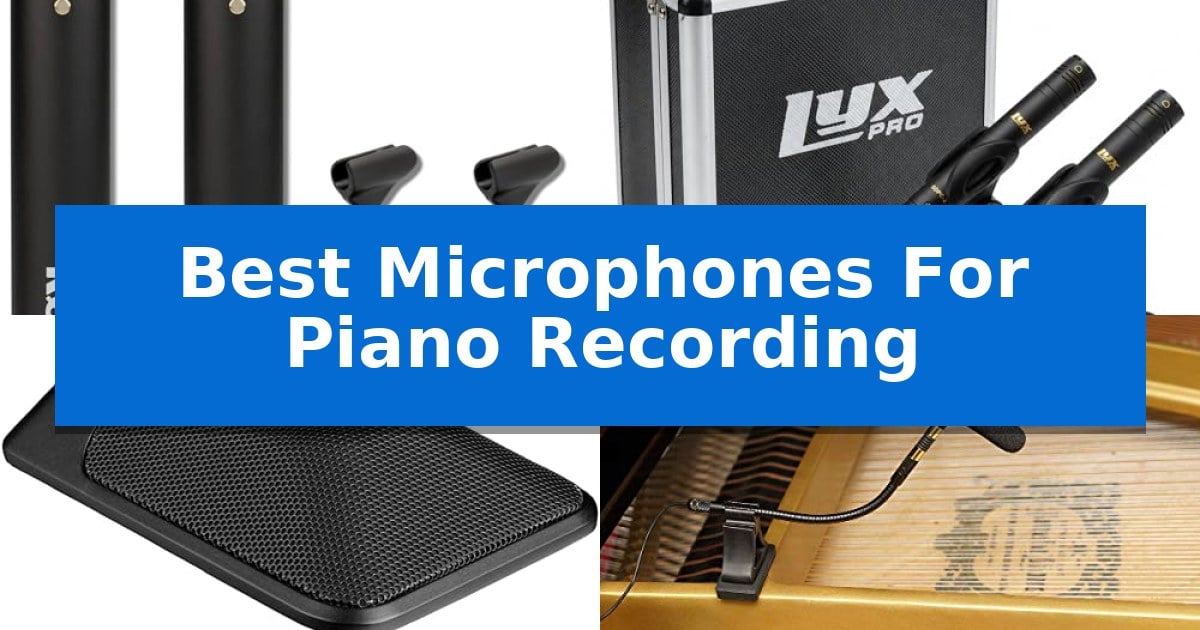
Recording a piano presents unique acoustic challenges, as you must balance the instrument's wide frequency range with the natural resonance of the room. Whether you are tracking a grand piano in a studio or capturing an upright for a home project, selecting the right microphone setup is essential for achieving a clear, balanced sound.
We have analyzed the Best Microphones For Piano Recording to help you navigate the different capture methods available. From matched stereo pairs that provide precise imaging to discreet boundary microphones that sit inside the lid, our guide focuses on the technical specifications and practical mounting options that will best suit your recording environment.
You may also want to compare Best Microphones for Piano, Best Microphones for Phones, and Best Microphones for Performing.
Best Microphones For Piano Recording
Quick Comparison
| Product | Best For | Key Strength | Score |
|---|---|---|---|
| Rode M5 Matched Pair Condenser Microphones | Best Overall | Factory-matched sensitivity within 1 dB for accurate stereo imaging. | 4.9 |
| LyxPro SDPC-2 Stereo Pencil Condenser Microphones | Versatile Multi-Pattern Stereo Capture | Three interchangeable capsules for flexible pickup patterns. | 4.5 |
| sE Electronics BL8 Boundary Microphone | Discreet Low-Profile Piano Recording | Low-profile boundary design for discreet placement | 4.7 |
| Rannsgeer PMMB19 Instrument Microphone | Direct Piano Body Mounting | Direct mounting system with magnetic base and clamp for stable positioning. | 4.8 |
How We Chose
- Polar Pattern Accuracy: Assessing how well the microphone isolates the piano while managing unwanted room reflections.
- Frequency Response Range: Evaluating the ability to capture the full overtone series from deep bass notes to shimmering high-end transients.
- Mounting and Placement Flexibility: Considering how easily the microphone integrates into a piano lid or onto a stand for optimal stereo imaging.
- Sensitivity and Self-Noise: Measuring the microphone's ability to record quiet passages without introducing an audible noise floor.
- Stereo Imaging Capability: Analyzing whether the system supports standard stereo techniques like ORTF or XY for a wide, natural soundstage.
1 Rode M5 Matched Pair Condenser Microphones — Precision Stereo Imaging for Piano
Capturing the nuanced resonance of a grand piano requires precise stereo imaging, which is exactly where the Rode M5 Matched Pair Condenser Microphones excel. By utilizing a factory-matched pair of 1/2-inch gold-sputtered diaphragms, this system ensures that the left and right channels maintain consistent sensitivity within 1 dB, allowing for a balanced and accurate representation of the instrument's full frequency range.
The included SB20 stereo bar simplifies the setup process by providing pre-marked positions for ORTF and XY recording techniques. This allows recordists to achieve professional-grade stereo width and phase coherence without the guesswork often associated with positioning individual microphones. The bar is constructed from durable ABS plastic and mounts easily to any standard microphone stand.
With a 19 dB-A self-noise rating and a 140 dB maximum SPL, these microphones are capable of handling the wide dynamic range of a piano without introducing unwanted noise or distortion. The 20 Hz to 20 kHz frequency response ensures that the delicate overtones of acoustic strings are captured with clarity, while the end-address cardioid geometry helps isolate the sound source from ambient room noise.
This bundle provides a comprehensive solution for those looking to move beyond mono recording. The combination of matched sensitivity and the versatile stereo bar makes it a practical choice for home studio environments where setup speed and reliable stereo imaging are essential for high-quality acoustic tracking.
Best for: The Rode M5 Matched Pair is best for studio recordists and musicians who require precise, phase-coherent stereo imaging for acoustic instruments like the piano.
Skip if: Skip this product if you require multi-pattern polar options or a large-diaphragm sound profile, as these are fixed-pattern, small-diaphragm pencil microphones.
PROS
- Factory-matched sensitivity within 1 dB for accurate stereo imaging.
- SB20 stereo bar includes pre-marked ORTF and XY angles for rapid setup.
- Wide 20 Hz to 20 kHz frequency response captures full piano overtones.
- 140 dB maximum SPL handles high-volume sources without distortion.
CONS
- Fixed cardioid pattern limits flexibility compared to multi-pattern microphones.
- Small-diaphragm design may not provide the specific tonal warmth associated with large-diaphragm condensers.
2 LyxPro SDPC-2 Stereo Pencil Condenser Microphones — Versatile Multi-Pattern Stereo Capture
Capturing the nuanced resonance of a piano requires precise placement and tonal versatility, which is where the LyxPro SDPC-2 Stereo Pencil Condenser Microphones provide a distinct advantage. This matched stereo pair is engineered to handle the fast transients and wide frequency range essential for acoustic instruments, ensuring the attack and decay of piano notes are recorded with clarity.
The kit includes three interchangeable capsules—omni, cardioid, and super cardioid—allowing you to adapt your recording setup to the specific acoustics of your room. The omni capsule is effective for capturing natural room ambience, while the cardioid and super cardioid options provide the focused directionality needed to isolate the piano from surrounding noise or other instruments.
Designed for professional and home studio environments, these microphones feature a 30Hz–18kHz frequency response and are built to connect directly to standard XLR audio interfaces, mixers, or preamps that provide phantom power. The inclusion of foam windscreens and tilting clips ensures you can position the mics securely over the strings or inside the piano housing for optimal sound capture.
Whether tracking for a studio project or recording a live performance, this package offers a comprehensive solution with its included aluminum carrying case for protection during transport. By utilizing a matched stereo pair, you can achieve a balanced, professional-grade stereo image that accurately represents the breadth and depth of a piano's soundstage.
Best for: Musicians and audio engineers seeking a versatile, matched stereo pair for capturing detailed piano and acoustic instrument recordings in various room environments.
Skip if: Users who require a single-point USB microphone solution or those who do not have an audio interface capable of providing phantom power for XLR condenser mics.
PROS
- Three interchangeable capsules for flexible pickup patterns.
- Matched stereo pair ensures consistent sound capture.
- Wide 30Hz–18kHz frequency response for detailed instrument tone.
- Complete kit includes windscreens, clips, and a protective case.
CONS
- Requires phantom power via an XLR interface or mixer.
- Manual capsule swapping required to change pickup patterns.
3 sE Electronics BL8 Boundary Microphone — Discreet Low-Profile Piano Recording
Capturing the nuanced resonance of a grand piano requires a microphone capable of handling high sound pressure levels while maintaining sonic transparency. The sE Electronics BL8 Boundary Microphone offers a specialized solution for this task, utilizing a low-profile design that allows for discreet placement directly on the piano frame or soundboard to achieve a direct, clear signal.
At the core of this microphone is the sE8 omni capsule, which features an ultra-thin 3-micron gold-sputtered diaphragm. This engineering choice is designed to provide superior transient response, ensuring that the percussive attack of piano hammers is captured with precision. The transformerless Class-A circuitry further supports this by delivering massive headroom, which helps prevent unwanted distortion during loud passages.
Flexibility is a primary design goal for this unit. It includes switchable EQ voicings, an attenuation pad, and a low-cut filter, allowing users to tailor the frequency response to the specific acoustic environment. For those requiring even more versatility, the interchangeable capsule system permits the installation of an optional sE8 cardioid capsule, expanding the mic's utility beyond piano recording to high-SPL sources like kick drums.
Built for demanding professional environments, the sE Electronics BL8 Boundary Microphone features an all-metal housing and a dent-resistant grille. These construction choices ensure the device remains durable during frequent setup changes, while the gold-plated XLR connector provides a reliable signal path for consistent, high-fidelity audio capture.
Best for: Professional piano recording and stage ambience capture where a discreet, low-profile footprint is required.
Skip if: You require a traditional large-diaphragm condenser microphone for specific off-axis coloration or specialized stereo miking techniques.
PROS
- Low-profile boundary design for discreet placement
- Superior transient response from the 3-micron gold-sputtered diaphragm
- High-SPL handling via transformerless Class-A circuitry
- Flexible tonal shaping with switchable EQ and filters
CONS
- Requires optional capsule for cardioid polar pattern functionality
4 Rannsgeer PMMB19 Instrument Microphone — Direct Piano Body Mounting
Achieving clear, isolated audio from a piano requires precise placement, and the Rannsgeer PMMB19 Piano Musical Instrument Microphone simplifies this with a dedicated Piano Clamp and Magnetic base stick design. This setup allows for direct mounting onto the instrument, ensuring the microphone stays securely in position during performances or recording sessions.
The microphone utilizes a cardioid polar pattern to focus on the piano's sound while minimizing unwanted noise from the surrounding environment. With a frequency response of 30 Hz to 16,000 Hz, it captures a broad range of the instrument's tonal characteristics. The inclusion of a 9-foot extension cable provides significant flexibility, allowing users to route connections easily to their audio equipment without being restricted by short leads.
Versatility is a core component of this system, featuring dual power options that support both direct connection to a bodypack transmitter and phantom power via the included Phantom Power Module. To ensure broad compatibility, the package includes four different types of connectors, making it compatible with bodypack transmitters from major brands like Shure, Sennheiser, Audio Technica, and AKG.
Designed for portability and ease of use, the entire unit weighs only 2 oz, including the shock mount clamp holder. It comes with a fabric carrying bag, making it a practical choice for musicians who need to transport their recording gear between venues or studios frequently.
Best for: Musicians and sound engineers who need a lightweight, secure, and versatile mounting solution for capturing piano audio in live or studio environments.
Skip if: Users who require a multi-microphone array for stereo imaging or those who do not have access to phantom power or compatible wireless bodypack transmitters.
PROS
- Direct mounting system with magnetic base and clamp for stable positioning.
- Broad compatibility with multiple wireless bodypack transmitter brands.
- Dual power flexibility supporting both phantom power and direct transmitter input.
- Lightweight 2 oz construction for easy transport and minimal instrument impact.
CONS
- Requires specific power input (Phantom Power or compatible transmitter) to function.
- Single microphone design may not be sufficient for full-scale stereo piano recording.
Best Microphones For Piano Recording Buying Guide
Understanding Polar Patterns
The polar pattern of a microphone dictates how much sound it picks up from different directions. For piano recording, cardioid patterns are often preferred because they focus on the strings while rejecting sound from the back and sides, which helps reduce room bleed.
In contrast, omni patterns capture sound equally from all directions. These are excellent for recording in a high-quality acoustic space where you want to include the natural ambience of the room to add depth and realism to your piano tracks.
Stereo Techniques for Piano
Using a matched pair of microphones is the industry standard for creating a wide, immersive stereo image. Techniques such as ORTF (110-degree angle) or XY (90-degree angle) allow you to capture the left-to-right spread of the piano strings accurately.
When using a stereo bar, ensure your microphones are phase-aligned. A matched pair ensures that both microphones have identical sensitivity and frequency response, preventing one side of the piano from sounding louder or tonally different than the other.
Boundary Microphone Placement
A boundary microphone is designed to be placed on a flat surface, such as the floor or the soundboard of a piano. By utilizing the principle of phase coherence at the surface, these mics can produce a very clear, direct sound with minimal phase cancellation.
These microphones are ideal for discreet recording where you want to avoid bulky stands or cables cluttering the stage. They are particularly effective for capturing the full body of a grand piano when placed carefully inside the lid.
Sensitivity and SPL Handling
Pianos can produce high sound pressure levels (SPL) during aggressive playing, while also requiring high sensitivity for delicate, soft passages. A microphone with a high maximum SPL rating ensures that the signal does not distort during loud crescendos.
Simultaneously, a low self-noise rating is critical. Because piano recordings often include quiet, sustained notes, you need a microphone that won't add a hiss or hum to the background of your performance.
Mounting and Connectivity
The physical mounting of your microphone can be just as important as the capsule itself. Direct body mounting systems allow you to attach the microphone directly to the piano frame, which is perfect for live performance settings where space is limited.
Always check the connectivity requirements of your gear. Many professional condenser microphones require phantom power (48V) from your audio interface or mixer to operate. Ensure your recording chain is compatible before finalizing your setup.
Frequently Asked Questions
Do I need a matched pair of microphones for piano?
A matched pair is highly recommended for stereo recording. It ensures that both the left and right channels have identical sensitivity and frequency characteristics, which is essential for a balanced, natural stereo image.
What is the advantage of a boundary microphone?
Boundary microphones are low-profile and can be placed directly on the piano's soundboard. They are excellent for capturing a clear, direct sound without the need for large microphone stands.
Can I use a single microphone to record a piano?
While a single microphone can record a piano, it will result in a mono signal. This may lack the width and spatial depth that a stereo pair provides, though it can be a useful technique for specific stylistic choices.
What does 'phantom power' mean for my microphone?
Phantom power (48V) is an electrical current sent through an XLR cable to power condenser microphones. Most professional studio mics require this to function, so ensure your interface supports it.
How do I avoid room noise in my piano recording?
Using a cardioid microphone pattern helps reject sound from the rear and sides. Additionally, placing the microphone closer to the sound source and using acoustic treatment in your room can significantly reduce unwanted reflections.
Conclusion: Our Top Pick
Selecting the right equipment depends heavily on your specific recording environment and the desired sound. For those seeking a versatile and professional stereo solution, the Rode M5 Matched Pair Condenser Microphones stands out as the most reliable choice for capturing the full frequency range of a piano with accurate stereo imaging.
While other options like boundary mics or clip-on systems offer unique advantages for live or space-constrained setups, the M5-MP provides the essential consistency needed for studio-quality results. Ensure your recording space is quiet and your interface provides the necessary phantom power to get the best performance from this matched pair.