
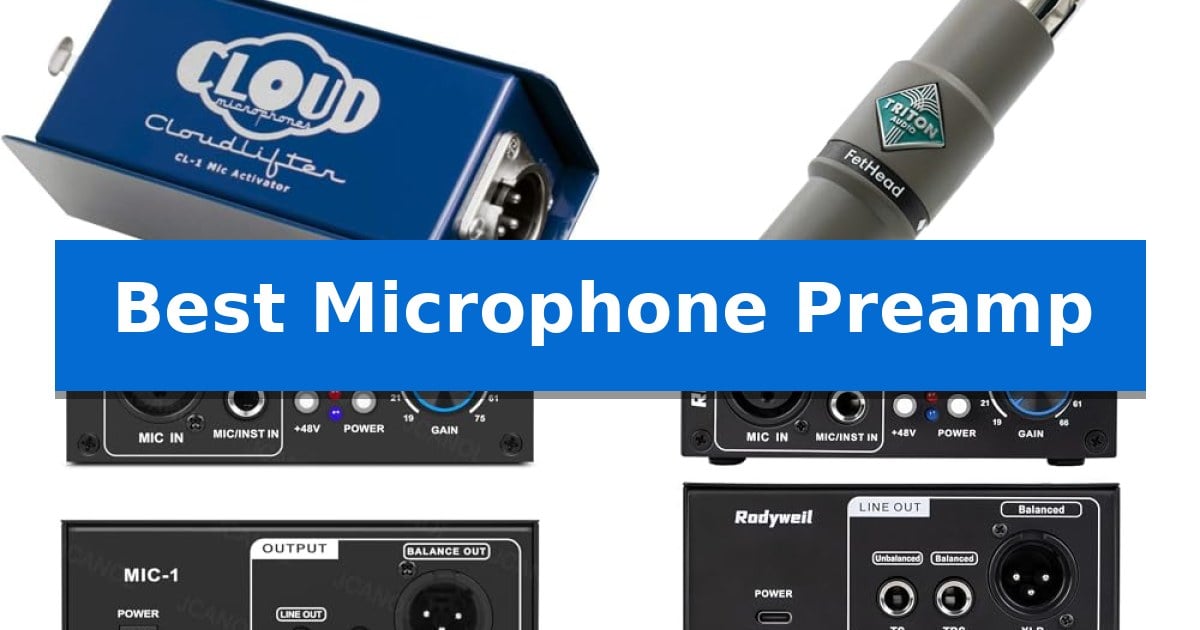
Achieving a clean, professional sound often requires more than just a high-quality microphone. If you find your recordings are plagued by background noise or lack the necessary volume, a Best Microphone Preamp can provide the essential signal boost your setup needs. Whether you are a podcaster using a power-hungry dynamic mic or a musician seeking analog warmth, the right preamp acts as the bridge between your source and your interface.
Selecting the right unit depends on your specific signal chain and the type of microphones you use. From compact in-line activators that leverage phantom power to versatile tube-based systems, these devices offer distinct ways to enhance your audio fidelity. We have analyzed the leading options to help you determine which model best fits your recording environment and technical requirements.
You may also want to compare Best Microphone Positioning for Recording Vocals, Best Microphone Positioning for Gaming Headsets, and Best Microphone Pop Filters.
Best Microphone Preamp
Quick Comparison
| Product | Best For | Key Strength | Score |
|---|---|---|---|
| Cloud Microphones Cloudlifter CL-1 Mic Activator | Best Overall | Provides up to +25dB of ultra-clean gain for passive microphones. | 4.9 |
| Triton Audio FetHead Microphone Preamp | Compact JFET signal boost | Low-noise JFET amplification provides clean gain for quiet sources. | 4.7 |
| JCANOL MIC-1 Microphone Preamp | High gain with versatile outputs | Provides up to +75dB of clean, transparent gain. | 4.6 |
| Rodyweil RO03 Microphone Preamp | Ultra-low noise performance | Ultra-low noise performance with -120dB EIN. | 4.3 |
| ART TPS II Tube Preamplifier | Warm analog tube character | V3 Variable Valve Voicing allows for customizable tube character. | 4.3 |
How We Chose
- Clean Gain Capacity: Assessing the maximum decibel boost provided without introducing unwanted noise or distortion.
- Input/Output Versatility: Evaluating the availability of balanced XLR, instrument-level inputs, and auxiliary output options.
- Power Requirements: Checking for phantom power compatibility and the flexibility of external power sources like USB-C.
- Signal Integrity: Analyzing the impact on audio transparency and the inclusion of features like high-impedance instrument inputs.
- Build and Form Factor: Considering the durability of the chassis and the suitability for both studio and mobile recording setups.
1 Cloud Microphones Cloudlifter CL-1 Mic Activator — Industry standard for clean gain
Achieving a professional-grade signal from passive microphones often requires more than just a standard interface, especially when dealing with quiet sources. The Cloud Microphones Cloudlifter CL-1 Mic Activator provides a dedicated solution by delivering up to +25dB of ultra-clean gain to your signal chain, ensuring that your audio remains clear and free from the unwanted noise often introduced by cranking up preamp gain.
Designed specifically for home studios and professional recording environments, this device utilizes Phantom power to boost the signal of passive microphones, including ribbon, tube, and battery-powered models. A key design advantage is that it provides this significant gain boost without passing Phantom power directly to the microphone, making it a safe and reliable choice for sensitive equipment that might otherwise be damaged by direct voltage.
The Cloud Microphones Cloudlifter CL-1 Mic Activator integrates seamlessly into existing setups, acting as a transparent bridge between your microphone and your preamp. Whether you are recording vocals, percussion, or acoustic instruments, the unit is engineered to maintain the natural sound profile of your microphone while effectively reducing feedback and increasing overall signal strength for cleaner, more professional production results.
Compact and durable, the unit is built to withstand the demands of frequent use in podcasting, live streaming, and studio sessions. Its straightforward operation ensures that creators can focus on their performance rather than troubleshooting complex signal chains, providing an immediate, noticeable improvement in audio quality for those utilizing passive microphones.
Best for: Creators and studio engineers using passive microphones who need clean, noise-free gain boost for quiet audio sources.
Skip if: Users who primarily rely on active, self-powered microphones that do not require external gain amplification.
PROS
- Provides up to +25dB of ultra-clean gain for passive microphones.
- Safe for ribbon microphones as it does not pass Phantom power through to the mic.
- Reduces unwanted noise and feedback by allowing lower preamp gain settings.
- Seamless integration with existing studio preamps and interfaces.
CONS
- Requires +48V Phantom power from an external source to operate.
- Adds an extra step in the signal chain requiring an additional XLR cable.
2 Triton Audio FetHead Microphone Preamp — Compact JFET signal boost
Achieving a clean, high-gain signal from low-output microphones often requires more than just a standard interface preamp. The Triton Audio FetHead in-Line Microphone Preamp addresses this by providing a transparent boost directly at the source, utilizing a Low-Noise Class-A JFET Amplifier design to elevate signal levels without introducing unwanted coloration or noise.
Engineered for reliability and signal integrity, the device features a Double Single-Ended Amplifier Topology powered by 4 Matched JFETs. This internal architecture ensures that the gain stage remains stable and quiet, making it an effective solution for ribbon or dynamic microphones that typically demand significant gain to reach optimal recording levels.
The unit is housed in a robust Shielded Enclosure, which protects the sensitive internal circuitry from electromagnetic interference. Its compact, in-line form factor allows it to connect directly between the microphone and the XLR cable, keeping your signal chain short and efficient without requiring additional power supplies, as it operates using standard 48V phantom power.
While this preamp is an essential tool for boosting quiet sources, it is important to note that it requires phantom power to function. It is designed specifically for passive microphones, meaning it will not provide the same benefit to condenser microphones that already possess their own active electronics.
Best for: Users of passive ribbon or dynamic microphones who need a clean, transparent gain boost to reach optimal recording levels.
Skip if: Users primarily recording with condenser microphones that already require phantom power for their own internal circuitry.
PROS
- Low-noise JFET amplification provides clean gain for quiet sources.
- Compact in-line design integrates seamlessly into existing XLR signal chains.
- Shielded enclosure minimizes external electromagnetic interference.
- No external power supply required as it runs on standard phantom power.
CONS
- Requires 48V phantom power to operate, limiting use with devices that cannot provide it.
- Not suitable for active microphones that already contain internal preamps.
3 JCANOL MIC-1 Microphone Preamp — High gain with versatile outputs
Achieving a clean, professional signal path for microphones often requires significant gain, especially when working with low-output dynamic microphones. The JCANOL MIC-1 Microphone Preamp addresses this by providing up to +75dB of transparent gain, ensuring that quiet sources are captured with clarity and minimal noise.
Engineered for versatility, this preamp features a -120dB EIN noise performance and utilizes dedicated DC analog power to reduce digital interference. The inclusion of a 1MΩ high-impedance TS instrument input allows for direct connection of instruments via a DI box, maintaining signal integrity and preventing impedance mismatch issues during recording sessions.
The unit offers flexible connectivity with a professional balanced XLR output for long-distance studio runs, alongside independent 3.5mm Mic and Line outputs for direct integration with portable audio devices. It also includes 48V phantom power, making it compatible with a wide array of dynamic and condenser microphones.
Built into a sturdy black metal shell, the JCANOL MIC-1 Microphone Preamp is designed to minimize EMC interference while remaining compact and portable. It is a practical solution for vocal recording and studio setups that require a reliable, low-distortion signal boost.
Best for: Users needing high, clean gain for low-output dynamic microphones or those requiring a versatile interface between studio gear and portable devices.
Skip if: Users who require simultaneous multi-channel recording, as the two input ports on this unit cannot operate at the same time.
PROS
- Provides up to +75dB of clean, transparent gain.
- Features a 1MΩ high-impedance TS input for instrument connectivity.
- Includes balanced XLR and dual 3.5mm outputs for flexible routing.
- Sturdy metal shell construction helps eliminate EMC interference.
CONS
- The two input ports cannot function simultaneously.
- Requires an external power source for operation.
4 Rodyweil RO03 Microphone Preamp — Ultra-low noise performance
Achieving a clean, professional signal path in home recording environments often hinges on the quality of your initial gain stage. The Rodyweil RO03 Microphone Preamp addresses common noise floor issues by providing an EIN of -120dB, ensuring that your recordings remain clear even when working with budget-friendly audio interfaces.
Designed for versatility in non-studio spaces, this unit features a Type-C 5V 1A power input. This design choice allows creators to power the device using standard phone chargers or portable power banks, making it a practical solution for mobile podcasting or field recording where traditional wall power might be inaccessible.
The Rodyweil RO03 Microphone Preamp offers 19-66 dB of variable gain, providing sufficient headroom for various microphone types. To maintain signal integrity, the internal circuitry is engineered to support only one active input at a time, preventing the frequency loss often associated with shared PCB designs found in older or replicated models.
Beyond microphone use, the device functions as a capable DI box. It features an upgraded 1MΩ TS input impedance, which is specifically tuned to preserve the natural tonal character of high-impedance instrument pickups, such as those found on electric guitars and basses.
Best for: Home and mobile creators who need a low-noise, portable gain stage that doubles as a high-impedance DI box for instruments.
Skip if: Users requiring simultaneous multi-microphone recording will find this unit unsuitable, as it is designed to support only one active input at a time to maintain signal fidelity.
PROS
- Ultra-low noise performance with -120dB EIN.
- Flexible power options via Type-C USB input.
- High-impedance 1MΩ instrument input for natural tone capture.
- True usable gain up to 66dB.
CONS
- Single active input limit prevents simultaneous multi-mic recording.
5 ART TPS II Tube Preamplifier — Warm analog tube character
The ART TPS II Tube Preamplifier System provides a distinct approach to signal processing by integrating Enhanced ART Tube Technology with a V3 Variable Valve Voicing circuit, allowing users to tailor the harmonic character of their audio signals. This unit is designed to function as both a dedicated microphone preamp and an instrument preamp, offering the flexibility to switch between these roles automatically based on the input source.
Engineered for versatility in studio environments, the device features Variable Input Impedance, which allows for precise matching with various microphone types to optimize frequency response and tonal clarity. The signal path is protected by an Enhanced OPL Output Protection Limiter, ensuring that output levels remain controlled during high-gain operation, while the wide frequency response of 5Hz to 50kHz maintains signal integrity across the audible spectrum.
The physical design emphasizes utility, housing the circuitry within a robust chassis that includes an LED input meter and an analog output meter for real-time signal monitoring. Power is managed via an internal toroidal transformer, which is selected to minimize noise interference. With its compact form factor, measuring approximately 1.75 inches in height and 19 inches in width, the unit is suited for integration into standard rack-mount setups.
Users benefit from the ability to dial in specific tube characteristics using the V3 settings, which adjust the internal circuit to provide different levels of warmth and saturation. This makes the ART TPS II Tube Preamplifier a practical tool for those seeking to add analog tube-based texture to digital recording chains without the complexity of vintage hardware maintenance.
Best for: Recording engineers and musicians who need a versatile, rack-mountable preamp that offers adjustable tube saturation for both microphones and instruments.
Skip if: Users who require a purely transparent, solid-state signal path or those who lack the rack space to accommodate a 19-inch wide unit.
PROS
- V3 Variable Valve Voicing allows for customizable tube character.
- Variable Input Impedance enables precise microphone matching.
- Enhanced OPL Output Protection Limiter prevents signal clipping.
- Dual-function design handles both microphone and instrument signals.
CONS
- Rack-mount form factor may be bulky for desktop-only setups.
- Requires external power connection via the toroidal transformer.
Best Microphone Preamp Buying Guide
Understanding Gain and Noise Floors
The primary purpose of a preamp is to raise the signal of a microphone to a level suitable for your audio interface. Passive microphones, such as many popular dynamic models, often require significant gain to reach an optimal recording level. A high-quality preamp provides this boost while maintaining a low noise floor, ensuring that you do not amplify unwanted hiss along with your audio.
When evaluating gain, look for the Equivalent Input Noise (EIN) specification. A lower EIN number indicates a quieter preamp, which is crucial when recording quiet sources like acoustic guitars or soft vocals. Choosing a unit that provides sufficient clean gain allows you to keep your interface's internal gain lower, resulting in a cleaner overall signal path.
Phantom Power and Compatibility
Many modern in-line preamps utilize 48V phantom power provided by your audio interface to function. It is important to ensure that your chosen preamp is compatible with your specific microphone type. Some units are designed to safely pass phantom power to condenser mics, while others isolate it to protect sensitive ribbon microphones from potential damage.
Always verify the input impedance of the preamp, especially if you plan to connect instruments directly. A high-impedance input, often labeled as 1MΩ, is essential for preserving the tonal character of electric guitars and basses. Mismatched impedance can lead to a loss of high-frequency detail and a thin, lifeless sound.
Tube Warmth vs. Transparent Solid-State
The choice between a solid-state preamp and a tube preamplifier often comes down to the desired sonic character. Solid-state units, including most in-line activators, are prized for their transparency and accuracy, making them ideal for capturing a clean, uncolored signal. They are typically compact, portable, and highly reliable for everyday recording tasks.
Tube preamps, by contrast, introduce harmonic distortion that many engineers describe as warmth. This coloration can add depth and character to digital recordings, making them sound more 'analog.' While tube units are often larger and require their own power supply, they offer a creative tool for shaping the tone of your vocals or instruments before the signal even reaches your computer.
Connectivity and Output Options
Consider how the preamp will integrate with your existing hardware. If you are recording in a professional studio, balanced XLR outputs are standard to minimize interference over long cable runs. For mobile creators, some preamps offer 3.5mm outputs, allowing for direct connection to cameras, portable recorders, or mobile devices.
The ability to handle multiple inputs is another factor to consider. Some units feature dual-channel modes or dedicated instrument inputs, which can simplify your setup by acting as a DI box. Ensure that the unit you select has the necessary ports to support your specific workflow without requiring complex adapters.
Portability and Power Flexibility
As recording moves out of the traditional studio, the need for portable, flexible equipment has grown. Preamps that accept USB-C power or operate via standard power banks offer the freedom to record in bedrooms, outdoor spaces, or remote locations without being tethered to a wall outlet.
A compact, rugged metal chassis is also beneficial for mobile use, as it protects the internal circuitry from physical damage and helps eliminate electromagnetic interference (EMI). When choosing a preamp for travel, prioritize units that combine a small footprint with the power flexibility required to work with your mobile recording gear.
Frequently Asked Questions
Do I need a preamp if my audio interface already has one?
Most audio interfaces have built-in preamps, but they may not provide enough clean gain for certain low-output dynamic microphones. An external preamp can provide the extra 'lift' needed to get a strong signal without pushing your interface's built-in preamps to their noisy limits.
Will a preamp damage my ribbon microphone?
Some preamps are designed to safely handle ribbon microphones by isolating the phantom power. Always check the manufacturer's specifications to ensure the unit is compatible with passive ribbon mics before connecting them.
What is the benefit of a tube preamp?
A tube preamp adds harmonic distortion, which is often perceived as 'warmth' or 'analog character.' This can make digital recordings sound less clinical and more musical, particularly for vocals and acoustic instruments.
Can I use a microphone preamp for my electric guitar?
Yes, if the preamp features a high-impedance (often 1MΩ) instrument input. This ensures that the guitar's signal is properly loaded, preserving the full frequency response and tonal character of your pickups.
Does a preamp improve the sound quality of a cheap microphone?
While a preamp can provide a cleaner, stronger signal, it cannot fundamentally change the frequency response or capsule quality of a microphone. It will, however, ensure that the signal from that microphone is captured as cleanly as possible.
Conclusion: Our Top Pick
For most creators seeking a reliable, high-quality solution, the Cloud Microphones Cloudlifter CL-1 Mic Activator stands out as the industry standard for clean gain. Its ability to provide up to +25dB of transparent boost using phantom power makes it an essential tool for anyone struggling with low-output dynamic microphones in a home studio or podcasting environment.
While other options like the JCANOL MIC-1 offer more versatile output formats and the ART TPS II provides unique tube coloration, the Cloudlifter remains the most straightforward and effective choice for improving signal strength without adding noise. Its robust design and ease of use ensure that it integrates seamlessly into almost any professional or home recording setup.