
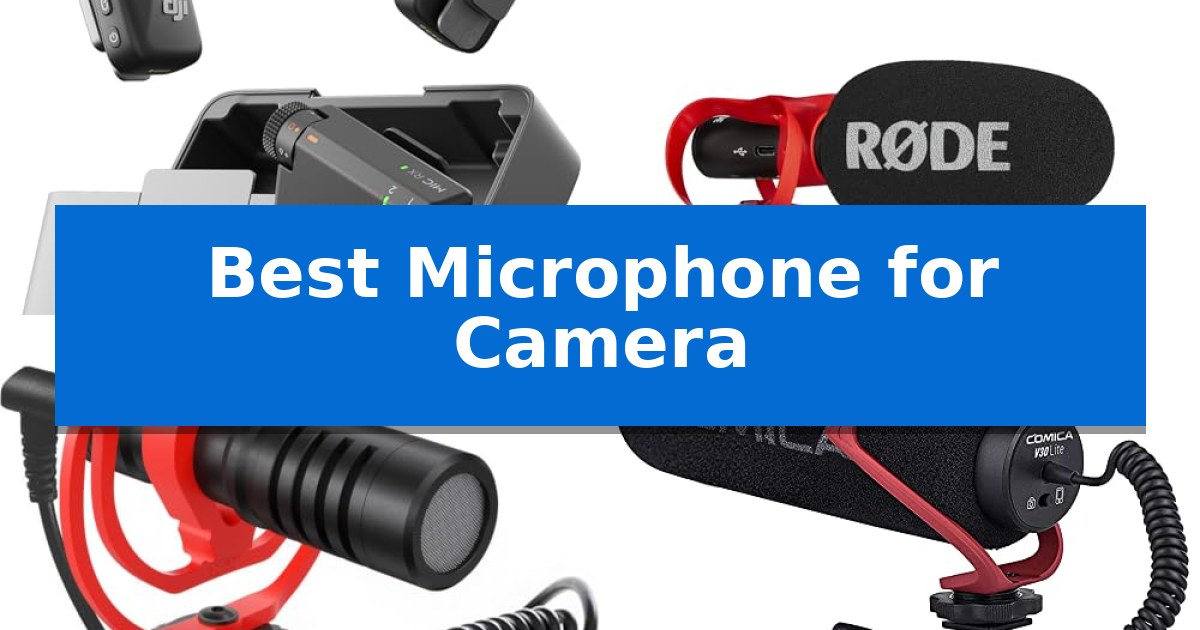
Capturing high-quality video is only half the battle; without clear, crisp audio, even the most visually stunning footage can fall flat. Finding the Best Microphone for Camera setups requires balancing your specific recording environment with the technical requirements of your gear, whether you are filming vlogs, interviews, or cinematic projects.
From ultra-compact wireless transmitters to directional shotgun mics that isolate your subject, the right choice depends on your workflow and device compatibility. We have analyzed the leading options to help you identify which microphone will best serve your production needs and ensure your audience hears every detail exactly as intended.
You may also want to compare Best Microphone for Camcorder, Best Microphone for Budget Video Conferencing, and Best Microphone for Breathy Vocals.
Best Microphone for Camera
Quick Comparison
| Product | Best For | Key Strength | Score |
|---|---|---|---|
| DJI Mic Mini Wireless Microphone | Best Overall | Ultralight 10g transmitter for discreet, comfortable wear. | 4.9 |
| Rode VideoMic GO II Shotgun Microphone | Battery-Free Professional Audio | No battery required for operation, reducing weight and maintenance. | 4.7 |
| Movo VXR10 Universal Shotgun Microphone | Reliable Directional Sound Capture | Directional pickup pattern isolates audio from the front. | 4.9 |
| Comica CVM-V30 LITE Shotgun Microphone | Simple Plug-and-Play Setup | No-battery design eliminates the need for charging or spare batteries. | 4.8 |
| Tikysky Camera Shotgun Microphone | Ideal for Close-Up Interviews | Super-cardioid pickup pattern for focused audio capture. | 4.8 |
How We Chose
- Device Compatibility: Assessing support for 3.5mm TRS/TRRS jacks, USB digital output, and proprietary ecosystem connections.
- Audio Pickup Patterns: Comparing directional shotgun sensitivity against omnidirectional wireless coverage for various recording environments.
- Power Requirements: Evaluating battery-free plug-in power designs versus integrated rechargeable battery systems.
- Form Factor and Mounting: Analyzing weight, size, and the inclusion of specialized shock mounts to minimize handling noise.
- Versatility: Checking for included accessories like windscreens and cables that facilitate immediate use across different cameras and mobile devices.
1 DJI Mic Mini Wireless Microphone — Ultralight Design for Discreet Filming
Weighing only 10 grams, the DJI Mic Mini Wireless Microphone offers a discreet, ultralight form factor that remains unobtrusive when mounted on-camera or worn during active filming. This compact transmitter is designed for creators who require high-quality audio without the bulk of traditional wireless systems.
The system delivers clear, 48kHz, 24-bit audio and features a 400m maximum transmission range, ensuring a stable connection even in busy outdoor environments. To maintain consistent sound levels, the microphone utilizes automatic limiting to prevent clipping, while the included charging case provides up to 48 hours of total battery life for extended recording sessions.
Versatility is a core component of the design, featuring two levels of noise cancellation—Basic for quiet indoor settings and Strong for noisy locations. The system is optimized for a wide range of scenarios, including interviews, livestreaming, and content creation, with a comprehensive set of included accessories.
For users within the DJI ecosystem, the transmitter connects directly to devices like the Osmo Pocket 3 and Osmo Action 5 Pro without requiring a separate receiver. This direct integration streamlines the setup process, allowing for immediate, high-quality audio capture across various DJI cameras and mobile gimbals.
Best for: Content creators and vloggers who need a lightweight, discreet wireless audio solution with long battery life and noise cancellation.
Skip if: Users who require a standard 3.5mm or XLR connection for professional cinema cameras, as this system is optimized for the DJI Osmo ecosystem and mobile devices.
PROS
- Ultralight 10g transmitter for discreet, comfortable wear.
- 48-hour total battery life when using the included charging case.
- Dual-level noise cancellation to handle various acoustic environments.
- Automatic limiting to prevent audio clipping and ensure reliable levels.
CONS
- Ecosystem dependency for direct receiver-less connection.
- Requires specific adapters for certain mobile devices.
2 Rode VideoMic GO II Shotgun Microphone — Battery-Free Professional Audio
Eliminating the need for external power sources or complex cabling, the RØDE VideoMic GO II Helix Ultra-Compact On-Camera Shotgun Microphone simplifies field audio by operating entirely on plug-in power from your camera or device. Its no-battery-required design ensures you are ready to record immediately without worrying about power levels during a shoot.
This microphone offers versatile connectivity through a 3.5mm TRS output for standard camera setups and a digital USB output for direct connection to smartphones, tablets, and computers. This dual-interface capability makes it a flexible tool for creators who switch between professional camera rigs and mobile content creation workflows.
Stability and audio clarity are managed by the Innovative HELIX isolation mount system, which is engineered to protect recordings from handling noise, bumps, and vibrations. The included deluxe windshield further assists in mitigating wind noise and plosives, ensuring cleaner capture in outdoor or unpredictable environments.
For those requiring more granular control, the microphone is compatible with RØDE Connect and RØDE Central software. These tools allow users to unlock advanced features such as a high-pass filter, high-frequency boost, and pad, providing professional-grade adjustments to your audio signal without needing additional hardware.
Best for: Content creators and videographers who require a versatile, battery-free microphone that transitions seamlessly between camera-mounted use and direct-to-device digital recording.
Skip if: Users who require an integrated battery for extended standalone operation or those who prefer a microphone with physical gain dials on the chassis rather than software-based adjustments.
PROS
- No battery required for operation, reducing weight and maintenance.
- Dual-output flexibility with both 3.5mm TRS and digital USB connectivity.
- Innovative HELIX isolation mount effectively reduces handling and mechanical noise.
- Advanced software features like high-pass filter and pad accessible via RØDE Central.
CONS
- Software-dependent controls mean advanced adjustments require a connected device.
- Lacks physical onboard switches for quick adjustments in the field.
3 Movo VXR10 Universal Shotgun Microphone — Reliable Directional Sound Capture
Achieving clear audio for video projects often requires moving beyond built-in hardware, and the Movo VXR10 Universal Shotgun Microphone offers a direct solution by utilizing a directional pickup pattern to isolate sound sources. This design choice helps minimize distracting ambient noise from the sides, making it a practical tool for vlogging, interviews, and on-the-go content creation.
The Movo VXR10 Universal Shotgun Microphone is constructed with a solid aluminum body, providing a durable frame for travel. It features a built-in shock mount designed to absorb handling noise and vibrations, which helps maintain audio stability without needing additional mounting hardware. The unit is compact, measuring approximately 0.86 x 3.2 inches, allowing it to integrate easily into various camera or smartphone setups.
Versatility is a core component of this microphone, as it includes cables for both cameras and smartphones. It functions via a 3.5mm mic input and requires plug-in power from the connected device. For outdoor recording, the package includes a fuzzy windscreen to help reduce wind interference. The system is designed to be plug-and-play, allowing users to connect and begin recording immediately.
When setting up the Movo VXR10 Universal Shotgun Microphone, placement is essential for optimal results. The manufacturer recommends positioning the microphone 1–5 feet from the subject to balance clarity and volume. Users should note that certain devices, such as specific camera models or newer smartphones, may require a 3.5mm adapter to establish a proper connection. Ensuring the correct TRS or TRRS cable is used for the specific device is necessary for functionality.
Best for: Content creators looking for a compact, directional microphone compatible with both cameras and mobile devices.
Skip if: Users with devices lacking a 3.5mm input or those requiring advanced features like gain control or battery-powered amplification.
PROS
- Directional pickup pattern isolates audio from the front.
- Solid aluminum body provides durability for mobile use.
- Built-in shock mount reduces handling noise.
- Includes essential accessories like a fuzzy windscreen and multiple cables.
CONS
- Requires 3.5mm adapter for many modern smartphones.
- Dependent on device plug-in power, limiting compatibility with some cameras.
4 Comica CVM-V30 LITE Shotgun Microphone — Simple Plug-and-Play Setup
Capturing clear audio for video projects often requires moving beyond built-in hardware, and the Comica CVM-V30 LITE Shotgun Microphone offers a streamlined approach for creators. By utilizing a no-battery drive design, this microphone draws power directly from your camera or smartphone, eliminating the need for external power sources and reducing the risk of mid-shoot power failure.
This super-cardioid condenser microphone is engineered to prioritize sound sources directly in front of the capsule while providing excellent off-axis rejection to minimize ambient noise. The integrated shock-absorption mount is a key design choice, specifically included to dampen handling noise and unwanted vibrations that can otherwise degrade audio quality during handheld filming.
Versatility is central to its utility, as the device features a simple switch on the body to toggle between Camera and Phone modes. This functionality removes the need for complex TRS or TRRS cable adapters, ensuring compatibility with a wide range of devices that possess a 3.5mm microphone jack. For mounting, the unit includes a standard cold-shoe design combined with a 1/4-inch thread at the base, allowing it to attach securely to tripods, cages, or camera hot shoes.
Before integrating this microphone into your workflow, ensure your recording device has an external microphone input and that the setting is enabled in the device menu. Because it relies on plug-in power, it is a practical solution for those seeking a plug-and-play experience for vlogs, interviews, and general video production.
Best for: Content creators and vloggers who require a lightweight, battery-free microphone that works seamlessly across both DSLR cameras and smartphones.
Skip if: Users who require professional-grade features like manual gain control, high-pass filters, or compatibility with devices lacking a 3.5mm microphone input.
PROS
- No-battery design eliminates the need for charging or spare batteries.
- Universal compatibility via a simple switch for camera or phone use.
- Integrated shock mount effectively reduces handling and vibrational noise.
- Super-cardioid polar pattern provides focused audio pickup.
CONS
- Requires a 3.5mm jack, making it incompatible with devices that only feature USB-C or Lightning ports without an adapter.
- Limited control options as it lacks onboard gain adjustment or monitoring features.
5 Tikysky Camera Shotgun Microphone — Ideal for Close-Up Interviews
Capturing clear audio during close-up interviews requires a specialized tool that minimizes ambient interference. The Tikysky Camera Shotgun Microphone utilizes a high-performance super-cardioid pickup pattern to isolate subjects effectively within a 3-meter range, making it a functional choice for vloggers and content creators who prioritize vocal clarity.
This shotgun condenser microphone is engineered with single-head mutual complementary sound pickup technology to provide a wide frequency response and high-definition resolution. It is designed to connect directly to devices featuring a standard 3.5mm (1/8") TRS jack, ensuring broad compatibility with many DSLR cameras from brands like Canon, Nikon, and Sony.
Usability is enhanced by a straightforward power management system that relies on AAA alkaline batteries. To maximize longevity, the device includes a low power indication function and a manual power switch, which helps preserve battery life during downtime. Its compact dimensions of 5.43" x 2.16" ensure it remains unobtrusive when mounted atop a camera.
While this microphone excels at close-range vocal capture, it is strictly intended for camera use. It is not compatible with XLR connectors, USB plugs, mobile phones, tablets, or computers. Users should verify their specific camera model's compatibility, as certain cameras like the Canon Rebel T5, T6, T7, R50, and Nikon D350 are not supported.
Best for: Content creators and videographers needing a dedicated, battery-powered shotgun microphone for close-up interviews and vlogging on compatible DSLR cameras.
Skip if: Users who require a microphone for mobile devices, computers, or professional XLR-based audio setups, or those using incompatible camera models like the Canon Rebel series.
PROS
- Super-cardioid pickup pattern for focused audio capture.
- Wide frequency response for high-definition sound resolution.
- Standard 3.5mm TRS compatibility for easy DSLR integration.
- Energy-saving design with low power indication.
CONS
- Limited compatibility with non-TRS devices and specific camera models.
- Not suitable for long-distance or high-noise environments.
Best Microphone for Camera Buying Guide
Understanding Polar Patterns
The polar pattern determines how a microphone captures sound from its surroundings. Super-cardioid or directional patterns, common in shotgun microphones, are designed to focus on the subject directly in front of the lens while rejecting ambient noise from the sides and rear.
This is essential for interviews or vlogging in busy environments. Conversely, omnidirectional wireless lavalier microphones capture sound equally from all directions, which is often preferred for natural-sounding dialogue where the speaker moves frequently.
Connectivity and Compatibility
Before purchasing, verify the input requirements of your camera. Most cameras use a 3.5mm TRS input, while smartphones often require a TRRS adapter or a digital USB-C connection.
Some modern microphones offer dual-output capabilities, allowing you to switch between analog and digital signals. Always check if your specific camera model provides the plug-in power necessary to operate battery-free shotgun microphones.
Handling Noise and Isolation
Vibrations from your hands or the camera's internal mechanics can easily ruin a recording. A high-quality shock mount is a critical component that physically isolates the microphone capsule from the camera body.
Look for systems that use advanced suspension materials, such as the HELIX isolation mount, which are engineered to absorb bumps and handling noise more effectively than standard rubber bands.
Power Management
Microphones generally fall into two power categories: battery-free and battery-powered. Battery-free models rely on the camera's plug-in power, which simplifies your setup and eliminates the risk of a dead battery mid-shoot.
However, if your camera does not provide sufficient voltage, you will need a microphone with an internal battery or a charging case. Wireless systems, in particular, require reliable battery life to support long-form content creation.
Environmental Protection
Outdoor recording introduces wind noise, which can create low-frequency rumbles that are difficult to remove in post-production. A fuzzy windscreen or 'deadcat' is an essential accessory for any outdoor shoot.
These covers are designed to diffuse wind energy before it hits the microphone capsule, ensuring that your dialogue remains clear even in breezy conditions.
Frequently Asked Questions
Do I need a battery for my shotgun microphone?
It depends on the model. Many modern shotgun microphones are designed to run on 'plug-in power' provided by your camera's 3.5mm jack. Always check your camera's manual to ensure it supports external microphones.
Can I use a camera microphone with my smartphone?
Yes, but you may need an adapter. If your phone lacks a 3.5mm jack, you will need a Lightning or USB-C to 3.5mm adapter. Some microphones also offer direct USB digital output for easier smartphone connectivity.
What is the difference between TRS and TRRS cables?
TRS cables are typically used for cameras and camcorders, while TRRS cables are designed for mobile devices and laptops. Using the wrong cable can result in no audio or distorted sound.
How do I minimize background noise in my videos?
Use a directional microphone and position it as close to the subject as possible. Additionally, many wireless microphones now include built-in noise cancellation levels to help isolate vocals in noisy environments.
Why is my audio clipping during recording?
Clipping occurs when the audio signal is too loud for the microphone or camera to process. Look for microphones with 'automatic limiting' features, which lower the volume automatically if the input signal becomes too high.
Conclusion: Our Top Pick
Selecting the right audio gear is a foundational step in improving your production value. For most creators, the DJI Mic Mini Wireless Microphone stands out as the most versatile option due to its ultralight design, extensive battery life, and powerful noise-canceling capabilities.
While shotgun microphones like the Rode VideoMic GO II offer excellent battery-free convenience for fixed setups, the DJI system provides the flexibility needed for mobile vlogging and interviews. By choosing a microphone that matches your specific camera interface and recording environment, you ensure that your content remains professional and engaging.