
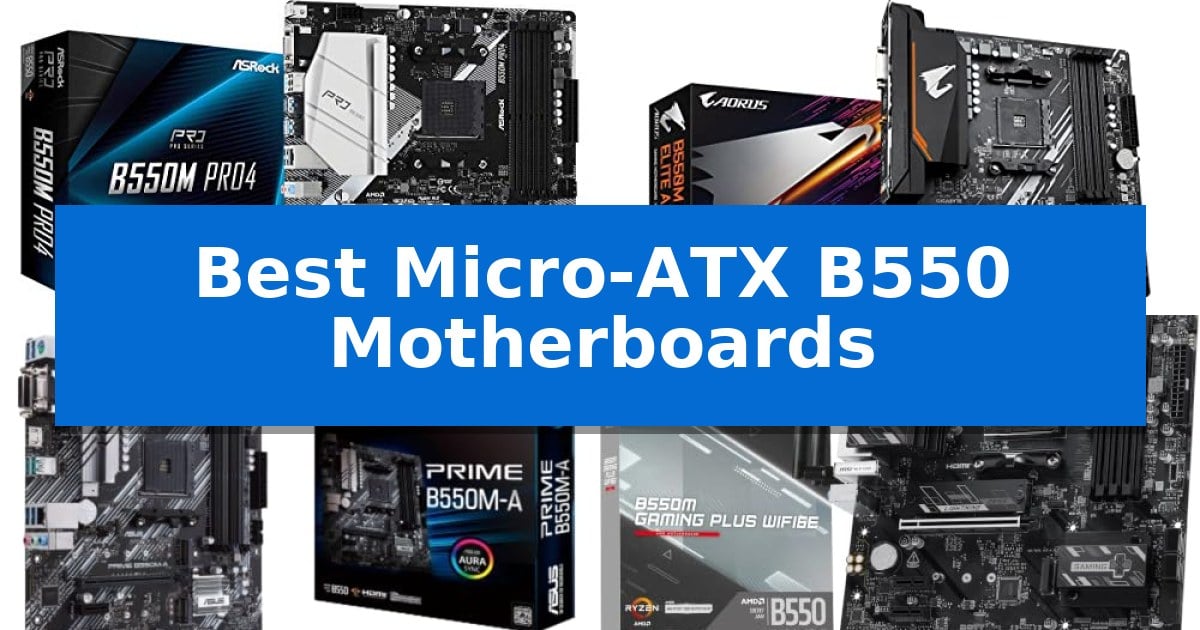
Building a compact PC requires balancing component size with functional requirements, and selecting the right foundation is critical. The Best Micro-ATX B550 Motherboards provide a versatile platform for AMD Ryzen 3000 and 5000 series processors, offering a sweet spot between the limited expansion of Mini-ITX and the bulk of full-sized ATX boards.
Whether you are prioritizing high-speed storage, robust power delivery for overclocking, or integrated wireless connectivity, these boards cater to diverse system needs. This guide evaluates current market options to help you identify the specific board that aligns with your chassis space, cooling requirements, and performance goals.
You may also want to compare Best Micro-ATX AMD Motherboards, Best Micro-ATX Computer Case, and Best Micro-ATX AM5 Motherboards.
Best Micro-ATX B550 Motherboards
Quick Comparison
| Product | Best For | Key Strength | Score |
|---|---|---|---|
| ASRock B550M Pro4 Motherboard | Best Overall | PCIe 4.0 support for high-speed graphics and storage performance. | 4.9 |
| GIGABYTE B550M AORUS Elite AX Motherboard | Premium Wireless and Thermal Features | WIFI 6E and Bluetooth 5.3 for high-bandwidth, low-interference wireless connectivity. | 4.7 |
| ASUS Prime B550M-A WiFi II Motherboard | Reliable Performance with Integrated WiFi | Integrated WiFi 6 for high-speed wireless connectivity. | 4.7 |
| MSI B550M Gaming Plus Motherboard | Enhanced Cooling for Stable Gaming | Frozr Guard cooling system with extended heatsinks and M.2 thermal protection. | 4.6 |
| ASRock B550M-HDV Motherboard | Essential Foundation for Budget Systems | PCIe 4.0 support for high-speed graphics and storage. | 4.4 |
How We Chose
- Socket and CPU compatibility with AMD AM4 Ryzen 3000 and 5000 series processors.
- Expansion slot configuration, specifically the presence and generation of PCIe x16 slots for graphics cards.
- Storage interface support, prioritizing boards with M.2 slots for NVMe SSDs and multiple SATA ports.
- Power delivery design and thermal management features to ensure stability under load.
- Integrated connectivity options, including rear I/O port variety and onboard wireless networking capabilities.
1 ASRock B550M Pro4 Motherboard — Versatile Connectivity for Mainstream Builds
The ASRock B550M Pro4 Motherboard provides a robust foundation for AMD Ryzen 3000 and 5000 series processors, utilizing a compact Micro ATX form factor that fits efficiently into smaller chassis designs. It is engineered with an 8 Power Phase Digi Power Design and a 2oz copper PCB, ensuring stable power delivery for demanding CPU workloads.
For storage and expansion, the board features a Hyper M.2 socket supporting PCIe Gen4x4 speeds, alongside a secondary M.2 slot and six SATA3 ports for versatile drive configurations. The primary graphics slot is a PCIe 4.0 x16 interface, complemented by additional PCIe 3.0 slots, allowing for modern GPU integration and AMD CrossFireX support.
Memory performance is supported by four DIMM slots capable of handling up to 128 GB of DDR4 RAM with XMP profile support and 15μ gold contacts for improved signal integrity. Connectivity options are extensive for a board of this size, including USB 3.2 Gen2 Type-A and Type-C ports on the rear panel, alongside Realtek Gigabit LAN and 7.1 channel HD audio.
Users managing multi-monitor setups or utilizing integrated graphics will benefit from the triple graphics output configuration, which includes HDMI, DisplayPort, and D-Sub ports. This board balances essential modern connectivity with the space-saving requirements of a Micro ATX build, making it a practical choice for mainstream desktop systems.
Best for: Builders seeking a compact, feature-rich platform for AMD Ryzen 3000-5000 series processors with support for PCIe 4.0 storage and graphics.
Skip if: Users requiring ATX-sized expansion options, multi-GPU configurations beyond CrossFireX, or integrated Wi-Fi connectivity.
PROS
- PCIe 4.0 support for high-speed graphics and storage performance.
- Comprehensive USB connectivity including Type-C and Gen2 ports.
- Robust power delivery with an 8-phase design and 2oz copper PCB.
- Flexible display outputs supporting triple-monitor setups.
CONS
- Micro ATX form factor limits expansion slots compared to full ATX boards.
- No integrated Wi-Fi included on this specific model.
2 GIGABYTE B550M AORUS Elite AX Motherboard — Premium Wireless and Thermal Features
Building a compact PC requires a motherboard that manages thermals and connectivity without sacrificing space, and the GIGABYTE B550M AORUS Elite AX Motherboard addresses this by integrating an enlarged MOSFET heatsink and an integrated I/O shield for streamlined assembly. This mATX board is engineered for versatility, supporting AMD Ryzen 5000, 4000, and 3000 series processors to provide a stable foundation for various build configurations.
The board features a Pure Digital 5+3 Power Phase design, utilizing premium chokes and capacitors to ensure consistent power delivery to the CPU. Memory performance is supported through four DIMM slots with Extreme Memory Profile compatibility, allowing for flexible RAM configurations in a small form factor. For storage and expansion, it includes an Ultra Durable PCIe 4.0 x16 slot, alongside one PCIe 4.0 M.2 slot and one PCIe 3.0 M.2 slot.
Connectivity is a primary focus, highlighted by WIFI 6E support which utilizes the 6 GHz band to minimize interference in congested environments. The board also includes Bluetooth 5.3 and a GbE LAN port with bandwidth management for stable networking. For those who prioritize ease of maintenance, the Q-Flash Plus feature allows for BIOS updates without the need to install a CPU, RAM, or GPU, simplifying the initial setup process.
The GIGABYTE B550M AORUS Elite AX Motherboard balances its compact mATX footprint with a user-friendly BIOS interface, featuring an Easy Mode for intuitive control. While it offers robust thermal management and modern wireless standards, users should ensure their case selection accommodates the mATX form factor and that their specific component requirements align with the provided PCIe and M.2 slot layout.
Best for: Builders seeking a compact mATX solution with modern Wi-Fi 6E connectivity and reliable thermal management for AMD Ryzen systems.
Skip if: Users requiring extensive multi-GPU support or a full-size ATX layout for additional expansion cards will find the mATX form factor and slot configuration restrictive.
PROS
- WIFI 6E and Bluetooth 5.3 for high-bandwidth, low-interference wireless connectivity.
- Q-Flash Plus allows for BIOS updates without requiring a CPU or memory installed.
- Advanced Thermal Armor with enlarged MOSFET heatsinks for improved heat dissipation.
- Integrated I/O shield simplifies the PC building process.
CONS
- mATX form factor limits the number of available PCIe expansion slots compared to full-size ATX boards.
- 5+3 Power Phase design is optimized for standard builds rather than extreme overclocking scenarios.
3 ASUS Prime B550M-A WiFi II Motherboard — Reliable Performance with Integrated WiFi
Building a compact yet powerful PC requires a foundation that balances space efficiency with modern connectivity. The ASUS Prime B550M-A WiFi II Motherboard addresses this by integrating the AMD AM4 socket with PCIe 4.0 support, providing a stable platform for 3rd Gen AMD Ryzen processors in a space-saving Micro-ATX form factor.
Connectivity is a primary focus for this board, featuring WiFi 6 (802.11ax) for high-speed wireless networking and a dedicated PCIe 4.0 x16 SafeSlot to ensure structural integrity for heavier graphics cards. The inclusion of dual M.2 slots, with one supporting PCIe 4.0 x4 speeds, allows for rapid storage performance, while HDMI 2.1 output provides support for high-resolution displays at 60Hz.
To maintain system stability under load, the motherboard utilizes comprehensive cooling solutions, including dedicated VRM and PCH heatsinks alongside hybrid fan headers managed by the Fan Xpert 2 utility. These tools allow users to monitor and adjust thermal performance directly, ensuring that components operate within safe parameters during intensive tasks.
Durability and memory optimization round out the feature set. The 5X Protection III suite provides safeguards such as LANGuard and overvoltage protection, while ASUS OptiMem technology refines trace layouts to improve memory signal integrity. This design choice enables memory kits to run at higher frequencies with lower voltage requirements, offering a practical advantage for system builders aiming for refined performance.
Best for: Builders seeking a compact, feature-rich foundation for an AMD Ryzen-based system with integrated wireless connectivity.
Skip if: Users requiring multi-GPU configurations or advanced overclocking features found on larger ATX enthusiast-grade boards.
PROS
- Integrated WiFi 6 for high-speed wireless connectivity.
- PCIe 4.0 support for both graphics and NVMe storage.
- Comprehensive cooling with dedicated VRM and PCH heatsinks.
- ASUS OptiMem trace layout for improved memory stability.
CONS
- Micro-ATX form factor limits expansion slots compared to full-size ATX boards.
4 MSI B550M Gaming Plus Motherboard — Enhanced Cooling for Stable Gaming
Managing thermal output in a compact build requires efficient heat dissipation, and the MSI B550M Gaming Plus WIFI6E Motherboard addresses this with its comprehensive Frozr Guard cooling system. This includes an extended heatsink, dedicated thermal pads for the chokes, and a specialized M.2 Shield Frozr to keep high-speed storage drives within optimal operating temperatures during heavy workloads.
Designed for the AM4 platform, this motherboard supports a wide range of processors, including the Ryzen 5000 and 3000 series. Stability is bolstered by MSI Core Boost technology, which optimizes the power delivery system to ensure consistent performance. For memory-intensive tasks, the four DIMM slots support overclocking speeds of 4400+ MHz, providing flexibility for users looking to maximize their system bandwidth.
Connectivity is a primary focus of this model, featuring an integrated Wi-Fi 6E module and Bluetooth 5.3 for modern wireless integration alongside a reliable 1Gbps LAN port. The board includes a PCIe 4.0 x16 slot reinforced with Steel Armor to support heavy graphics cards, ensuring structural integrity for high-performance components.
Storage expansion is handled by dual M.2 connectors, with the primary slot utilizing Gen4 x4 speeds for rapid data transfer. The rear I/O panel provides essential connectivity with USB 5Gbps Type-A ports and 7.1 HD Audio, making it a well-rounded foundation for a compact, high-performance desktop setup.
Best for: Users building a compact, high-performance gaming PC who require modern wireless connectivity and advanced thermal management for AM4 processors.
Skip if: Users who require more than one PCIe 4.0 x16 slot or need a full-ATX form factor for multi-GPU configurations or extensive expansion cards.
PROS
- Frozr Guard cooling system with extended heatsinks and M.2 thermal protection.
- Wi-Fi 6E and Bluetooth 5.3 support for high-speed wireless networking.
- Steel Armor reinforced PCIe 4.0 x16 slot for heavy graphics card support.
- MSI Core Boost technology for improved power delivery stability.
CONS
- Limited to 1Gbps LAN rather than higher-speed 2.5G options.
- Micro-ATX form factor restricts the number of available expansion slots compared to ATX boards.
5 ASRock B550M-HDV Motherboard — Essential Foundation for Budget Systems
Building a compact yet capable system requires a motherboard that balances size with essential connectivity, and the ASRock B550M-HDV Motherboard provides a stable foundation for AMD Ryzen 5000, 4000, and 3000 Series processors. Designed for the micro-ATX form factor, this board integrates a 6 Power Phase design with 50A power chokes to ensure consistent power delivery for your CPU.
For modern performance, the primary PCIe x16 slot is PCIe 4.0 ready, allowing for high-bandwidth communication with compatible graphics cards. Storage needs are met through a Hyper M.2 slot that supports both PCIe Gen4x4 and SATA3 interfaces, alongside four standard SATA3 ports for additional drive expansion.
The board prioritizes versatility in display output, featuring HDMI, DVI-D, and D-Sub (VGA) ports to support a wide range of monitors. Users can also take advantage of dual-channel DDR4 memory support with speeds reaching 4733+ (OC), providing a responsive experience for daily tasks and productivity.
Connectivity remains a core focus, with the inclusion of 6x USB 3.2 Gen1 ports and Gigabit LAN for reliable networking. ASRock has also implemented Full Spike Protection across the USB, audio, and LAN ports to guard against electrical surges, adding a layer of durability to your system build.
Best for: Budget-conscious builders looking for a compact micro-ATX foundation that supports modern PCIe 4.0 and legacy display outputs.
Skip if: Users requiring advanced overclocking features, multi-GPU support, or more than two DIMM slots for high-capacity memory configurations.
PROS
- PCIe 4.0 support for high-speed graphics and storage.
- Triple monitor output options including legacy VGA.
- Stable 6-phase power delivery for reliable operation.
- Comprehensive surge protection for critical ports.
CONS
- Limited to two DIMM slots, restricting total memory expansion.
- Micro-ATX form factor may not fit all chassis designs.
Best Micro-ATX B550 Motherboards Buying Guide
Form Factor and Chassis Compatibility
The Micro-ATX form factor is defined by its 9.6" x 9.6" dimensions, making it a versatile choice for mid-tower and some compact cases. Before purchasing, it is essential to verify that your chosen chassis supports this specific mounting pattern to ensure all standoffs align correctly.
Beyond the physical footprint, consider the clearance for your CPU cooler and graphics card. Because these boards are more compact, large air coolers or thick GPUs may interfere with RAM slots or adjacent headers, so checking the physical layout against your other components is a necessary step.
Power Delivery and Thermal Management
The power phase design of a motherboard determines how efficiently it delivers electricity to the CPU. Boards with more robust power phases and heatsink-equipped VRMs (Voltage Regulator Modules) are better suited for higher-end processors that draw more power, especially during sustained tasks.
Effective heat dissipation is vital for system longevity. Look for boards that feature extended heatsinks over the MOSFETs and dedicated thermal pads for M.2 slots. These components help prevent thermal throttling, ensuring your system maintains peak performance during intensive gaming or productivity workloads.
Storage and Expansion Capabilities
B550 motherboards typically support PCIe 4.0 for the primary x16 slot and at least one M.2 slot, providing high-bandwidth connectivity for modern graphics cards and NVMe SSDs. This is a significant advantage for users looking to leverage the faster data transfer speeds of current-generation hardware.
When planning your storage, count the number of available M.2 and SATA ports. If you intend to run multiple drives for large media libraries or RAID configurations, ensure the board provides enough headers to accommodate your setup without requiring additional expansion cards.
Connectivity and Networking
Integrated features like WiFi 6 or 6E and Bluetooth are increasingly common and offer a cleaner build by reducing the need for external adapters. If your setup is located away from an Ethernet drop, prioritizing a board with built-in wireless is a practical decision.
Review the rear I/O panel for the specific USB ports you require. A good mix of USB 3.2 Gen 2 Type-A and Type-C ports provides the necessary bandwidth for external peripherals, while multiple display outputs are useful if you are using an APU with integrated graphics.
BIOS and DIY Features
A user-friendly BIOS interface simplifies system tuning, memory overclocking, and fan curve adjustments. Look for boards that offer an 'Easy Mode' for quick configuration, which is particularly helpful if you are new to building PCs.
Additional DIY-friendly features, such as Q-Flash Plus or similar BIOS flashback utilities, allow you to update the firmware without needing a CPU or RAM installed. This can be a lifesaver if you purchase a board that requires an update to support your specific processor generation.
Frequently Asked Questions
Can I use a Ryzen 5000 series CPU with these B550 boards?
Yes, most B550 motherboards support Ryzen 5000 series processors, though a BIOS update may be required depending on the board's manufacturing date.
What is the main difference between B550 and X570 chipsets?
B550 generally offers PCIe 4.0 support for the primary GPU and one M.2 slot, whereas X570 provides PCIe 4.0 lanes across more slots and ports, often at a higher price point.
Do all Micro-ATX boards fit in any PC case?
No, you must ensure your case specifically lists support for the Micro-ATX (mATX) form factor. Some smaller cases only support Mini-ITX boards.
Is WiFi necessary for a gaming motherboard?
It depends on your setup. If you can connect via a wired Ethernet cable, it is generally more stable for gaming, but built-in WiFi is essential if you lack a direct line to your router.
What does the 'OC' label mean on memory specifications?
The 'OC' label indicates that the board supports memory speeds higher than the standard JEDEC frequency through the use of XMP (Extreme Memory Profile) settings in the BIOS.
Conclusion: Our Top Pick
Selecting the right motherboard is the most foundational step in your PC build, and the ASRock B550M Pro4 Motherboard stands out as the most versatile option for a wide range of users. Its combination of robust power delivery, comprehensive connectivity, and support for high-speed memory ensures it can handle both mainstream and demanding workloads effectively.
By choosing this board, you gain a reliable platform that balances essential features like dual M.2 slots and PCIe 4.0 support with a design that fits comfortably in most standard cases. It provides the necessary stability and expansion options to support your system as your performance needs evolve.