
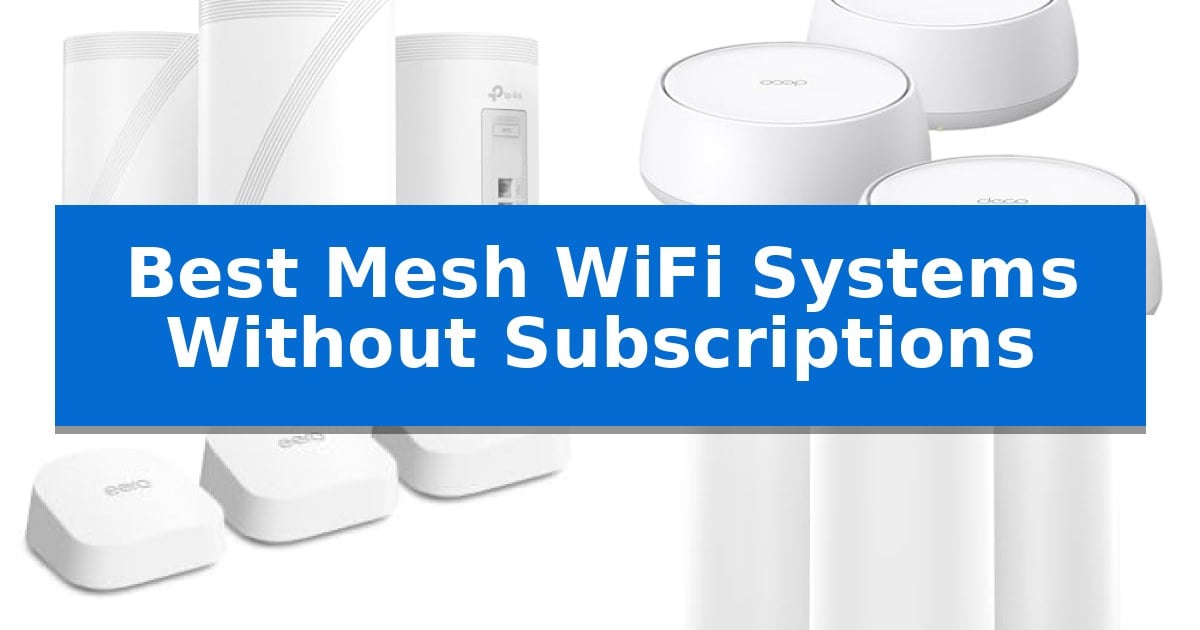
Finding a reliable network solution often leads to hidden costs, with many manufacturers gating essential security and parental controls behind monthly paywalls. If you want to own your hardware completely, selecting the Best Mesh WiFi Systems Without Subscriptions is the most effective way to avoid recurring service fees while maintaining full control over your home network.
This guide focuses on high-performance mesh hardware that delivers robust security, traffic management, and device optimization as standard features. By prioritizing systems that offer comprehensive management tools out of the box, you can ensure your home remains connected and secure without needing an ongoing financial commitment.
You may also want to compare Best Mesh WiFi Systems with Wired Backhaul, Best Mesh WiFi Systems with Smart Roaming, and Best Mesh WiFi Systems with Outdoor Connectivity.
Best Mesh WiFi Systems Without Subscriptions
Quick Comparison
| Product | Best For | Key Strength | Score |
|---|---|---|---|
| TP-Link Deco 7 Pro Mesh System | Best Overall | Subscription-free access to essential security, QoS, and parental controls. | 4.9 |
| TP-Link Deco 7 Mesh System | Advanced WiFi 7 Coverage | WiFi 7 technology provides high-speed, 4-stream dual-band performance. | 4.4 |
| Amazon eero 7 Mesh Router | Future-Proofed Dual-Band Performance | Wi-Fi 7 performance with multi-link operation support. | 4.3 |
| NETGEAR Orbi 370 Mesh System | Seamless Whole-Home WiFi 7 | Subscription-free core mesh functionality | 4.3 |
| DBIT AX1500 Mesh System | Budget-Friendly WiFi 6 Expansion | Subscription-free management and security features. | 4.6 |
How We Chose
- Hardware performance including Wi-Fi standard support and total stream capacity.
- Availability of security, parental controls, and traffic management features within the base software.
- Physical connectivity options such as multi-gigabit WAN/LAN ports for wired backhaul.
- Ease of setup and the reliability of the manufacturer's dedicated management application.
- Scalability and compatibility with existing network infrastructure and modems.
1 TP-Link Deco 7 Pro Mesh System — High-Performance Multi-Gigabit Networking
Maintaining a high-speed home network often feels like a constant battle against subscription-based management apps and hidden recurring costs. The TP-Link Deco 7 Pro Mesh System removes this barrier by providing a high-performance, subscription-free networking experience that prioritizes hardware capability over gated software features.
Engineered for demanding environments, this tri-band Wi-Fi 7 system delivers a combined speed of up to 14 Gbps, utilizing 8 streams to handle heavy traffic from 4K/8K streaming, AR/VR gaming, and high-bandwidth downloads. The inclusion of Multi-Link Operation (MLO) and 4K-QAM technology ensures that modern devices like the iPhone 16 Pro and PS5 Pro maintain stable, high-speed connections even while moving throughout the home.
The hardware is built for future-proof connectivity, featuring 10 Gbps, 2.5 Gbps, and 1 Gbps WAN/LAN ports on each unit. This allows users to fully utilize multi-gigabit internet plans without bottlenecking. With a coverage area of up to 8,100 sq. ft. and support for over 200 devices, the system uses AI-Roaming to create a single, unified network name that manages handoffs between nodes automatically.
Security is integrated at the hardware level, with TP-Link acting as a signatory of the CISA Secure-by-Design pledge. Users gain access to TP-Link HomeShield for essential network security, Quality of Service (QoS), and parental controls without requiring an ongoing subscription. Additionally, the system supports VPN Client and Server functionality, allowing devices to access remote servers directly through the router.
Best for: Large homes requiring multi-gigabit speeds and advanced Wi-Fi 7 connectivity without recurring subscription fees.
Skip if: Users who do not have multi-gigabit internet plans or Wi-Fi 7 compatible devices may find the high-end specifications exceed their current networking requirements.
PROS
- Subscription-free access to essential security, QoS, and parental controls.
- High-capacity 10 Gbps wired backhaul and WAN/LAN ports for multi-gigabit internet.
- Advanced Wi-Fi 7 technology including Multi-Link Operation for stable, high-speed performance.
- Extensive coverage of 8,100 sq. ft. supporting over 200 concurrent devices.
CONS
- Requires separate modem as it does not include built-in modem functionality.
- Higher initial hardware investment compared to entry-level mesh systems.
2 TP-Link Deco 7 Mesh System — Advanced WiFi 7 Coverage
Managing a reliable home network often involves navigating complex subscription models, but the TP-Link Deco 7 Mesh System offers a streamlined approach by focusing on hardware-based performance and integrated security without mandatory recurring fees. This system utilizes WiFi 7 technology to deliver high-speed connectivity across large areas, making it a practical choice for households requiring stable coverage for multiple devices.
The TP-Link Deco 7 Mesh System is engineered to cover up to 6,600 sq. ft., supporting over 150 devices simultaneously. By leveraging 2.5G Ethernet ports and wired backhaul capabilities, it ensures that traffic between units remains balanced and efficient. The inclusion of AI-Roaming technology allows the network to adapt to your movement, maintaining a unified network name throughout your home for seamless transitions.
Security is handled through the TP-Link HomeShield service, which provides essential network protection, parental controls, and quality of service features out of the box. As a signatory of the CISA Secure-by-Design pledge, the manufacturer prioritizes advanced security as a core requirement. Furthermore, the system includes built-in VPN client and server support, allowing devices to access remote servers without needing individual software installations.
Setup and ongoing management are performed via the Deco App, which simplifies firmware updates and network configuration. While the system is designed to work exclusively with other Deco units to form a mesh, it remains backward compatible with all previous WiFi generations, ensuring that your existing hardware can still connect to the network.
Best for: Large homes requiring high-capacity WiFi 7 coverage and integrated security features without the need for ongoing subscription services.
Skip if: Users who require a non-mesh standalone router or those looking to mix and match hardware from different manufacturers, as this system is designed to work only with other Deco units.
PROS
- WiFi 7 technology provides high-speed, 4-stream dual-band performance.
- 2.5G Ethernet ports enable fast, stable wired backhaul.
- AI-Roaming ensures a seamless, unified network experience.
- Integrated VPN support allows for secure remote access without individual device software.
CONS
- Limited ecosystem compatibility as it only functions within the Deco mesh network.
- Requires a separate modem to connect to internet service providers.
3 Amazon eero 7 Mesh Router — Future-Proofed Dual-Band Performance
Maintaining a consistent home network without recurring monthly fees requires hardware that prioritizes local management and robust software. The Amazon eero 7 Mesh Router distinguishes itself by offering a high-performance Wi-Fi 7 foundation that functions as a complete system right out of the box, ensuring your home connectivity remains under your control without mandatory service tiers.
Engineered for modern bandwidth demands, this system supports internet plans up to 2.5 Gbps and utilizes two auto-sensing 2.5 GbE ports to handle high-speed traffic efficiently. With a 3-pack configuration, it provides coverage for up to 6,000 sq. ft. and supports over 120 connected devices, making it suitable for dense smart-home environments where stability is paramount.
The core of the system relies on proprietary TrueMesh software, which works alongside TrueRoam and TrueChannel technologies to dynamically optimize your connection path. By proactively managing signal distribution, the hardware minimizes disruptions and dead spots, ensuring that your devices stay connected to the most reliable node as you move throughout your home.
While the system is designed for a seamless, subscription-free baseline experience, it maintains backward compatibility with all previous eero generations. Users who desire additional layers of protection—such as advanced ad blocking or integrated VPN services—have the option to add eero Plus, but the core mesh functionality operates independently of these services. The unit is further backed by an industry-leading three-year warranty, providing long-term assurance for your network investment.
Best for: Large households requiring high-speed Wi-Fi 7 coverage and a reliable, subscription-free mesh foundation.
Skip if: Users who require advanced, granular manual configuration of network settings, as the system prioritizes automated, simplified management.
PROS
- Wi-Fi 7 performance with multi-link operation support.
- 2.5 GbE ports for high-speed wired backhaul or internet input.
- 6,000 sq. ft. coverage capacity in a 3-pack.
- Three-year warranty included for long-term support.
CONS
- Advanced security features are locked behind an optional subscription.
- Limited manual control compared to enthusiast-grade routers.
4 NETGEAR Orbi 370 Mesh System — Seamless Whole-Home WiFi 7
The NETGEAR Orbi 370 Mesh System simplifies home networking by providing a dual-band WiFi 7 solution that blankets up to 6,000 square feet with a single, unified network. This three-pack system, consisting of one router and two satellite extenders, is engineered to support up to 70 devices simultaneously, ensuring that high-bandwidth activities like 8K streaming and VR gaming remain stable across multiple rooms.
Designed for straightforward management, the system utilizes the Orbi app to guide users through a step-by-step installation process. It is compatible with existing cable or fiber modems and features a 2.5 Gig port to accommodate high-speed internet plans. By leveraging Enhanced Backhaul technology, the system maintains consistent throughput for connected devices, including those using older WiFi 6 or WiFi 5 standards.
Security is integrated directly into the hardware with Advanced Router Protection and automatic firmware updates enabled out of the box. While the system includes a 30-day trial of NETGEAR Armor for enhanced threat detection, the core mesh functionality operates without requiring a mandatory ongoing subscription, making it a practical choice for those prioritizing long-term network ownership.
For users with larger or multi-story homes, the system offers scalability through the addition of extra Orbi 370 Series satellites. This modular approach allows for coverage expansion up to 2,000 square feet per additional unit, providing a flexible solution that adapts to the specific layout and construction materials of the home.
Best for: Homeowners seeking a high-capacity, subscription-free WiFi 7 mesh network that supports dozens of devices across large floor plans.
Skip if: Users who require a tri-band system for dedicated wireless backhaul or those who do not have a high-speed internet plan that justifies the investment in WiFi 7 technology.
PROS
- Subscription-free core mesh functionality
- WiFi 7 technology for future-ready speeds up to 5 Gbps
- Extensive 6,000 sq. ft. coverage with the included three-pack
- Easy setup via the dedicated mobile application
CONS
- Dual-band design lacks a dedicated third band for wireless backhaul
- NETGEAR Armor security features require a separate subscription after the trial period
5 DBIT AX1500 Mesh System — Budget-Friendly WiFi 6 Expansion
Maintaining a stable home network without recurring monthly fees is a priority for many users, and the DBIT AX1500 Mesh System addresses this by providing a comprehensive, subscription-free hardware solution. This 2-pack system is designed to replace traditional routers and extenders, offering a unified network that covers up to 3,900 square feet.
At the heart of this system is WiFi 6 AX1500 technology, which delivers combined wireless speeds of up to 1500Mbps. It is engineered to handle high-demand environments, supporting over 120 simultaneous connections. Each node is equipped with 4 Gigabit Ethernet ports, allowing for stable, wired connections for gaming consoles, smart TVs, or PCs, ensuring that bandwidth-heavy tasks like 4K/8K streaming remain lag-free.
The system utilizes smart roaming technology to ensure devices transition between nodes without dropping connections, providing a seamless experience throughout large or multi-story homes. For security, it incorporates enterprise-grade WPA3-SAE encryption to protect against unauthorized access, alongside an isolated guest network to keep visitor traffic separate from your primary devices.
Setup and management are handled via an intuitive mobile app or web GUI, which includes built-in parental controls to manage screen time and block harmful content. The hardware is also flexible, allowing for easy expansion by adding more nodes wirelessly to reach difficult areas like attics or outdoor spaces, all while maintaining compatibility with most major U.S. internet providers.
Best for: Large homes or multi-story layouts requiring a subscription-free, high-capacity WiFi 6 network with extensive wired connectivity options.
Skip if: Users who require multi-gigabit WAN ports or advanced tri-band backhaul performance for ultra-high-speed fiber internet plans exceeding 1Gbps.
PROS
- Subscription-free management and security features.
- 4 Gigabit Ethernet ports per node for flexible wired device connectivity.
- Supports 120+ simultaneous connections for smart home environments.
- WiFi 6 AX1500 performance for high-definition streaming and gaming.
CONS
- Dual-band architecture may limit backhaul speed compared to tri-band systems.
- 1500Mbps total speed is optimized for standard to mid-range broadband plans.
Best Mesh WiFi Systems Without Subscriptions Buying Guide
Understanding Mesh Networking Standards
Modern mesh systems utilize advanced standards like Wi-Fi 7 to manage high-density environments. When selecting a system, consider whether your devices can take advantage of Multi-Link Operation (MLO) or 320MHz channels, which significantly improve throughput and reduce latency in busy households.
Compatibility is equally vital. Ensure the system supports your current internet plan speeds. If you have a multi-gigabit connection, look for units featuring 10 Gbps or 2.5 Gbps Ethernet ports to prevent bottlenecks at the router level.
The Importance of Wired Backhaul
While mesh systems are designed for wireless convenience, a wired backhaul—connecting your mesh nodes via Ethernet cables—is the gold standard for stability. This configuration frees up wireless bands for your client devices, resulting in more consistent performance across large homes.
Systems that support both wireless and wired backhaul offer the most flexibility. If you have an older home with thick walls or limited wireless signal propagation, prioritizing a system with multiple high-speed ports per unit will allow you to build a more resilient network.
Evaluating Security and Privacy Features
Many manufacturers now offer 'premium' security tiers, but the best systems provide essential protection as a core requirement. Look for devices that include WPA3-SAE encryption, isolated guest networks, and basic network scanning without requiring a subscription.
Data privacy is a significant concern in modern networking. Systems that emphasize Secure-by-Design principles often provide more transparent control over your traffic, allowing you to manage your network's security posture locally rather than relying on cloud-based subscription services.
Coverage and Scalability
Mesh systems are modular by nature, but the effective range of each node varies based on home layout and construction materials. A system rated for 6,000 square feet may perform differently in a multi-story home compared to an open-plan apartment.
Always check if the system allows for easy expansion. The ability to add additional nodes wirelessly or via Ethernet as your needs grow ensures that your investment remains relevant as you move or renovate.
Management and Ease of Use
The management app is your primary interface for network maintenance. A high-quality app should provide clear, step-by-step setup instructions, real-time device monitoring, and straightforward tools for setting up parental controls or quality-of-service (QoS) rules.
Avoid systems that hide basic configuration options behind a paywall. The best hardware provides a complete feature set in the free version of the app, ensuring you can manage your network effectively from day one.
Frequently Asked Questions
Do I need a separate modem for these mesh systems?
Yes, all the mesh systems listed here require a separate modem provided by your internet service provider to connect to the internet.
Can I mix different mesh router models?
Generally, it is best to stick to the same product line or brand to ensure seamless roaming and compatibility, though some manufacturers allow limited cross-compatibility within their own ecosystem.
What is the benefit of Wi-Fi 7 over Wi-Fi 6?
Wi-Fi 7 offers significantly higher throughput, lower latency, and improved efficiency in crowded environments through technologies like Multi-Link Operation and wider channel support.
Is a wired backhaul necessary for a mesh system?
It is not strictly necessary, but it is highly recommended for maximum stability and speed, especially if you have a large home or high-bandwidth requirements.
Are parental controls truly free on these systems?
The systems selected for this guide include basic parental controls as part of their standard, no-subscription feature set, allowing you to manage screen time and content without extra fees.
Conclusion: Our Top Pick
For users seeking the most robust performance without the burden of monthly fees, the TP-Link Deco 7 Pro Mesh System stands out as the premier choice. It combines cutting-edge Wi-Fi 7 technology with 10 Gbps connectivity, ensuring your network is ready for the fastest internet plans available today.
By providing comprehensive security and management tools as standard, this system eliminates the need for ongoing subscriptions. While it represents a significant investment in hardware, the combination of high-capacity backhaul and AI-driven roaming makes it a reliable, long-term solution for demanding home networks.