
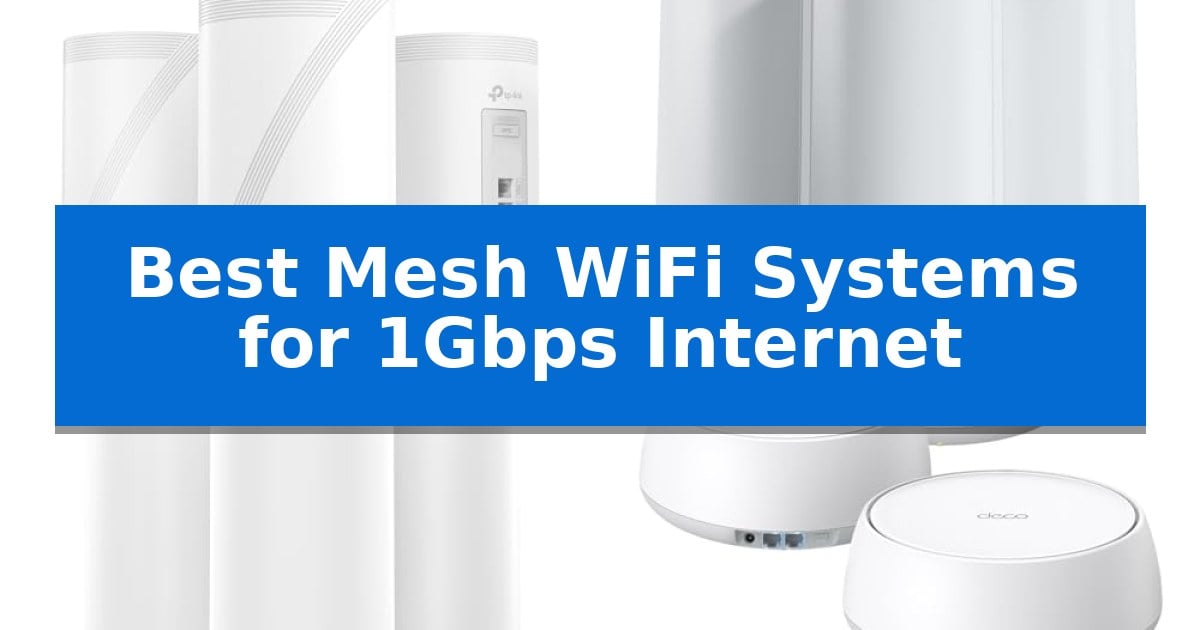
Upgrading to a 1Gbps internet plan requires hardware capable of handling that bandwidth without creating bottlenecks. If you are struggling with dead zones or inconsistent speeds, the Best Mesh WiFi Systems for 1Gbps Internet are designed to distribute your connection evenly across your entire home.
Selecting the right system involves more than just looking at advertised speeds. You need to consider how your devices connect, the physical layout of your space, and the specific networking standards that ensure your connection remains stable for every user in your household.
You may also want to compare Best Mesh WiFi Systems Compatible with Xfinity, Best Mesh WiFi Systems Compatible with Sonos, and Best Mesh WiFi System with Router and Extender.
Best Mesh WiFi Systems for 1Gbps Internet
Quick Comparison
| Product | Best For | Key Strength | Score |
|---|---|---|---|
| TP-Link Deco 7 Pro Mesh System | Best Overall | 10 Gbps WAN/LAN port for true multi-gigabit internet support. | 4.9 |
| NETGEAR Orbi 770 Mesh System | High-Capacity Tri-Band Performance | WiFi 7 technology delivers significantly faster speeds compared to previous generations. | 4.3 |
| NETGEAR Orbi 370 Mesh System | Efficient WiFi 7 Coverage | WiFi 7 technology supports speeds up to 5 Gbps for future-ready performance. | 4.7 |
| TP-Link Deco 7 Mesh System | Seamless Multi-Device Streaming | Wi-Fi 7 technology for high-speed data throughput. | 4.5 |
| Amazon eero 6+ Mesh System | Affordable Gigabit Connectivity | Built-in smart home hub for Thread and Zigbee devices | 4.4 |
How We Chose
- Wired and wireless backhaul performance for consistent data flow.
- Presence of multi-gigabit Ethernet ports to prevent hardware bottlenecks.
- Coverage area and device capacity for high-density environments.
- Ease of setup and ongoing network security features.
- Compatibility with existing modem hardware and ISP requirements.
1 TP-Link Deco 7 Pro Mesh System — Unlocks Multi-Gigabit Speeds
Maximizing the potential of high-speed internet requires hardware capable of handling multi-gigabit throughput without bottlenecks. The TP-Link Deco 7 Pro Mesh System addresses this by integrating a 10 Gbps WAN/LAN port, allowing users to fully utilize modern multi-gigabit fiber plans. This system is engineered for high-demand environments, supporting over 200 devices simultaneously across an 8,100 sq. ft. coverage area.
At the core of its performance is Tri-Band Wi-Fi 7 technology, which delivers a combined speed of up to 14 Gbps. By utilizing Multi-Link Operation (MLO) and 320MHz channels, the system combines multiple bands into a single, stable stream. This reduces latency and ensures consistent connectivity for bandwidth-intensive tasks like 8K streaming and AR/VR gaming, even as users move between rooms thanks to AI-Roaming technology.
The hardware design prioritizes both versatility and security. Each unit includes a 10 Gbps, 2.5 Gbps, and 1 Gbps port, alongside a USB 3.0 port for additional connectivity. Security is integrated through the CISA Secure-by-Design pledge and the inclusion of TP-Link HomeShield, which provides network security, Quality of Service (QoS) management, and parental controls. Setup is streamlined via the free Deco App, ensuring compatibility with major internet providers.
For those managing complex network needs, the system supports VPN Client and Server functionality, allowing devices to access remote VPN servers without requiring individual software installations. This combination of high-capacity wired backhaul and advanced wireless protocols makes it a robust solution for users seeking to future-proof their home network infrastructure.
Best for: Users with multi-gigabit internet plans who require high-capacity, low-latency coverage for a large number of smart devices.
Skip if: Users with standard 1Gbps or slower internet plans who do not require 10Gbps wired ports or the advanced throughput capabilities of Wi-Fi 7.
PROS
- 10 Gbps WAN/LAN port for true multi-gigabit internet support.
- Tri-Band Wi-Fi 7 with MLO for high-speed, stable wireless performance.
- Extensive 8,100 sq. ft. coverage suitable for large homes.
- Integrated VPN support for network-wide security and flexibility.
CONS
- Premium hardware specifications may exceed the requirements of basic home internet setups.
- Requires separate modem as it does not include built-in modem functionality.
2 NETGEAR Orbi 770 Mesh System — High-Capacity Tri-Band Performance
Maintaining high-speed connectivity across a large home requires hardware capable of handling modern bandwidth demands. The NETGEAR Orbi 770 Mesh System addresses this by utilizing WiFi 7 technology, which provides up to 11 Gbps of total throughput to support bandwidth-heavy activities like 8K streaming, VR, and high-density device environments.
This system features a tri-band design with Enhanced Backhaul, ensuring that data traffic remains efficient even when multiple devices are active simultaneously. By creating a unified network across up to 8,000 sq ft, the router and two satellite extenders eliminate dead zones, allowing for consistent coverage from the basement to the rooftop.
Integration into existing setups is straightforward, as the system is compatible with any cable or fiber internet provider and includes a 2.5 Gig port to maximize the potential of high-speed plans. Users can manage their network, guest access, and device connections through the Orbi app, which provides a guided, step-by-step installation process.
Security is integrated directly into the hardware, featuring Advanced Router Protection and automatic firmware updates to maintain network integrity. For users seeking additional safeguards, the system supports NETGEAR Armor, which offers tools to protect against malware and identity theft, ensuring that the network remains a secure foundation for all connected home devices.
Best for: Large homes requiring high-capacity, multi-device connectivity for 1Gbps or faster internet plans.
Skip if: Users living in smaller apartments or those who do not require the expansive 8,000 sq ft coverage and advanced WiFi 7 throughput of a three-piece system.
PROS
- WiFi 7 technology delivers significantly faster speeds compared to previous generations.
- Tri-band connectivity with enhanced backhaul maintains performance across many devices.
- Broad coverage of up to 8,000 sq ft with the included three-pack configuration.
- 2.5 Gig port support ensures compatibility with high-speed internet service plans.
CONS
- Separate subscription required for full NETGEAR Armor security features.
- Large physical footprint due to the three-unit mesh configuration.
3 NETGEAR Orbi 370 Mesh System — Efficient WiFi 7 Coverage
Modern high-speed internet plans require hardware that can keep pace without creating bottlenecks, and the NETGEAR Orbi 370 Mesh System is built specifically to address this with its WiFi 7 architecture. By utilizing a dual-band design with Enhanced Backhaul, this system is engineered to maintain high-speed connectivity across a footprint of up to 6,000 square feet, ensuring that bandwidth-heavy tasks like 8K streaming and VR do not suffer from slowdowns.
The system is designed for high-density environments, capable of linking up to 70 devices simultaneously. It includes a 2.5 Gig port to support multi-gigabit internet plans, allowing users to leverage the full capacity of their high-speed providers. Setup is streamlined through the Orbi app, which provides guided instructions to get the router and two satellite extenders operational quickly.
Security is integrated directly into the hardware, featuring out-of-the-box Advanced Router Protection and automatic firmware updates. Users also have access to NETGEAR Armor, a suite of tools designed to protect against malware and identity theft, though this requires a separate subscription after the initial 30-day trial. The system is backwards compatible with WiFi 6 and WiFi 5 devices, ensuring existing hardware remains connected.
For those with larger or multi-storey homes, the system offers modular scalability, allowing for the addition of extra satellites to extend coverage by 2,000 square feet per unit. This flexibility makes it a practical solution for users looking to eliminate dead zones while preparing their home network for the performance demands of future technology.
Best for: Households with high-speed internet plans looking to utilize WiFi 7 technology for seamless, large-area coverage.
Skip if: Users with smaller living spaces who do not require a multi-unit mesh system or those who prefer a tri-band system for dedicated wireless backhaul.
PROS
- WiFi 7 technology supports speeds up to 5 Gbps for future-ready performance.
- 2.5 Gig port ensures compatibility with high-speed internet plans.
- 6,000 sq ft coverage provided by the router and two satellite extenders.
- Scalable design allows for easy expansion in larger homes.
CONS
- Dual-band architecture lacks a dedicated third band for wireless backhaul.
- Subscription required for the full suite of NETGEAR Armor security features after the trial.
4 TP-Link Deco 7 Mesh System — Seamless Multi-Device Streaming
Maintaining a stable connection across a large home while utilizing a 1Gbps internet plan requires hardware capable of handling high-bandwidth traffic without bottlenecks. The TP-Link Deco 7 Mesh System addresses this by integrating Wi-Fi 7 technology, which provides the necessary throughput for demanding tasks like 8K streaming and AR/VR gaming.
This system is designed for expansive coverage, supporting up to 6,600 sq. ft. and managing over 150 devices simultaneously. By utilizing 2.5G Ethernet ports, the units facilitate a high-speed wired backhaul, ensuring that the mesh network maintains performance consistency even when data traffic is heavy.
Usability is centered around the Deco App, which streamlines the setup process and provides ongoing firmware management. The system also incorporates AI-Roaming technology, which intelligently adapts to your movement throughout the home to maintain a unified network connection, preventing the need to manually switch between access points.
Security is a core component of the design, with the system featuring TP-Link HomeShield for network and IoT protection. Additionally, the inclusion of VPN Client and Server support allows for flexible, secure remote access without requiring individual software installations on every connected device.
Best for: Large homes requiring high-bandwidth capacity and seamless roaming for over 150 connected devices.
Skip if: Users who do not have a 1Gbps internet plan or those who prefer a traditional single-router setup without mesh expansion needs.
PROS
- Wi-Fi 7 technology for high-speed data throughput.
- 2.5G Ethernet ports supporting efficient wired backhaul.
- AI-Roaming for seamless device transitions.
- Integrated VPN client and server functionality.
CONS
- Requires a separate modem to function with internet service providers.
- Backhaul performance is dependent on using at least two units.
5 Amazon eero 6+ Mesh System — Affordable Gigabit Connectivity
The Amazon eero 6+ Mesh System provides a streamlined approach to home networking by integrating a built-in smart home hub that supports Thread and Zigbee devices. This feature eliminates the need for separate hubs, allowing for direct connectivity with Alexa-compatible smart home equipment while maintaining a compact, unobtrusive design.
Designed to handle high-bandwidth demands, this system supports internet plans up to a gigabit. It utilizes the 160 MHz radio channel to boost bandwidth, ensuring sufficient capacity for simultaneous high-demand activities like video chatting, streaming, and remote work. The TrueMesh technology works to intelligently route traffic, which helps in minimizing dead spots and reducing connection drop-offs throughout the home.
Installation is managed through the eero app, which provides step-by-step guidance for setup and ongoing network management. The system is designed to be scalable and is backward-compatible with previous-generation eero devices, allowing for flexible expansion of coverage up to 4,500 sq. ft. with the included 3-pack.
Security and maintenance are handled through automatic updates, ensuring the network remains current. While basic management is included, users can opt for a separate subscription to access additional network security and management features. The system is supported by dedicated customer service for troubleshooting assistance.
Best for: Users seeking an affordable, easy-to-manage mesh system that integrates smart home hub functionality for gigabit internet plans.
Skip if: Users who require advanced, granular manual network configuration or those who prefer a system without subscription-based features for extended security management.
PROS
- Built-in smart home hub for Thread and Zigbee devices
- Supports gigabit internet speeds
- TrueMesh technology for intelligent traffic routing
- Simple setup via the eero app
CONS
- Subscription required for advanced security and management features
Best Mesh WiFi Systems for 1Gbps Internet Buying Guide
Understanding Backhaul Technology
Backhaul is the method by which mesh satellites communicate with the main router. A dedicated tri-band system often uses one band exclusively for this communication, which prevents your devices from competing for bandwidth with the router's internal traffic.
For those with wired infrastructure, some systems support wired backhaul, where satellites are connected via Ethernet cables. This is the most reliable way to ensure your 1Gbps connection is delivered at full speed to every corner of your home.
The Importance of Multi-Gigabit Ports
If your router only has 1Gbps ports, you are technically limited by the hardware interface itself. Many modern mesh systems now include 2.5Gbps or 10Gbps WAN/LAN ports to ensure that the full speed provided by your ISP can actually reach your local network.
When shopping, check if the system allows for multi-gigabit input. This is particularly important if you plan to upgrade to even faster internet tiers in the future, as it prevents the need to replace your entire network setup.
WiFi Standards and Compatibility
WiFi 7 is the latest standard, offering significant improvements in latency and efficiency over WiFi 6. Systems supporting WiFi 7 are better equipped to handle high-bandwidth tasks like 8K streaming and AR/VR gaming.
However, ensure your client devices—such as laptops and smartphones—can take advantage of these standards. While newer systems are backward compatible, the full performance benefits are realized when your devices also support the latest protocols.
Coverage and Placement
Mesh systems are rated for specific square footage, but these numbers assume an open floor plan. Walls, floors, and furniture can significantly reduce the effective range of any wireless signal.
It is often better to choose a system that allows for easy expansion. If you find a dead zone in a specific room, adding an extra satellite is a more effective solution than trying to boost the power of a single central unit.
Security and Network Management
Modern mesh routers provide more than just connectivity; they act as the gatekeeper for your smart home. Look for systems that offer automated firmware updates and robust parental controls to keep your network secure.
Many manufacturers also offer subscription-based security services. While these can provide advanced protection against malware and identity theft, ensure you understand which features are included for free versus those that require a monthly fee.
Frequently Asked Questions
Do I need a new modem for these mesh systems?
Most mesh systems function as routers only and do not replace your modem. You will need to connect your mesh system to your existing modem or gateway provided by your ISP.
Can I mix and match different mesh brands?
Generally, no. Mesh systems rely on proprietary protocols to communicate between the main router and satellites, so you should stick to the same brand and often the same product line for optimal performance.
How many satellites do I really need?
Start with the manufacturer's recommended coverage for your home size. If you have a multi-story home or thick walls, you may need more units than the square footage rating suggests.
What is the difference between dual-band and tri-band?
Dual-band systems use two frequencies for both devices and backhaul, which can lead to congestion. Tri-band systems add a third band, often dedicated to backhaul, resulting in faster and more stable connections.
Will these systems work with my 1Gbps plan?
Yes, all systems listed are capable of handling 1Gbps internet, provided your modem and cabling are also rated for those speeds.
Conclusion: Our Top Pick
Choosing the right mesh system depends on your home's layout and your specific device needs. For most users looking to maximize their 1Gbps connection, the TP-Link Deco 7 Pro Mesh System stands out due to its high-capacity tri-band performance and versatile multi-gigabit port options.
While other systems offer great coverage or more affordable entry points, the Deco 7 Pro provides the necessary headroom to ensure your network remains fast and reliable as your device count grows. Ensure your home is prepared for the installation by confirming your modem's compatibility before setup.