
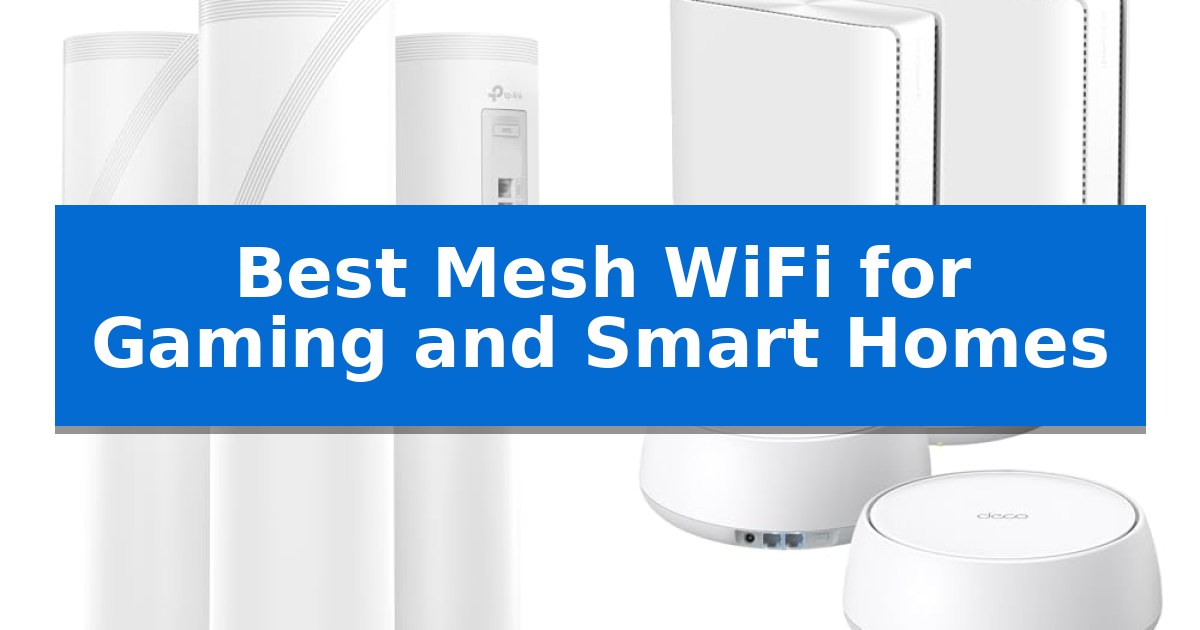
Building a reliable network that balances high-bandwidth gaming with a sprawling ecosystem of smart home devices requires more than just a standard router. When your connection struggles to handle simultaneous 4K streaming, competitive gaming sessions, and dozens of connected IoT sensors, it is time to consider a dedicated mesh system.
Finding the Best Mesh WiFi for Gaming and Smart Homes involves prioritizing low-latency backhaul, robust device management, and consistent signal strength across your entire floor plan. We have evaluated the latest systems to help you identify which hardware effectively manages your specific traffic demands without compromising on speed or security.
You may also want to compare Best Mesh WiFi for Gamers, Best Mesh WiFi for Fiber Internet, and Best Mesh WiFi for DSL.
Best Mesh WiFi for Gaming and Smart Homes
Quick Comparison
| Product | Best For | Key Strength | Score |
|---|---|---|---|
| TP-Link Deco 7 Pro Mesh System | Best Overall | 10 Gbps WAN/LAN ports for true multi-gigabit wired performance. | 4.9 |
| ASUS ZenWiFi BQ16 Pro Router | Ultimate Quad-Band Performance | WiFi 7 support for high-speed, low-latency connectivity. | 4.4 |
| NETGEAR Orbi 370 Mesh System | Reliable High-Speed Coverage | WiFi 7 technology provides high-speed throughput for gaming and 8K streaming. | 4.7 |
| TP-Link Deco 7 Mesh System | Efficient WiFi 7 Entry | WiFi 7 technology for high-speed streaming and gaming | 4.6 |
| Amazon eero 6+ Mesh System | Integrated Smart Home Hub | Built-in smart home hub for Thread and Zigbee devices | 4.7 |
How We Chose
- Wi-Fi standard and band configuration for multi-device environments.
- Wired backhaul and multi-gigabit port availability for high-speed internet plans.
- Coverage area and signal penetration through typical home construction materials.
- Device management features, including AI-driven roaming and traffic prioritization.
- Security protocols and privacy-focused network management tools.
1 TP-Link Deco 7 Pro Mesh System — Best for Multi-Gigabit Gaming
Maintaining a high-performance network for competitive gaming and smart home automation requires hardware that can handle massive data throughput without latency. The TP-Link Deco 7 Pro Mesh System addresses this by utilizing Wi-Fi 7 technology and an 8-stream tri-band architecture to deliver aggregate speeds up to 14 Gbps. This system is engineered to manage over 200 devices simultaneously, ensuring that bandwidth-heavy tasks like 8K streaming and AR/VR gaming remain stable across your entire home.
Connectivity is a standout feature, as each unit is equipped with a 10 Gbps WAN/LAN port, allowing users to leverage multi-gigabit internet plans to their full potential. The inclusion of Multi-Link Operation (MLO) and 320MHz channel width ensures that data packets are prioritized and delivered efficiently, even in dense environments. For wired backhaul, the system supports a 10 Gbps wired connection between nodes, providing a rock-solid foundation for the wireless mesh.
Usability is simplified through the Deco App, which facilitates a quick setup process and provides ongoing management tools. The system incorporates AI-Roaming technology to maintain a unified network name, automatically shifting devices to the strongest available node as you move. Security is addressed through the TP-Link HomeShield suite, which includes basic network security, quality of service, and parental controls, all built upon a Secure-by-Design foundation.
The TP-Link Deco 7 Pro Mesh System offers a robust solution for those who require high-speed wired and wireless integration. While it provides extensive coverage of up to 8,100 sq. ft., its performance is best realized in households with multi-gigabit ISP plans and modern Wi-Fi 7 compatible hardware.
Best for: Users with multi-gigabit internet plans who require low-latency connectivity for gaming and high-density smart home device management.
Skip if: Users with standard internet plans under 1 Gbps or those who do not own Wi-Fi 7 compatible devices may not fully utilize the advanced throughput capabilities of this system.
PROS
- 10 Gbps WAN/LAN ports for true multi-gigabit wired performance.
- Wi-Fi 7 technology with MLO and 320MHz channels for high-speed wireless.
- AI-Roaming ensures seamless transitions between mesh nodes.
- Advanced security via the CISA Secure-by-Design pledge and HomeShield.
CONS
- High-end hardware may be overkill for basic home browsing needs.
- Modem must be purchased separately as it is not included in the package.
2 ASUS ZenWiFi BQ16 Pro Router — Ultimate Quad-Band Performance
Maintaining a stable, high-speed connection across a large home requires hardware capable of handling dense device traffic and demanding applications. The ASUS ZenWiFi BQ16 Pro Router addresses this by utilizing WiFi 7 technology, which provides a massive capacity for smart home ecosystems and gaming setups through its quad-band connectivity.
This system is engineered for extensive coverage, supporting up to 8,000 sq. ft. with a two-pack configuration. It features twelve internal antennas and sixteen high-power front-end modules, which work in tandem to eliminate dead zones. The inclusion of Multi-Link Operation and 4096-QAM ensures that high-bandwidth activities remain consistent even when multiple devices are active simultaneously.
Management of complex networks is simplified through the Smart Home Master feature, allowing users to establish up to three distinct SSIDs. This is particularly useful for isolating IoT devices from primary gaming traffic. Furthermore, the router includes subscription-free network security and parental controls, providing essential management tools without recurring costs.
For users requiring wired reliability, the unit offers 10G port connectivity, facilitating high-speed backhaul for thick-walled environments. The system also supports versatile WAN configurations and includes a USB port for 4G LTE or 5G mobile tethering, ensuring an always-on connection. Robust heat dissipation is integrated into the design to maintain reliability during extended operation.
Best for: Large homes requiring high-bandwidth gaming performance and extensive IoT device management.
Skip if: Users living in small apartments or those who do not require advanced features like 10G ports or quad-band WiFi 7.
PROS
- WiFi 7 support for high-speed, low-latency connectivity.
- Quad-band architecture optimizes traffic for gaming and smart devices.
- 10G ports enable high-speed wired backhaul.
- Subscription-free security and parental controls.
CONS
- Large physical footprint may require significant shelf or desk space.
3 NETGEAR Orbi 370 Mesh System — Reliable High-Speed Coverage
Maintaining a stable network for high-bandwidth activities like gaming and smart home automation requires hardware capable of handling multiple connections without performance degradation. The NETGEAR Orbi 370 Mesh System addresses this by utilizing WiFi 7 technology, which delivers speeds up to 5 Gbps and supports up to 70 devices simultaneously across a 6,000 sq ft area.
This system employs a dual-band architecture with enhanced backhaul to ensure consistent data flow between the router and its two satellite extenders. By offloading traffic effectively, it minimizes the bottlenecks often found in dense smart home environments where numerous sensors, cameras, and gaming consoles compete for bandwidth.
Installation is managed through the Orbi app, which provides a guided, step-by-step setup process. The hardware is designed for broad compatibility, functioning with existing cable or fiber modems and supporting internet plans up to 2.5 Gbps via its dedicated port, making it a straightforward upgrade for most home network configurations.
Security is integrated directly into the system with Advanced Router Protection and automatic firmware updates. Users also have access to a 30-day trial of NETGEAR Armor, which adds a layer of protection against malware and identity theft, ensuring that connected smart home devices remain shielded from external threats.
Best for: Large homes requiring high-speed, low-latency connectivity for gaming consoles and a high volume of smart home devices.
Skip if: Users with internet plans exceeding 2.5 Gbps or those who require a tri-band system for more complex, high-traffic network environments.
PROS
- WiFi 7 technology provides high-speed throughput for gaming and 8K streaming.
- Extensive coverage of up to 6,000 sq ft with the included three-pack system.
- Integrated security features including automatic updates and protection tools.
- Simple setup via the dedicated mobile application.
CONS
- Dual-band configuration may be less efficient than tri-band systems for extremely congested networks.
- NETGEAR Armor requires a separate subscription after the initial 30-day trial.
4 TP-Link Deco 7 Mesh System — Efficient WiFi 7 Entry
Managing a high-traffic home network requires hardware that balances raw throughput with intelligent traffic management. The TP-Link Deco 7 Mesh System utilizes 4-stream BE5000 dual-band WiFi 7 technology to deliver speeds up to 4324 Mbps on the 5 GHz band, providing the bandwidth necessary for demanding tasks like 8K streaming and low-latency AR/VR gaming.
Designed for expansive environments, this system covers up to 6,600 sq. ft. and supports over 150 devices simultaneously. The inclusion of 2.5G Ethernet ports allows for a wired backhaul, which works in tandem with wireless signals to ensure consistent performance across all units. This architecture is particularly effective for maintaining stability in smart homes where numerous IoT devices compete for airtime.
The system simplifies network administration through the Deco App, which facilitates rapid setup and ongoing firmware maintenance. For security, the hardware integrates HomeShield for IoT protection and supports VPN Client and Server modes, allowing devices to route traffic through remote servers without requiring individual software installations on every connected gadget.
Connectivity is further enhanced by AI-Roaming technology, which creates a unified network name that adapts to your movement throughout the home. As a signatory of the CISA Secure-by-Design pledge, the TP-Link Deco 7 Mesh System prioritizes advanced security protocols, making it a robust choice for users who require both performance and a hardened defense against network vulnerabilities.
Best for: Large households requiring high-capacity WiFi 7 coverage for gaming, 8K streaming, and extensive smart home device management.
Skip if: Users who require a dedicated tri-band system for specific high-bandwidth wireless backhaul or those who do not have a separate modem to provide internet service.
PROS
- WiFi 7 technology for high-speed streaming and gaming
- 2.5G Ethernet ports support high-performance wired backhaul
- AI-Roaming ensures seamless connectivity across large areas
- CISA Secure-by-Design compliance for enhanced network safety
CONS
- Requires a separate modem for internet connectivity
- Dual-band architecture may be less efficient than tri-band systems for complex wireless backhaul needs
5 Amazon eero 6+ Mesh System — Integrated Smart Home Hub
Managing a modern home network requires balancing high-speed data demands for gaming with the constant connectivity needs of numerous smart devices. The Amazon eero 6+ Mesh System addresses this by integrating a built-in smart home hub, which supports Thread and Zigbee protocols to connect compatible devices directly without requiring additional bridges.
This system is engineered to handle modern internet plans, supporting speeds up to a Gigabit without the premium price tag often associated with high-performance mesh hardware. By utilizing the 160 MHz radio channel, the Amazon eero 6+ Mesh System provides increased bandwidth, which helps maintain stable connections for simultaneous activities like streaming, video conferencing, and online gaming.
Reliability is managed through eero TrueMesh technology, which intelligently routes network traffic to minimize dead spots and reduce drop-offs throughout the home. The system is designed for ease of use, featuring a guided setup through the eero app and the ability to receive automatic updates to ensure the network remains secure over time.
While the system offers robust coverage for up to 4,500 sq. ft. with the included 3-pack, users should note that advanced network management and specific online security features may require a separate subscription. The compact design ensures the nodes fit easily into various home environments, providing a streamlined solution for those looking to consolidate their smart home and networking hardware.
Best for: Users seeking a unified mesh network that simplifies smart home device management while supporting Gigabit internet speeds.
Skip if: Users who require advanced, subscription-free granular network management or those with extremely large properties exceeding the rated coverage area.
PROS
- Built-in smart home hub for Thread and Zigbee devices
- Supports Gigabit speeds on the 160 MHz radio channel
- TrueMesh technology for intelligent traffic routing
- Simple setup and management via the eero app
CONS
- Subscription required for advanced security and management features
Best Mesh WiFi for Gaming and Smart Homes Buying Guide
Understanding Wi-Fi Standards and Bands
Modern mesh systems utilize different Wi-Fi standards, with Wi-Fi 7 currently offering the most significant improvements in throughput and latency. Systems supporting multiple bands—such as tri-band or quad-band—are essential for separating traffic, ensuring that your gaming console stays on a dedicated, interference-free lane while smart home devices operate on a separate frequency.
When selecting a system, look for Multi-Link Operation (MLO) and 4K-QAM support. These technologies allow devices to aggregate bands for faster speeds and more stable connections, which is particularly beneficial for high-bandwidth tasks like cloud gaming or 8K video streaming.
The Importance of Wired Backhaul
While mesh systems are designed for wireless convenience, a wired backhaul is the gold standard for performance. By connecting your mesh satellites to the main router via Ethernet, you free up wireless bandwidth for your devices, resulting in significantly lower latency and more consistent speeds throughout your home.
Ensure your chosen system includes multi-gigabit Ethernet ports (such as 2.5G or 10G) if you have high-speed internet plans. This prevents the router from becoming a bottleneck, allowing you to utilize the full potential of your ISP's bandwidth.
Managing Smart Home Density
Smart homes often involve dozens of low-power devices like light bulbs, sensors, and cameras. A robust mesh system should support a high number of simultaneous connections without degrading the performance of your primary high-bandwidth devices.
Look for systems that offer dedicated IoT network support or advanced traffic management. Features like AI-Roaming help ensure that your mobile devices switch between satellites seamlessly as you move, preventing dropped connections during video calls or gaming.
Security and Network Control
Network security is critical when managing a large number of connected devices. Many modern mesh systems include built-in security suites that offer advanced threat protection, automatic firmware updates, and parental controls to keep your data private and your network safe from external vulnerabilities.
Check if the system supports VPN client and server functionality. This allows you to route specific traffic through a VPN directly at the router level, providing an extra layer of security for all your connected devices without needing individual software installations.
Coverage and Scalability
The physical layout of your home dictates the number of nodes required. While manufacturers provide coverage estimates, these are often based on ideal conditions. If your home has thick walls or multiple stories, you may need a system that supports easy expansion by adding additional satellites.
Consider the physical dimensions and design of the nodes. Since mesh units are often placed in living areas, choosing a system that fits your home's aesthetic while providing adequate ventilation for heat dissipation is a practical consideration for long-term reliability.
Frequently Asked Questions
Do I need a modem for these mesh systems?
Yes, most mesh systems are routers only and require a separate modem provided by your internet service provider to connect to the internet.
Can I mix and match different mesh brands?
Generally, no. Mesh systems from different brands or even different product lines within the same brand are often incompatible and will not form a unified mesh network.
What is the benefit of a tri-band system over a dual-band system?
A tri-band system provides an extra frequency band, which can be used as a dedicated backhaul for communication between nodes, reducing congestion and improving overall speed for connected devices.
How many mesh nodes do I need for my home?
The number of nodes depends on your square footage and home layout. Start with the manufacturer's recommendation for your size, but be prepared to add nodes if you encounter dead zones caused by structural obstacles.
Will a mesh system improve my gaming ping?
A mesh system can improve gaming stability and reduce latency compared to a standard router, especially if you use a wired backhaul to connect your nodes.
Conclusion: Our Top Pick
Selecting the right mesh system requires balancing your need for high-speed gaming performance with the connectivity demands of a modern smart home. After evaluating the available options, the TP-Link Deco 7 Pro Mesh System stands out as the most capable choice for most users.
With its support for 10Gbps multi-gigabit connectivity, 8-stream tri-band Wi-Fi 7, and advanced AI-Roaming, this system provides the bandwidth and stability necessary for demanding gaming and IoT environments. While it represents a significant investment, its robust hardware and comprehensive security features make it a reliable foundation for your home network.