
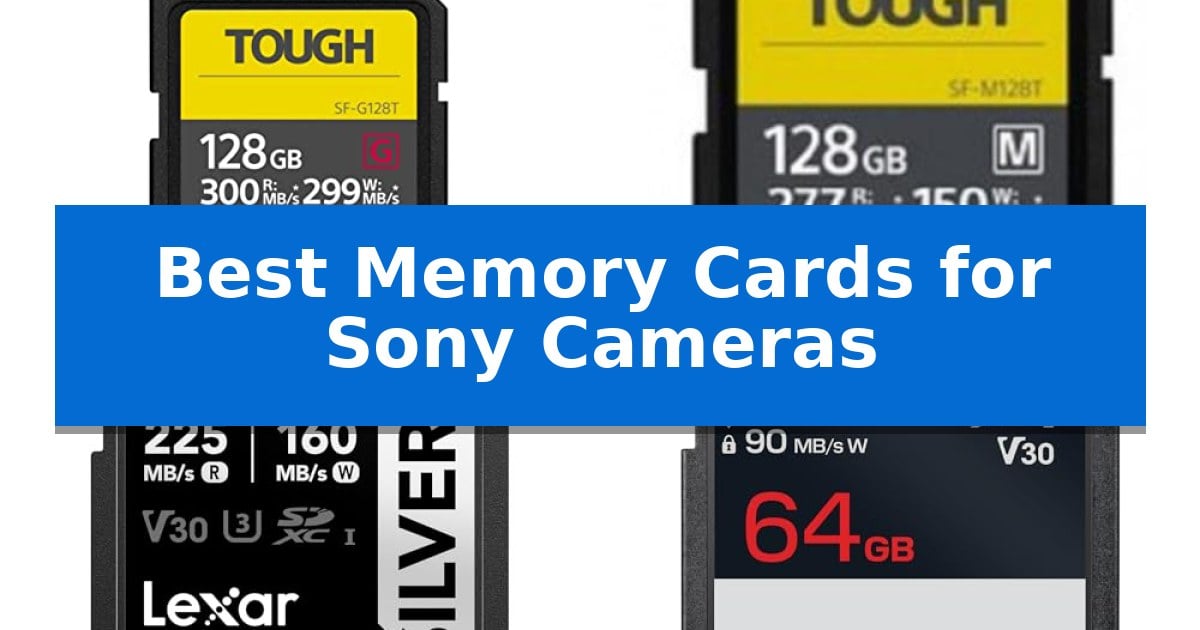
Choosing the right storage for your photography gear is essential to ensure your camera performs at its peak. Whether you are recording high-bitrate video or capturing continuous bursts of high-resolution stills, the Best Memory Cards for Sony Cameras must handle demanding data rates without dropping frames or causing buffer bottlenecks.
Our guide focuses on identifying reliable, high-speed storage solutions that align with the specific UHS-II and UHS-I requirements of modern Sony systems. We examine key performance metrics and build quality to help you select the right card for your specific shooting workflow.
You may also want to compare Best Memory Cards for Sony Camcorders, Best Memory Cards for Sony AX700, and Best Memory Cards for Sony a6700.
Best Memory Cards for Sony Cameras
Quick Comparison
| Product | Best For | Key Strength | Score |
|---|---|---|---|
| Sony TOUGH-G Series SD Memory Card | Best Overall | One-piece molded construction provides superior bend strength and physical durability. | 4.9 |
| Sony TOUGH-M Series SD Memory Card | Durable Build for Field Reliability | 18x stronger than standard UHS-II cards for superior physical durability. | 4.3 |
| Lexar Silver Series SD Memory Card | Balanced Performance for Enthusiasts | V30 rating supports 4K 60FPS video recording. | 4.6 |
| SanDisk Extreme PRO SD Memory Card | Standard Choice for High-Res Stills | V30 and U3 speed class ratings ensure consistent performance for 4K UHD video. | 4.7 |
| Gigastone 4K Camera Pro SD Card | Budget-Friendly 4K Video Support | V30 speed class ensures stable 4K video recording. | 4.9 |
How We Chose
- Read and write speed ratings for handling 4K video and burst photography.
- UHS-II versus UHS-I interface compatibility with Sony camera slots.
- Durability features including water, dust, and shock resistance.
- Capacity options to support long-form recording or high-resolution stills.
- Warranty terms and data recovery support for long-term reliability.
1 Sony TOUGH-G Series SD Memory Card — Maximum Speed for Professional 4K
Reliability in the field often hinges on the physical integrity of your storage media, and the Sony TOUGH-G Series SD Memory Card addresses this with a unique one-piece molded construction. By eliminating the traditional rib structure and write-protection switch, this design achieves a high level of bend strength, rated 18 times greater than standard SD cards.
Beyond its structural resilience, this card is built for demanding workflows, featuring IPX8 waterproof and IP6X dustproof ratings. These specifications ensure the internal components remain protected in harsh environments, while the UHS-II, Class 10, U3 compliance provides the necessary throughput for high-bitrate 4K video recording and rapid continuous burst photography.
Performance-wise, the card supports transfer speeds up to 300 MB/s and write speeds up to 299 MB/s. While these speeds are optimized for UHS-II compatible cameras, the card maintains backward compatibility with UHS-I equipment, ensuring it functions across a wider range of devices, albeit at lower performance tiers.
The absence of a write-protection switch is a deliberate design choice to minimize points of failure, though it requires users to manage file protection settings directly through their camera interface. With an operating temperature range of -13℉ to +185℉, this card is engineered to maintain consistent operation across extreme climates.
Best for: Professional photographers and videographers requiring high-speed data transfer and maximum physical durability for 4K recording in challenging environments.
Skip if: Users who frequently rely on the physical write-protection switch to manage data security on their SD cards will find this ribless, switchless design inconvenient.
PROS
- One-piece molded construction provides superior bend strength and physical durability.
- IPX8 and IP6X ratings ensure high-level protection against water and dust ingress.
- High-speed performance with up to 300 MB/s read and 299 MB/s write speeds for 4K workflows.
- Ribless, switchless design removes fragile components prone to breakage.
CONS
- No physical write-protection switch requires all lock management to be handled via camera software.
- Premium pricing reflects the specialized construction and high-speed UHS-II performance.
2 Sony TOUGH-M Series SD Memory Card — Durable Build for Field Reliability
Reliability in the field often hinges on the physical resilience of your storage media, especially when shooting in unpredictable environments. The Sony TOUGH-M Series SD Memory Card addresses this with a specialized toughness design that is rated to be 18x stronger than standard UHS-II cards, providing a robust physical buffer for your data.
Beyond its structural integrity, this card is built to handle the demands of high-resolution workflows. It supports 4K video recording and offers read speeds up to 277MB/s alongside write speeds up to 150MB/s. These specifications ensure that data transfer from the camera to your workstation is efficient, minimizing downtime during intensive shooting sessions.
Practicality is further enhanced by the card's environmental protections. It features IPX8 waterproof and IPX6 dustproof ratings, shielding your files from moisture and debris. Whether you are working in humid conditions or dusty landscapes, the card is engineered to maintain its functionality where standard cards might fail.
The Sony TOUGH-M Series SD Memory Card is backed by a five-year limited warranty, reflecting the manufacturer's confidence in its durability. With a capacity of 128GB, it provides a balanced storage solution for photographers and videographers who require a dependable, high-speed medium that can withstand rigorous handling.
Best for: Photographers and videographers working in harsh outdoor environments who require extreme physical durability and reliable 4K video recording speeds.
Skip if: Users who primarily shoot in controlled studio environments and do not require the specialized impact, water, or dust resistance of the TOUGH series.
PROS
- 18x stronger than standard UHS-II cards for superior physical durability.
- IPX8 waterproof and IPX6 dustproof ratings for field reliability.
- High-speed performance with up to 277MB/s read and 150MB/s write speeds.
- Supports 4K video recording for demanding production needs.
CONS
- Higher cost compared to standard SD cards due to the reinforced build.
3 Lexar Silver Series SD Memory Card — Balanced Performance for Enthusiasts
Reliable storage is essential for capturing high-resolution media, and the Lexar Silver Series SD Memory Card provides a robust solution for photographers and videographers using Sony cameras. With a 256GB capacity, this card offers ample space for long shooting sessions, ensuring you spend more time behind the lens and less time managing file storage.
Performance is defined by its 225MB/s max read speed, which significantly reduces wait times when transferring large files to your workstation. For active recording, the 160MB/s max write speed ensures the card keeps pace with your camera's demands. It is rated V30, meaning it is optimized to support 4K 60FPS video recording, delivering the consistent data throughput required for smooth, high-quality footage.
Designed for demanding environments, the card features a durable build that is wearproof, drop-proof, temperature-proof, x-ray-proof, shockproof, magnetic-proof, and vibration-resistant. This level of protection helps safeguard your data against the rigors of field work and travel, providing peace of mind during intensive shoots.
Compatibility is a core strength, as the card is engineered to work seamlessly with a variety of devices, including Sony, Canon, and Nikon cameras. Whether you are a professional or an enthusiast, this card offers a balanced combination of speed and reliability to support your creative workflow.
Best for: Photographers and videographers who require reliable, high-capacity storage for 4K video recording and rapid file transfers.
Skip if: Users who require higher speed classes for 8K video or extreme burst-mode photography may find the V30 rating limiting.
PROS
- V30 rating supports 4K 60FPS video recording.
- 225MB/s read speed enables fast file transfers.
- Comprehensive durability features protect against shocks, drops, and extreme temperatures.
- Extensive compatibility across major camera brands.
CONS
- V30 speed class may not be sufficient for the most demanding high-bitrate professional video formats.
4 SanDisk Extreme PRO SD Memory Card — Standard Choice for High-Res Stills
Reliability during high-intensity recording is paramount for professional photography, and the SanDisk 64GB Extreme PRO SD Memory Card is engineered to meet these demands. Featuring UHS-I, U3, and V30 speed class ratings, this card is specifically designed to handle the data throughput required for 4K UHD video and high-resolution still image capture.
Beyond its core speed capabilities, the card is built for durability. It is designed to defy the elements, providing resilience against rough handling and extreme environmental conditions. This makes it a dependable choice for photographers who frequently work on location and need hardware that maintains integrity under constant use.
For workflow efficiency, the card integrates with the SanDisk Memory Zone desktop app. This utility simplifies the process of backing up, organizing, and transferring files, whether you are using a dedicated card reader or a built-in SD slot. With capacities available up to 2TB, it offers significant storage headroom for extended shooting sessions.
The SanDisk 64GB Extreme PRO SD Memory Card balances high-speed performance with practical management tools. While it is optimized for 4K workflows, users should ensure their specific camera model supports the UHS-I interface to fully leverage its rated read and write speeds.
Best for: Photographers and videographers requiring reliable, high-speed storage for 4K UHD recording and high-resolution burst photography.
Skip if: Users who require UHS-II or UHS-III interface speeds for specialized cinema cameras or high-bitrate RAW video workflows.
PROS
- V30 and U3 speed class ratings ensure consistent performance for 4K UHD video.
- Resilient design engineered to withstand extreme conditions and rough handling.
- SanDisk Memory Zone app support for streamlined content management and backups.
- Lifetime Limited warranty coverage provides long-term peace of mind.
CONS
- UHS-I interface may limit maximum transfer speeds compared to newer UHS-II standards.
5 Gigastone 4K Camera Pro SD Card — Budget-Friendly 4K Video Support
Reliable storage is essential for capturing high-resolution media, and the Gigastone 4K Camera Pro SD Card provides a dedicated solution for users needing consistent performance. Designed as a full-sized SD card, this storage medium is built to handle the demands of 4K Ultra HD video recording, making it a functional choice for photographers and videographers using compatible digital point-and-shoot cameras, HD camcorders, and DSLRs.
Engineered for versatility in various environments, the card features a robust design that is waterproof, temperature-proof, x-ray-proof, shock-proof, and magnetic-proof. These physical protections help safeguard data against common environmental hazards during travel or field work. The inclusion of a mini case further assists in keeping the card secure when not in use.
Performance-wise, the card supports data transfer speeds of up to 170 MB/s, which facilitates efficient file offloading to a PC. It carries a V30 video speed rating, ensuring the sustained write speeds necessary for capturing high-bitrate video content without interruption. This makes it a practical component for those who prioritize steady recording capabilities in their workflow.
To provide long-term peace of mind, the product is backed by a 5-year limited warranty. This coverage period reflects the manufacturer's commitment to durability, ensuring that the card remains a reliable part of your camera kit for years of regular use.
Best for: Photographers and videographers requiring reliable, high-capacity storage for 4K video recording in diverse environmental conditions.
Skip if: Users who require specialized high-speed formats like CFexpress or UHS-II for professional-grade burst photography or cinema-level data rates.
PROS
- V30 speed class ensures stable 4K video recording.
- Comprehensive environmental protection including waterproof and shock-proof design.
- Includes a mini case for organized storage.
- Backed by a 5-year limited warranty.
CONS
- UHS-I interface may limit transfer speeds compared to newer UHS-II or CFexpress standards.
Best Memory Cards for Sony Cameras Buying Guide
Understanding UHS-II vs. UHS-I Compatibility
Sony cameras often feature slots that support the UHS-II interface, which provides significantly faster data transfer speeds compared to the older UHS-I standard. Using a UHS-II card is critical for professional videographers who need to clear the camera buffer quickly during high-speed continuous shooting or when recording high-bitrate 4K video.
While UHS-II cards are backward compatible with UHS-I slots, you will be limited to the slower speeds of the older interface. Always check your specific camera model's manual to confirm if it can take full advantage of the faster V90 or V60 speed classes to avoid overspending on performance you cannot utilize.
The Importance of Video Speed Classes
The V-rating (Video Speed Class) on an SD card indicates its minimum sustained write speed, which is vital for video recording. A V90 rating is generally required for the most demanding 4K formats, while V30 cards are often sufficient for standard 4K and Full HD recording.
Selecting a card with an insufficient V-rating can lead to recording errors or the camera stopping mid-shot. Matching the card's V-rating to your camera's maximum bitrate settings ensures a stable, uninterrupted workflow during long recording sessions.
Durability and Physical Resilience
Photographers working in outdoor or unpredictable environments should prioritize cards with high durability ratings. Features like waterproof, dustproof, and shockproof construction are essential for protecting your data against accidental drops, moisture, or extreme temperature fluctuations.
Some premium cards utilize one-piece molded construction, which eliminates the ribbing and write-protection switches found on standard cards. This design choice significantly increases bend strength and reduces the number of fragile components that could break inside your camera or card reader.
Capacity and Data Management
The amount of storage you need depends on your file format and shooting volume. High-resolution RAW files and 4K video consume space rapidly, making 128GB or 256GB capacities standard for most professionals. Larger cards allow for longer sessions without the need to swap media, which is crucial during live events.
Consider the efficiency of your transfer process as well. Cards with higher maximum read speeds, such as those reaching 300MB/s, can significantly reduce the time spent offloading footage to your computer, streamlining your post-production workflow.
Warranty and Data Recovery
Memory cards are critical assets, and their longevity is often backed by manufacturer warranties. Look for cards that offer lifetime limited warranties or multi-year coverage, as these reflect the manufacturer's confidence in the product's long-term reliability.
Some brands include free data recovery software or services, which can be a lifesaver if files are accidentally deleted or the card encounters a logical error. While this should not replace a robust backup strategy, it provides an extra layer of security for your valuable creative work.
Frequently Asked Questions
Can I use a UHS-II card in a camera that only supports UHS-I?
Yes, UHS-II cards are backward compatible with UHS-I devices. However, the card will operate at the slower UHS-I speed limits, meaning you will not benefit from the faster read and write capabilities of the UHS-II interface.
What does the V30 or V90 rating mean?
These ratings represent the minimum sustained write speed in megabytes per second. V30 guarantees at least 30MB/s, while V90 guarantees at least 90MB/s, which is necessary for high-bitrate 4K video recording.
Are all SD cards waterproof?
No, only cards specifically engineered with sealed, ruggedized designs are waterproof. Always check the product specifications for IPX ratings to confirm the level of protection against water and dust.
How often should I format my memory card?
It is best practice to format your memory card in-camera after you have safely backed up your files to a computer or external drive. This helps maintain the file system structure and reduces the risk of data corruption.
Does a faster card improve camera autofocus?
No, memory card speed does not affect autofocus performance. It only impacts how quickly the camera can write data to the card and clear its internal buffer after a burst of shots or during video recording.
Conclusion: Our Top Pick
For photographers and videographers who demand the highest performance from their Sony equipment, the Sony TOUGH-G Series SD Memory Card stands out as the premier choice. Its combination of high-speed V90 write performance and a robust, ribless design makes it exceptionally reliable for professional 4K workflows and high-speed burst shooting.
While it represents a higher investment, the durability and speed benefits provide peace of mind in challenging field conditions. If your shooting needs are less demanding, other options in our list offer excellent value, but for maximum reliability and throughput, this card remains our top recommendation.