
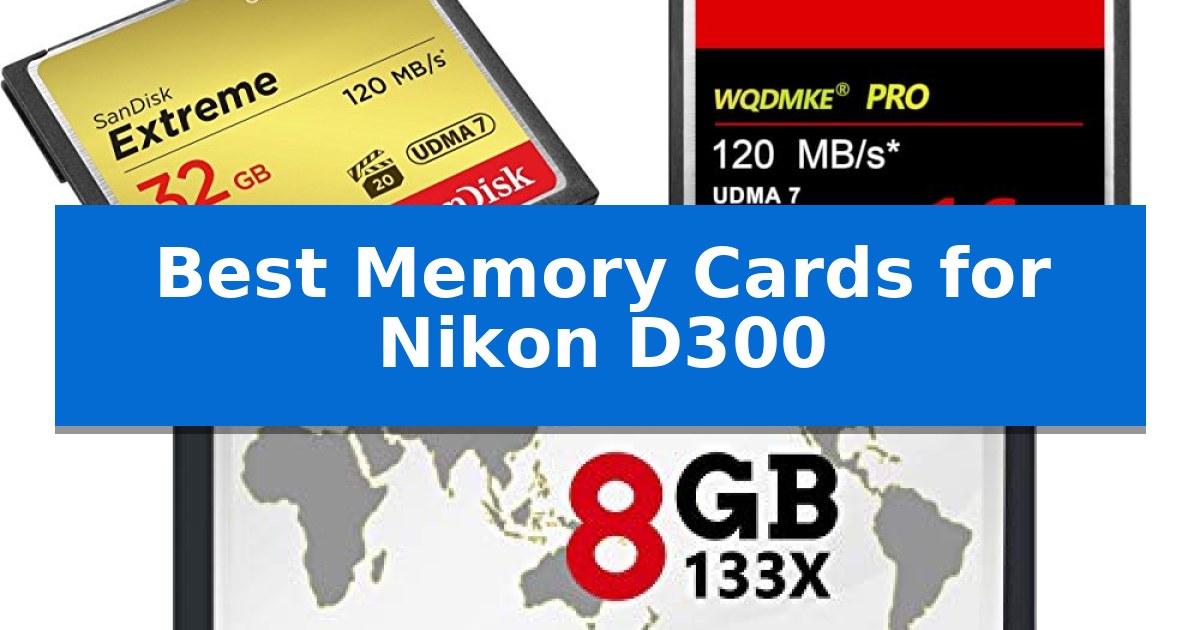
Finding the right storage for a classic DSLR requires balancing legacy compatibility with modern performance needs. When selecting the Best Memory Cards for Nikon D300, photographers must prioritize reliable data transfer and physical durability to ensure their images remain secure during long shooting sessions.
The Nikon D300 utilizes the CompactFlash interface, making it essential to choose cards that support the camera's specific UDMA requirements. This guide evaluates three distinct options to help you choose the right storage capacity and speed for your specific photography style.
You may also want to compare Best Memory Cards for Nikon D200, Best Memory Cards for Nikon D90, and Best Memory Cards for Nikon Coolpix W100.
Best Memory Cards for Nikon D300
Quick Comparison
| Product | Best For | Key Strength | Score |
|---|---|---|---|
| SanDisk Extreme CompactFlash Memory Card | Best Overall | VPG-20 certification ensures stable, sustained video recording. | 4.9 |
| WQDMKE CompactFlash Memory Card | Budget Option for Legacy DSLRs | VPG-65 certification ensures stable performance for professional video recording. | 4.3 |
| Cloudisk CompactFlash Memory Card | Standard Speed for Everyday Shooting | RTV silicone coating for enhanced shock and vibration protection | 4.4 |
How We Chose
- Interface compatibility with CompactFlash standards
- Read and write speed performance for burst shooting
- Physical durability and resistance to shock or vibration
- Storage capacity options for RAW and JPEG file management
- Video performance guarantees for sustained data streams
1 SanDisk Extreme CompactFlash Memory Card — Reliable Choice for Professional Shooters
Reliable data storage is essential for maintaining the workflow of a high-performance camera like the Nikon D300. The SanDisk 32GB Extreme CompactFlash Memory Card provides a robust solution for photographers who require consistent performance during demanding shooting sessions.
Engineered for speed, this card features read speeds of up to 120MB/s and write speeds of up to 85MB/s, facilitating rapid image transfer and efficient buffer clearing. The inclusion of VPG-20 (Video Performance Guarantee) ensures a sustained data recording rate of 20MB/s, which is critical for maintaining smooth, unbroken video streams without dropped frames.
Beyond raw speed, the card is built for field durability. It features an RTV silicone coating designed to protect against shock and vibration, ensuring your data remains secure even when shooting in challenging environments. This physical resilience is paired with a Lifetime Limited warranty, offering long-term peace of mind for professional and enthusiast photographers alike.
While the 32GB capacity is well-suited for high-resolution stills, users who frequently shoot long-duration video may eventually find the storage limit reached quickly. However, for those prioritizing a balance of speed, durability, and reliable performance in a legacy CompactFlash interface, this card remains a highly capable choice.
Best for: Photographers using the Nikon D300 who require reliable, high-speed storage for both burst photography and video capture.
Skip if: Users who require massive storage capacities exceeding 32GB for long-form video projects or those who do not have a device compatible with the CompactFlash UDMA 7 interface.
PROS
- VPG-20 certification ensures stable, sustained video recording.
- RTV silicone coating provides enhanced protection against shock and vibration.
- High-speed performance with up to 120MB/s read and 85MB/s write capabilities.
- Backed by a Lifetime Limited warranty.
CONS
- 32GB capacity may be limiting for extensive high-definition video recording.
- CompactFlash form factor is specific to older camera models and not compatible with modern SD-based devices.
2 WQDMKE CompactFlash Memory Card — Budget Option for Legacy DSLRs
The WQDMKE Camera CF Memory Card 16GB provides a dedicated storage solution for legacy DSLR users, specifically those operating cameras like the Nikon D300 that rely on the CompactFlash interface. This card is built to handle the demands of professional-quality media, featuring support for the VPG-65 (Video Performance Guarantee) specification, which ensures consistent write performance for high-definition video capture.
Designed for versatility, this card supports the capture of 1080p full-HD, 3D, and 4K video, making it a functional choice for photographers who also utilize their DSLR or HD camcorder for motion capture. With a 16GB storage capacity, it offers a balanced amount of space for high-quality image files and extended video lengths, allowing for reliable data management during extended shooting sessions.
Performance is defined by its UDMA interface, which enables read speeds of up to 120MB/s and write speeds of up to 85MB/s. These specifications facilitate efficient file transfers from the card to a computer, reducing the time spent waiting for large batches of photos or long video clips to offload. The card's physical dimensions of 1.7 by 1.4 inches ensure it fits securely within the standard CompactFlash slots found in older professional camera bodies.
Choosing the right media for a legacy system requires balancing capacity with interface compatibility. The WQDMKE Camera CF Memory Card 16GB serves as a practical, evidence-based option for those who need to maintain the functionality of their existing camera gear without needing to upgrade to modern, non-compatible formats.
Best for: Photographers using legacy DSLR cameras with CompactFlash slots who require reliable, VPG-65 compliant storage for high-quality photos and video.
Skip if: Users requiring high-capacity storage for professional 4K cinema workflows or those whose devices utilize SD or CFexpress card slots instead of CompactFlash.
PROS
- VPG-65 certification ensures stable performance for professional video recording.
- UDMA interface provides fast read speeds up to 120MB/s for efficient data offloading.
- CompactFlash form factor is specifically designed for compatibility with legacy DSLR hardware.
CONS
- 16GB capacity may be limiting for users shooting exclusively in high-bitrate 4K or large RAW file formats.
- Legacy interface restricts use to older camera models and card readers.
3 Cloudisk CompactFlash Memory Card — Standard Speed for Everyday Shooting
Reliable storage is essential for maintaining the workflow of a classic DSLR, and the Cloudisk CompactFlash Memory Card provides a dedicated solution for legacy hardware. Designed specifically for devices that utilize the CF 2.0 standard, this card ensures that your camera remains operational for both high-resolution RAW and JPEG image capture.
Built with a focus on durability, the card is engineered to withstand demanding environments. It features an RTV silicone coating that provides protection against shock and vibration, supported by rigorous testing to ensure stability during use. This construction is intended to safeguard your files against the physical stresses often encountered in field photography.
In addition to its physical resilience, the card is designed for efficient data management. It offers faster read speeds compared to traditional CompactFlash media, which helps reduce the time spent transferring and editing your images. The card also carries FCC, CE, and ROSH certifications, reflecting its adherence to established stability standards.
Compatibility is a primary strength of this 8GB storage option. It is specifically tailored for CompactFlash-compatible digital SLRs, making it a straightforward choice for photographers using equipment like the Nikon D300. With its 1-year warranty, it serves as a practical, focused tool for those who need to keep older, feature-rich cameras running smoothly.
Best for: Photographers using legacy DSLR cameras that require reliable, shock-resistant CompactFlash storage for high-resolution image capture.
Skip if: Users who require high-capacity storage for long-duration video recording or those whose cameras support newer, faster interface standards like SD or CFexpress.
PROS
- RTV silicone coating for enhanced shock and vibration protection
- Faster read speeds compared to traditional CF cards
- Broad compatibility with legacy digital SLRs
- Certified stability with FCC, CE, and ROSH compliance
CONS
- Limited 8GB capacity may be insufficient for modern high-volume workflows
Best Memory Cards for Nikon D300 Buying Guide
Understanding CompactFlash Compatibility
The Nikon D300 is designed specifically for CompactFlash (CF) media. Unlike modern SD cards, these cards are physically larger and utilize a different pin-based interface. It is critical to ensure your card is labeled as CompactFlash to avoid compatibility issues.
Check the UDMA (Ultra Direct Memory Access) rating of your card. The D300 supports UDMA modes, which allow for faster data transfer between the card and the camera buffer. Using a card that supports these standards can significantly improve your experience during high-speed burst shooting.
The Importance of Write Speeds
Write speeds determine how quickly the camera can clear its internal buffer after you take a series of photos. If you frequently shoot in RAW format, the file sizes are much larger, and a card with a faster write speed will prevent the camera from locking up while it saves data.
While the D300 has a limit on how fast it can write data, using a card with higher specifications ensures you are not creating a bottleneck. Look for cards that explicitly state their write performance to ensure smooth operation during action or wildlife photography.
Durability and Data Protection
Because memory cards are often swapped in the field, they are exposed to various environmental hazards. Many professional-grade cards feature RTV silicone coating or specialized internal housing designed to protect against shock and vibration.
If you shoot outdoors or in challenging conditions, prioritize cards that have undergone rigorous stress testing. These features provide an extra layer of security for your captured memories, reducing the risk of data corruption due to accidental drops or physical impact.
Storage Capacity Requirements
Choosing the right capacity depends on your file format and shooting volume. A 16GB or 32GB card is often sufficient for most D300 users, providing enough space for hundreds of high-resolution images without the risk of losing an entire massive library if a single card fails.
Consider carrying multiple smaller-capacity cards rather than one single massive card. This strategy acts as a simple form of redundancy, ensuring that a single card failure does not result in the total loss of your entire project or trip.
Video Performance Guarantees
While the D300 is primarily a stills camera, some users may utilize it for video capture. Look for cards that mention VPG (Video Performance Guarantee) ratings, which ensure a minimum sustained write speed.
A consistent write speed is vital for video to prevent dropped frames or recording errors. Even if you only shoot stills, a card with a VPG rating is often built to higher quality standards, making it a reliable choice for long-term use.
Frequently Asked Questions
Can I use an SD card in my Nikon D300?
No, the Nikon D300 only features a CompactFlash card slot. You would need a specific CompactFlash to SD adapter, though these can sometimes be unreliable or slow.
What is the maximum capacity card the D300 can read?
The Nikon D300 generally supports high-capacity CF cards, but it is often recommended to stick to 32GB or smaller to ensure full compatibility with the camera's file system.
Why does my camera say 'Card Error'?
This can be caused by bent pins in the camera slot or a corrupted file system on the card. Always format your card inside the camera menu before your first use.
Do I need the fastest card available?
The D300 has a maximum speed at which it can write data. While a very fast card will work, you may not see a performance benefit beyond the camera's internal limit.
How should I clean the card contacts?
Avoid touching the pins on the card. If they appear dirty, use a specialized electronic contact cleaner and a lint-free cloth, but never use water or abrasive materials.
Conclusion: Our Top Pick
For photographers looking for the most reliable performance, the SanDisk Extreme CompactFlash Memory Card stands out as the top choice. Its combination of high-speed data transfer and durable construction makes it an excellent match for the Nikon D300, ensuring your images are saved quickly and securely.
While other options may offer lower entry prices, the proven reliability of this card provides peace of mind during critical shoots. By choosing a card built for professional-grade capture, you ensure that your camera's buffer clears efficiently, allowing you to focus on your composition rather than technical limitations.