
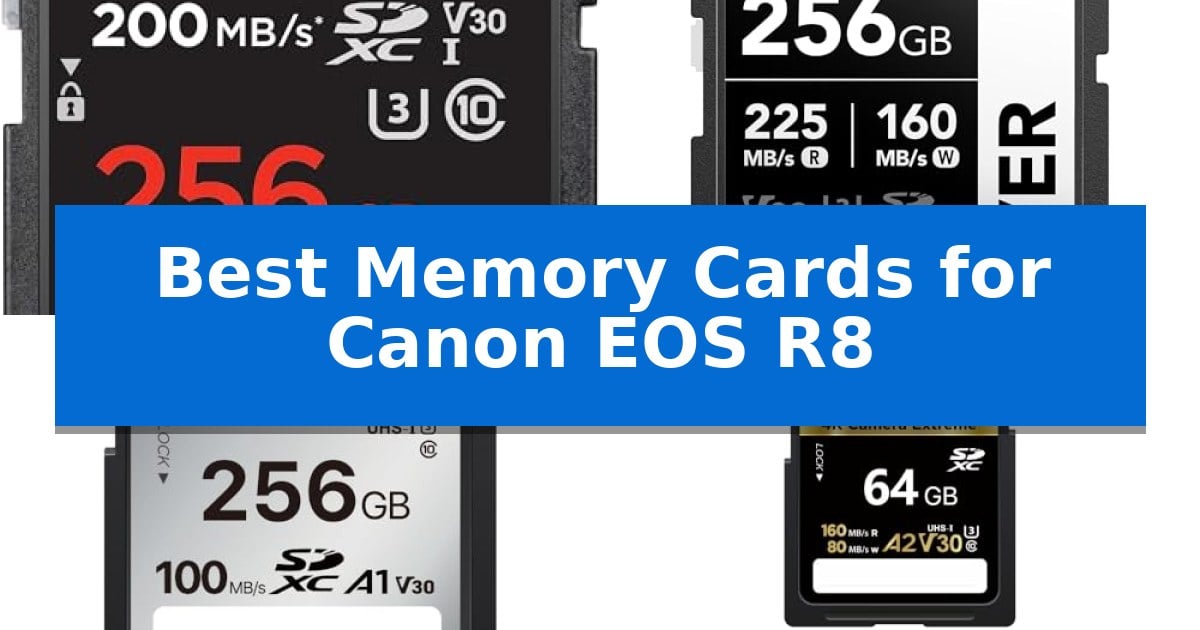
Capturing high-resolution stills and smooth 4K video with your camera requires a reliable storage solution that can keep pace with your creative workflow. Finding the Best Memory Cards for Canon EOS R8 involves balancing sustained write speeds with the capacity needed for long shooting sessions, ensuring you never miss a critical moment due to buffer delays.
Whether you are a professional photographer or a dedicated enthusiast, the right SD card acts as the backbone of your digital storage strategy. We have analyzed several top-performing options to help you identify which card provides the necessary performance for your specific shooting requirements, from high-speed burst photography to demanding UHD video recording.
You may also want to compare Best Memory Cards for Canon EOS R7, Best Memory Cards for Canon EOS R5 Mark II, and Best Memory Cards for Canon EOS R5.
Best Memory Cards for Canon EOS R8
Quick Comparison
| Product | Best For | Key Strength | Score |
|---|---|---|---|
| SANDISK Extreme PRO SD Memory Card | Best Overall | UHS Speed Class 3 (U3) and V30 ratings for stable 4K video recording. | 4.9 |
| Lexar Silver SD Memory Card | Fast Transfers for 4K Workflows | V30 speed class supports smooth 4K 60FPS video recording. | 4.9 |
| GIGASTONE 4K Camera Pro SD Card | Value Option for UHD Recording | UHS-I V30 rating supports 4K UHD video recording. | 4.7 |
| GIGASTONE 4K Camera Extreme SD Card | High-Speed Performance for Video | 4K UHD video compatibility for high-resolution recording. | 4.8 |
How We Chose
- Sustained write speeds to support 4K UHD video recording and continuous burst mode.
- UHS-I interface compatibility for seamless integration with the camera's internal hardware.
- Data transfer rates to minimize downtime when offloading large files to a computer.
- Build quality and environmental resistance to protect data in various shooting conditions.
- Capacity options that align with typical file sizes for high-resolution images and video.
1 SANDISK Extreme PRO SD Memory Card — Reliable High-Speed Burst Shooting
Capturing high-resolution 4K video and rapid-fire sequential bursts requires a storage medium that can keep pace with the Canon EOS R8. The SANDISK 256GB Extreme PRO SD Memory Card is engineered to meet these demands, utilizing UHS Speed Class 3 (U3) and Video Speed Class 30 (V30) ratings to ensure consistent, real-time data capture during intensive shooting sessions.
Beyond its recording capabilities, this card streamlines post-production workflows through SanDisk QuickFlow Technology. When paired with a compatible reader, it achieves read speeds of up to 200MB/s, significantly reducing the time required to offload large files to a workstation. For photographers and videographers, this means less time tethered to a computer and more time behind the lens.
Reliability remains a core focus of this storage solution, which is backed by a lifetime limited manufacturer warranty. With a substantial 256GB capacity, it provides ample space for high-bitrate video files and extensive RAW image sequences, making it a practical choice for long-form projects where swapping cards frequently is not an option.
While the card is optimized for high-speed performance, users should note that achieving the maximum 200MB/s read speed requires hardware that supports these proprietary transfer protocols. It remains a robust, high-capacity tool for those who prioritize efficient file management and consistent write performance for their mirrorless camera setup.
Best for: Photographers and videographers who need reliable, high-capacity storage for 4K video recording and rapid burst photography.
Skip if: Users who do not require high-speed offloading or large storage capacities may find more cost-effective options with lower speed ratings.
PROS
- UHS Speed Class 3 (U3) and V30 ratings for stable 4K video recording.
- QuickFlow Technology enables fast read speeds up to 200MB/s.
- 256GB capacity supports extensive shooting without frequent card changes.
- Lifetime limited manufacturer warranty provides long-term support.
CONS
- Maximum read speeds require specific compatible hardware to achieve.
- Proprietary technology is required to reach the highest advertised transfer rates.
2 Lexar Silver SD Memory Card — Fast Transfers for 4K Workflows
Capturing high-resolution video and continuous bursts on the Canon EOS R8 requires a reliable storage medium that can keep pace with the camera's processing demands. The Lexar 256GB Silver SD Memory Card is engineered to support these workflows, offering a V30 speed class rating that ensures stable recording for 4K 60FPS video.
Beyond its video capabilities, this card features a 225MB/s maximum read speed, which significantly shortens the time spent transferring large files to a computer or external drive. For photographers who frequently shoot in burst mode, the 160MB/s maximum write speed helps maintain the camera's buffer performance, ensuring you are ready to capture the next sequence without unnecessary delays.
Reliability in various shooting environments is addressed through a robust, durable design. The card is built to be wearproof, drop-proof, temperature-proof, x-ray-proof, shockproof, magnetic-proof, and vibration-resistant, providing peace of mind when working in challenging field conditions. It is also backed by a Lifetime Limited Warranty.
Compatibility is a primary strength of this storage solution, as it is designed to work seamlessly with a wide range of devices, including Canon, Sony, and Nikon cameras. With a substantial 256GB capacity, it provides ample space for extended shooting sessions, making it a practical choice for enthusiasts and professionals who need to minimize card swaps.
Best for: Photographers and videographers who require reliable, high-capacity storage for 4K video recording and high-speed burst photography.
Skip if: Users who require ultra-high-speed V60 or V90 cards for specialized high-bitrate cinema formats or extreme burst-rate professional sports photography.
PROS
- V30 speed class supports smooth 4K 60FPS video recording.
- 225MB/s read speed enables efficient file transfers.
- Comprehensive durability features protect data in harsh environments.
- Lifetime Limited Warranty provides long-term support.
CONS
- UHS-I interface may limit performance compared to UHS-II cards in specific high-end workflows.
3 GIGASTONE 4K Camera Pro SD Card — Value Option for UHD Recording
The GIGASTONE 4K Camera Pro SD Card provides a reliable storage solution for photographers using the Canon EOS R8, specifically designed to handle the demands of 4K Ultra HD video recording. With a UHS-I A1 V30 speed class rating, this card is built to maintain the consistent write speeds necessary for high-resolution video capture.
This full-sized SD card offers data transfer speeds up to 170 MB/s, which helps reduce wait times when offloading large image files or video clips to a PC. Its versatility makes it suitable for various devices, including DSLRs and HD camcorders, ensuring that users can transition between different camera systems without needing multiple types of memory media.
Durability is a core component of this card's design, as it is engineered to be waterproof, temperature-proof, x-ray-proof, shock-proof, and magnetic-proof. These protective features provide peace of mind when shooting in diverse environments, from outdoor landscapes to studio settings, and the card includes a mini case for secure storage.
To support long-term usage, the product comes with a 5-year limited warranty. This commitment from the manufacturer underscores the intended longevity of the storage media, making it a practical choice for users who prioritize hardware reliability alongside high-capacity performance.
Best for: Photographers and videographers seeking a durable, high-capacity storage solution for 4K video recording and general photography.
Skip if: Users who require the extreme write speeds of UHS-II or CFexpress cards for high-speed burst photography or professional RAW video workflows.
PROS
- UHS-I V30 rating supports 4K UHD video recording.
- Comprehensive protection against water, temperature, shock, and x-rays.
- Fast data transfer speeds up to 170 MB/s.
- Includes a 5-year limited warranty.
CONS
- UHS-I interface may limit performance in professional high-burst scenarios.
4 GIGASTONE 4K Camera Extreme SD Card — High-Speed Performance for Video
Capturing high-resolution video and continuous bursts on the Canon EOS R8 requires reliable storage that can keep pace with the camera's high-speed processing. The GIGASTONE 4K Camera Extreme SD Card is engineered to meet these demands, offering UHS-I A2 V30 U3 performance standards that ensure consistent write speeds for 4K UHD video recording.
This full-sized SD card provides a robust data transfer speed of up to 160MB/s, which helps reduce wait times when offloading large files to a computer. Its design is built for durability in various shooting environments, featuring waterproof, temperature-proof, x-ray-proof, and shock-proof construction, along with magnetic resistance to protect your footage.
Beyond its technical specifications, the card includes a 5-year limited warranty and comes with a dedicated mini case for secure storage. This combination of protective features and high-speed compatibility makes it a practical choice for photographers and videographers looking to maintain a streamlined workflow with their EOS R8.
When selecting memory for your camera, consider that while this card is optimized for 4K video, it is a UHS-I interface. Users who frequently shoot extremely high-bitrate RAW bursts or specialized cinema formats may eventually find the limits of the UHS-I bus speed compared to UHS-II alternatives, though it remains a balanced option for general high-resolution photography and video.
Best for: Photographers and videographers needing reliable, durable 4K-compatible storage for the Canon EOS R8.
Skip if: Users who require the maximum possible write speeds for high-bitrate professional cinema formats or extended high-speed burst photography that exceeds UHS-I bus capabilities.
PROS
- 4K UHD video compatibility for high-resolution recording.
- Durable design with waterproof, shock-proof, and temperature-proof ratings.
- Includes a 5-year limited warranty for long-term peace of mind.
- Fast 160MB/s transfer speeds for efficient file management.
CONS
- UHS-I interface may limit performance for professional-grade high-bitrate video workflows.
Best Memory Cards for Canon EOS R8 Buying Guide
Understanding Speed Classes
The Video Speed Class (V30) rating is a critical specification for the Canon EOS R8, as it guarantees a minimum sustained write speed of 30MB/s. This is essential for recording 4K video without experiencing dropped frames or unexpected recording stops.
While higher numbers might seem appealing, matching the card's rating to your camera's actual requirements prevents overspending on performance that the device cannot utilize. Always look for the U3 and V30 labels to ensure your card meets the baseline for high-bitrate video.
Capacity and Workflow
Choosing the right capacity depends on your file format choices and how often you offload data. A 256GB card offers a substantial buffer for long days of shooting, reducing the need to swap cards frequently and minimizing the risk of losing small media.
Consider your typical workflow; if you shoot primarily in RAW format, your storage needs will grow significantly faster than if you stick to JPEG or compressed video formats. Balancing capacity with your budget ensures you have enough room for your projects without paying for unused space.
Data Transfer Efficiency
The read speed of a memory card determines how quickly you can move your footage from the card to your editing workstation. Cards featuring proprietary technology, such as SanDisk QuickFlow, can significantly reduce wait times when paired with compatible card readers.
Investing in a high-speed reader is just as important as buying a fast card. Even the most advanced card will be bottlenecked by an outdated USB 2.0 reader, so ensure your entire data pipeline supports the speeds your card is capable of delivering.
Durability and Reliability
Since memory cards are often used in unpredictable environments, features like shock-proof, temperature-proof, and waterproof construction are vital for data protection. These physical safeguards help prevent data corruption caused by accidental drops or exposure to the elements.
Look for cards that include a limited lifetime warranty or long-term manufacturer support. This provides peace of mind, knowing that the manufacturer stands behind the longevity of the flash memory used in their products.
Compatibility Checks
The Canon EOS R8 utilizes the UHS-I interface, meaning it is optimized for cards that adhere to this standard. While UHS-II cards are backward compatible, they often come at a premium price without providing a performance boost in this specific camera body.
Always verify that the card is formatted correctly within the camera before your first shoot. This simple step ensures the file system is optimized for the camera's specific writing patterns, further reducing the risk of errors.
Frequently Asked Questions
Does the Canon EOS R8 support UHS-II memory cards?
The Canon EOS R8 is compatible with UHS-II cards, but it will operate at UHS-I speeds. You will not see a performance increase, so UHS-I cards are generally the more cost-effective choice.
What is the minimum speed class required for 4K video?
For reliable 4K UHD video recording, you should use a card with at least a V30 (Video Speed Class 30) rating to ensure a sustained write speed of 30MB/s.
How often should I format my memory card?
It is recommended to format your memory card in the camera after you have successfully backed up your files to a computer. This clears the card and ensures the file structure remains healthy.
Can I use a 512GB card in the Canon EOS R8?
Yes, the Canon EOS R8 supports high-capacity SDXC cards, including 512GB and larger, provided they are formatted correctly by the camera.
Why is my card not reaching the advertised speed?
Advertised speeds are often maximum read speeds reached under ideal testing conditions. Actual write speeds, which are more important for recording, are typically lower and depend on the host device's interface.
Conclusion: Our Top Pick
Selecting the right storage is essential for maintaining the performance of your camera. For most users, the SANDISK Extreme PRO SD Memory Card stands out as the most reliable choice due to its consistent V30 performance and proven compatibility with high-resolution video workflows.
By choosing a card that matches the specific interface requirements of the Canon EOS R8, you ensure that your camera operates without buffer limitations. While other options offer competitive value, the balance of speed, durability, and manufacturer support makes this our top recommendation for your photography and videography needs.