
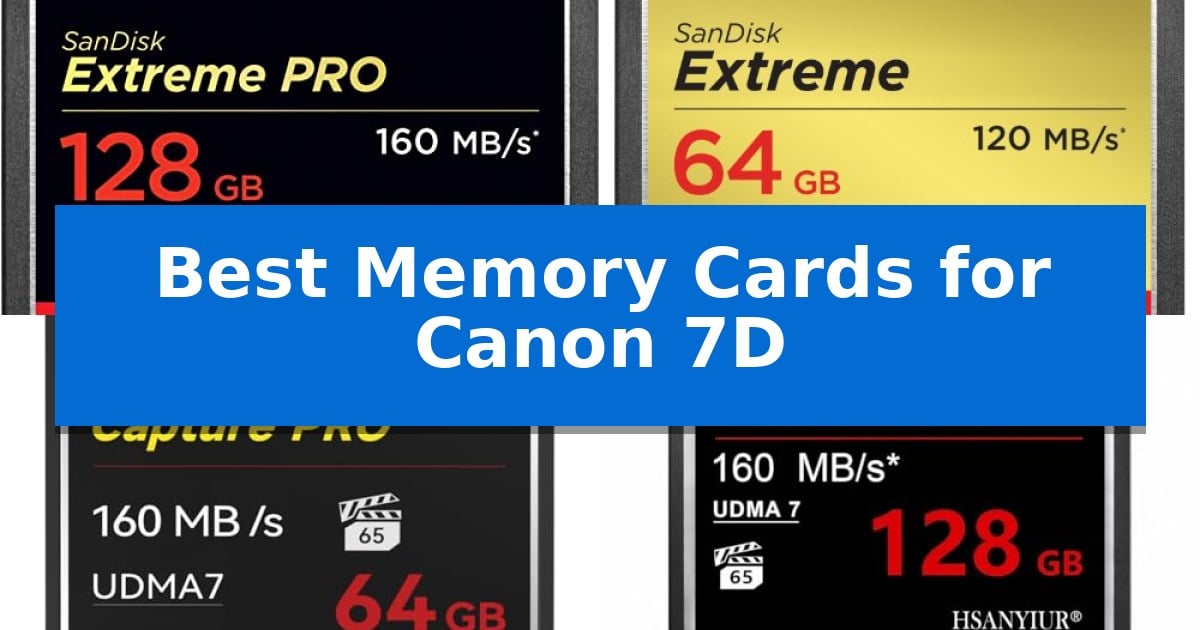
Finding the right storage for your camera is essential for maintaining a smooth workflow, especially when shooting high-resolution images or extended video clips. The Best Memory Cards for Canon 7D must balance reliable write speeds with the capacity needed to handle demanding burst shooting sessions without interruption.
Whether you are capturing fast-paced action or recording high-bitrate video, selecting a card that matches your camera's interface requirements is critical. We have evaluated the top CompactFlash options to help you identify which storage solution best supports your specific photography and videography needs.
You may also want to compare Best Memory Cards for Canon 5D Mark IV, Best Memory Cards for Camera Video, and Best Memory Cards for Android Smartphones.
Best Memory Cards for Canon 7D
Quick Comparison
| Product | Best For | Key Strength | Score |
|---|---|---|---|
| SANDISK Extreme PRO CompactFlash Memory Card | Best Overall | Industry-leading write speeds up to 150MB/s for fast burst shooting. | 4.9 |
| SANDISK Extreme CompactFlash Memory Card | Reliable Performance for Daily Capture | UDMA 7 interface for efficient data transfer speeds. | 4.6 |
| PEFISHOP High Speed CompactFlash Memory Card | Durable Build for Outdoor Photography | VPG-65 certified for consistent 65MB/s minimum write speeds. | 4.8 |
| HSANYIUR CompactFlash Memory Card | High Capacity for Extended Sessions | 128GB high-capacity storage for uninterrupted shooting. | 4.9 |
| WQDMKE CompactFlash Memory Card | Essential Storage for DSLR Cameras | VPG-65 certification ensures consistent video write performance. | 4.3 |
How We Chose
- Compatibility with the CompactFlash Type I interface and UDMA 7 standards.
- Sustained write speeds required for high-speed continuous burst shooting.
- Video Performance Guarantee (VPG) ratings for stable, drop-free recording.
- Storage capacity options to accommodate long-duration sessions without card swaps.
- Physical durability features including shock, water, and temperature resistance.
1 SANDISK Extreme PRO CompactFlash Memory Card — Professional Speed for Burst Shooting
The SANDISK 128GB Extreme PRO CompactFlash Memory Card is engineered for high-performance photography, utilizing UDMA 7 technology to support the demanding requirements of professional DSLR cameras like the Canon 7D. This card is built to handle intensive data tasks, providing a reliable storage solution for photographers who prioritize speed and efficiency during high-speed burst shooting.
With read speeds up to 160MB/s (1067X), this card significantly reduces the time required to transfer large image files and video clips to a computer, streamlining your post-production workflow. The write speeds of up to 150MB/s (1000X) are specifically designed to keep up with the rapid frame rates of professional cameras, ensuring the buffer clears quickly during continuous shooting sessions.
Beyond still photography, this card is capable of capturing cinema-quality 4K and Full HD video. Its robust construction and technical specifications make it a dependable choice for those who need to switch between high-resolution stills and video recording without changing media. The card is backed by a limited lifetime warranty, reflecting its durability for frequent use in the field.
While this card offers significant performance advantages, it is important to ensure your specific camera model supports the CompactFlash interface. As a high-capacity, high-speed storage medium, it is best suited for users who frequently shoot in RAW format or record long video sequences where data throughput is critical.
Best for: Professional photographers and videographers using Canon 7D cameras who require high-speed burst shooting and efficient data transfer.
Skip if: Users who do not require high-speed write performance or those whose devices do not support the CompactFlash memory card format.
PROS
- Industry-leading write speeds up to 150MB/s for fast burst shooting.
- High-speed read performance up to 160MB/s to improve workflow efficiency.
- Supports 4K and Full HD video recording for versatile media capture.
- Includes a limited lifetime warranty for long-term peace of mind.
CONS
- CompactFlash interface is not compatible with standard SD card slots found in many modern cameras.
2 SANDISK Extreme CompactFlash Memory Card — Reliable Performance for Daily Capture
Capturing high-resolution images and video on a Canon 7D requires a storage medium capable of handling consistent data throughput. The SANDISK 64GB Extreme CompactFlash Memory Card is engineered to meet these demands, utilizing the UDMA 7 interface to facilitate efficient file transfers and reliable recording during intensive shooting sessions.
This card is built for demanding environments, featuring a durable design that has undergone rigorous stress, shock, and vibration testing. The inclusion of an RTV silicone coating provides an additional layer of protection against physical impacts, which is essential for photographers working in varied field conditions.
For those utilizing the Canon 7D for video production, the card supports VPG-20 (Video Performance Guarantee). This standard ensures a sustained data recording rate of 20MB/s, which helps maintain a smooth and unbroken video stream, preventing dropped frames during capture.
With read speeds of up to 120MB/s and write speeds of up to 85MB/s, this card provides the necessary overhead for quick shot-to-shot performance. It offers a balance of speed and capacity, making it a practical choice for photographers who need to clear their buffer quickly without sacrificing data integrity.
Best for: Photographers and videographers using the Canon 7D who require reliable, sustained write speeds for high-definition video and rapid burst photography.
Skip if: Users who require higher capacity storage or faster transfer speeds for 4K/8K cinema-grade video workflows may find this card's capacity and interface limitations insufficient.
PROS
- UDMA 7 interface for efficient data transfer speeds.
- VPG-20 certification ensures stable video recording.
- RTV silicone coating provides enhanced shock and vibration protection.
CONS
- 64GB capacity may be limiting for long-duration high-bitrate video projects.
3 PEFISHOP High Speed CompactFlash Memory Card — Durable Build for Outdoor Photography
Reliable storage is essential for maintaining the workflow of high-resolution photography and video, particularly when using professional DSLR cameras that demand consistent data throughput. The PEFISHOP High Speed CompactFlash Memory Card addresses these needs by utilizing the UDMA 7 interface, which allows for maximum theoretical bandwidth during intensive shooting sessions.
Designed for demanding environments, this 64GB card is built to be waterproof, shockproof, and temperature-resistant, operating effectively in conditions ranging from -13°F to 185°F. This durability makes it a practical choice for photographers working in varied outdoor settings where equipment protection is a priority.
Performance is centered on the Video Performance Guarantee 65 (VPG-65) standard, which ensures a minimum sustained write speed of 65MB/s. This specification is critical for capturing smooth, drop-free 4K video and managing high-speed continuous burst shooting without interruption. With sustained read speeds reaching up to 160MB/s, transferring large files to a workstation is streamlined.
Compatibility is a primary consideration for this card, as it is engineered for modern professional cameras supporting the CompactFlash (CF) Type I format. While it works seamlessly with the Canon 7D, 5D, and 1D series, as well as later Nikon professional models, it is not intended for older legacy cameras. Users should verify their specific camera manual for maximum capacity support before integration.
Best for: Professional photographers and videographers using modern CF-compatible DSLR cameras who require reliable, high-speed storage for 4K video and continuous burst shooting.
Skip if: Users operating older legacy DSLR models that do not support the UDMA 7 interface or high-capacity 64GB cards should seek alternative storage solutions.
PROS
- VPG-65 certified for consistent 65MB/s minimum write speeds.
- Rugged design featuring waterproof, shockproof, and temperature-resistant construction.
- High-speed performance with read speeds up to 160MB/s for efficient data transfer.
- Optimized for 4K video and high-speed continuous shooting workflows.
CONS
- Compatibility limitations with older legacy camera models.
- Capacity constraints for users requiring more than 64GB of storage.
4 HSANYIUR CompactFlash Memory Card — High Capacity for Extended Sessions
Managing high-resolution photography and 4K video workflows requires reliable storage that keeps pace with your camera's demands. The HSANYIUR CompactFlash Memory Card provides a robust solution for professional creators, offering read speeds up to 160MB/s to ensure efficient data transfer during post-production.
Designed with a 128GB capacity, this memory card allows for extended shooting sessions without the need to swap media, making it an asset for weddings, travel, and long-form events. It adheres to the VPG standard, which supports consistent, high-bitrate video recording and rapid burst photography, preventing the slowdowns that can interrupt a creative flow.
Durability is a core component of its design, featuring waterproof, shockproof, and extreme temperature resilience. Whether you are working in freezing conditions or high heat, the card is engineered to protect your data. Its cross-platform compatibility ensures it functions across various professional camera ecosystems, providing flexibility for photographers using multiple systems.
Before integrating this card into your kit, ensure your camera model supports the 128GB capacity. By utilizing premium materials, the card offers a stable foundation for data integrity, helping to maintain a reliable workflow throughout your professional assignments.
Best for: Professional photographers and videographers requiring high-capacity, durable storage for extended 4K video recording and rapid burst photography.
Skip if: Users with older camera models that do not support 128GB CompactFlash cards or those who do not require high-bitrate video capabilities.
PROS
- 128GB high-capacity storage for uninterrupted shooting.
- VPG standard compliance for consistent high-bitrate video performance.
- Rugged build with waterproof, shockproof, and temperature-resistant properties.
- Fast 160MB/s read speeds for efficient data offloading.
CONS
- Compatibility check required for older camera models regarding 128GB capacity support.
5 WQDMKE CompactFlash Memory Card — Essential Storage for DSLR Cameras
Reliable storage is essential for maintaining the workflow of a DSLR, and the WQDMKE Camera CF Memory Card 16GB provides a dedicated solution for photographers using legacy hardware like the Canon 7D. This card utilizes the UDMA interface to deliver read speeds of up to 120MB/s and write speeds reaching 85MB/s, ensuring that data transfer remains efficient when moving files from the camera to a computer.
Designed to meet the VPG-65 (Video Performance Guarantee) specification, this card is built to handle professional-quality video requirements. It supports the capture of 1080p full-HD, 3D, and 4K video content, making it a versatile choice for users who occasionally switch between high-resolution still photography and video recording on their DSLR or HD camcorder.
With a 16GB storage capacity, this card offers sufficient space for a substantial volume of high-quality images and extended video clips. The compact form factor is specifically engineered for the CompactFlash slots found in professional-grade cameras, providing a secure and stable connection for long-term shooting sessions.
Choosing the right media involves balancing capacity with the specific interface requirements of your camera. While this card provides robust performance for standard and high-definition tasks, users should ensure their specific camera firmware supports the UDMA standard to fully utilize the rated speed capabilities.
Best for: Photographers using DSLR cameras with CompactFlash slots who require reliable storage for high-definition video and image capture.
Skip if: Users who require high-capacity storage for massive RAW file bursts or long-form 4K recording may find the 16GB limit restrictive.
PROS
- VPG-65 certification ensures consistent video write performance.
- UDMA interface supports fast read and write speeds up to 120MB/s.
- Durable CompactFlash form factor compatible with professional DSLR cameras.
CONS
- 16GB capacity may be insufficient for high-volume RAW photography.
Best Memory Cards for Canon 7D Buying Guide
Understanding CompactFlash Standards
The CompactFlash (CF) format remains a staple for professional DSLR cameras due to its robust physical design and high-speed data transfer capabilities. When selecting a card, the UDMA (Ultra Direct Memory Access) rating is a primary indicator of how quickly the camera can offload data from its buffer to the card.
For the Canon 7D, ensuring the card supports UDMA 7 is vital to achieving the maximum theoretical bandwidth the camera can handle. This standard significantly reduces the time the camera spends writing data, which is essential for clearing the buffer during rapid-fire continuous shooting.
The Importance of Write Speeds
While read speeds are important for transferring files to your computer, write speeds are the most critical factor for in-camera performance. A card with a slow write speed will cause your camera to pause or stutter when the internal buffer fills up during a burst of action.
Look for cards that specify a sustained write speed rather than just a peak marketing number. This ensures that the card can maintain a consistent data flow, preventing dropped frames during video recording or lag during high-speed photography.
Video Performance Guarantee (VPG)
If you use your camera for video, the VPG rating is a non-negotiable specification. This industry standard guarantees a minimum sustained write speed, ensuring that your video stream remains unbroken and free of errors.
A VPG-65 or similar rating indicates that the card is capable of handling high-bitrate video recording without the risk of the camera stopping the recording prematurely due to data bottlenecks.
Capacity and Workflow Efficiency
Choosing the right capacity depends on your typical shooting volume and file format. While higher capacities like 128GB allow for extended sessions without swapping cards, they also require a reliable card reader to ensure efficient file transfers to your workstation.
Consider your workflow: if you frequently shoot in RAW or record long 4K video clips, a larger capacity card prevents the frustration of running out of space mid-event. Conversely, smaller cards may be sufficient for studio work where frequent offloading is part of your routine.
Durability in the Field
Photography often takes you into unpredictable environments, making the physical construction of your memory card a key consideration. Many modern CF cards feature RTV silicone coatings or specialized shells designed to resist shock, vibration, and extreme temperatures.
Investing in a card with waterproof and temperature-resistant ratings provides an extra layer of security for your data. These features ensure that your captured images remain safe even if you are shooting in rain, high humidity, or freezing conditions.
Frequently Asked Questions
Does the Canon 7D support all CompactFlash cards?
The Canon 7D uses the CompactFlash Type I format. While most modern CF cards are backward compatible, it is important to check if your specific camera firmware supports high-capacity cards (such as 128GB or higher) to ensure full compatibility.
What is the difference between read and write speeds?
Read speed is how fast you can transfer files from the card to your computer, while write speed is how fast the camera can save data to the card. For photography, write speed is the most important factor for preventing buffer lag.
Do I need a VPG-rated card for photography?
VPG ratings are primarily designed for video recording to ensure a steady stream of data. While not strictly necessary for still photography, a card that meets VPG standards often features high-quality components that also benefit burst shooting performance.
Can I use a UDMA 7 card in an older camera?
Yes, UDMA 7 cards are generally backward compatible with older CF devices. However, the camera will only operate at the maximum speed supported by its own internal controller, meaning you may not see the full speed benefits of the card.
How should I maintain my CompactFlash cards?
Always format your cards within the camera menu rather than on your computer to ensure the file system is optimized for your specific model. Keep the pins clean and store the cards in a protective case when not in use to prevent physical damage.
Conclusion: Our Top Pick
Selecting the right storage is a fundamental step in ensuring your camera performs reliably in every environment. After reviewing the available options, the SANDISK Extreme PRO CompactFlash Memory Card stands out as the most dependable choice for photographers who require consistent high-speed performance for burst shooting and demanding video workflows.
With its UDMA 7 interface and industry-leading write speeds, it provides the necessary headroom to keep your camera's buffer clear during action-packed sessions. While other options offer varying capacities and durability features, this card remains the standard for those who prioritize data integrity and speed in their professional photography setup.