
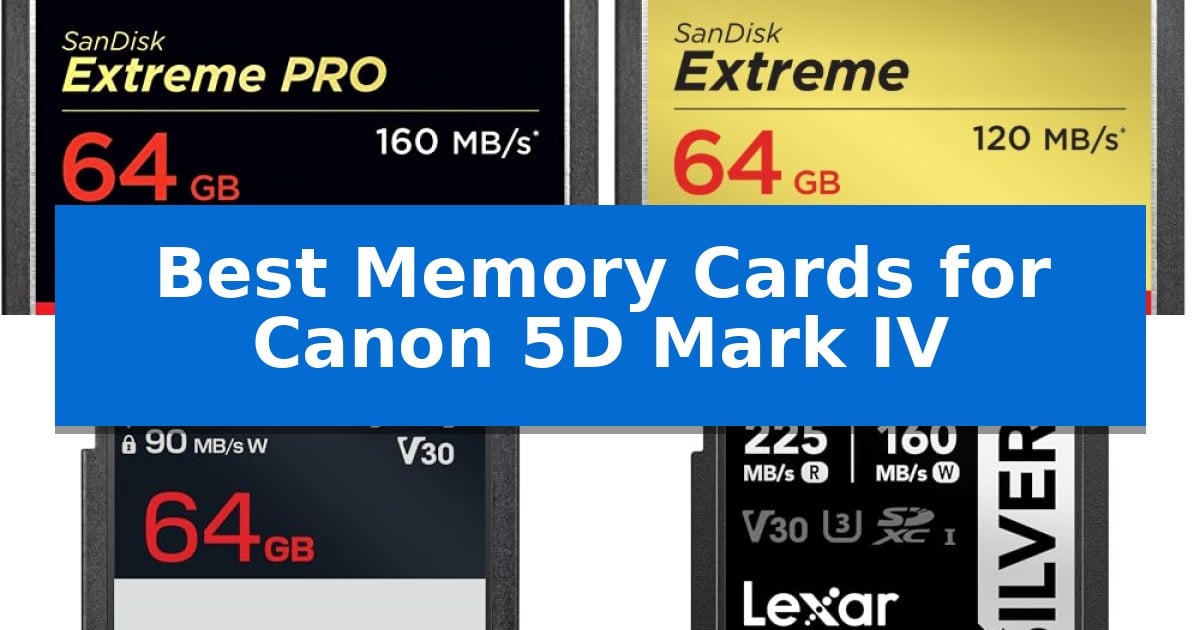
Selecting the right storage media is critical for maintaining the performance of your camera. The Best Memory Cards for Canon 5D Mark IV must support the specific interface requirements of this dual-slot system to ensure consistent write speeds during high-resolution burst shooting and 4K video recording.
Whether you prioritize the high-speed throughput of CompactFlash for intensive tasks or the versatility of SD cards for everyday workflows, choosing the correct card prevents data bottlenecks. This guide examines the technical specifications of available options to help you match your storage media with your specific shooting demands.
You may also want to compare Best Memory Cards for Camera Video, Best Memory Cards for Android Smartphones, and Best Memory Cards for Android Phones.
Best Memory Cards for Canon 5D Mark IV
Quick Comparison
| Product | Best For | Key Strength | Score |
|---|---|---|---|
| SANDISK Extreme PRO CompactFlash Memory Card | Best Overall | UDMA 7 interface for high-speed data transfer | 4.9 |
| SANDISK Extreme CompactFlash Memory Card | Reliable Professional Video Capture | VPG-20 certification ensures stable, sustained video recording. | 4.4 |
| SANDISK Extreme PRO SD Memory Card | High Speed UHS-I Workflow | V30 and U3 speed class ratings for consistent 4K UHD video capture. | 4.7 |
| LEXAR Silver SD Memory Card | Optimized for 4K Recording | V30 speed class supports high-quality 4K 60FPS video. | 4.3 |
| GIGASTONE 4K Camera Pro SD Card | Budget Friendly High Capacity | 256GB high-capacity storage for extensive shooting. | 4.3 |
How We Chose
- Interface Compatibility: Verifying support for UDMA 7 CompactFlash and UHS-I SD standards to ensure full camera functionality.
- Sustained Write Speeds: Evaluating cards based on their ability to handle high-bitrate video and rapid-fire RAW image bursts without buffer stalls.
- Reliability Standards: Assessing manufacturer-rated durability, including shock and temperature resistance for field usage.
- Workflow Efficiency: Comparing read speeds to determine how quickly files can be offloaded to post-production workstations.
- Capacity and Value: Reviewing storage density relative to the needs of professional photographers and videographers.
1 SANDISK Extreme PRO CompactFlash Memory Card — Fastest UDMA 7 Performance
Reliable data management is critical when shooting with the Canon 5D Mark IV, particularly when capturing high-resolution stills or cinema-quality video. The SANDISK 64GB Extreme PRO CompactFlash Memory Card utilizes UDMA 7 technology to ensure your camera's buffer clears efficiently, allowing for sustained performance during demanding shoots.
Engineered for professionals, this card features a Video Performance Guarantee (VPG-65), which maintains a minimum sustained write speed of 65MB/sec. This specification is essential for those relying on the camera's internal recording capabilities for 4K and Full HD video, preventing dropped frames during long takes.
Workflow efficiency is significantly improved by the card's 160MB/s read speed, which minimizes the time spent transferring large files to your workstation. Additionally, the 150MB/s write speed supports the high-speed burst requirements of the 5D Mark IV, ensuring you do not miss critical moments due to card latency.
Durability and peace of mind are built into the design, backed by a limited lifetime warranty. The package also includes a one-year offer for RescuePRO media recovery software, providing a safety net should you accidentally delete important files from your storage.
Best for: Professional photographers and videographers requiring consistent high-speed write performance for 4K video and rapid burst photography on the Canon 5D Mark IV.
Skip if: Users who do not require the high-speed performance of UDMA 7 or those who prefer a higher capacity card for extended multi-day shoots without offloading.
PROS
- UDMA 7 interface for high-speed data transfer
- VPG-65 certification for reliable 4K video recording
- 150MB/s write speed for rapid burst shooting
- Limited lifetime warranty for long-term reliability
CONS
- 64GB capacity may be limiting for long-duration 4K video projects
2 SANDISK Extreme CompactFlash Memory Card — Reliable Professional Video Capture
Capturing high-resolution imagery requires a storage medium capable of keeping pace with the camera's internal buffer, and the SANDISK 64GB Extreme CompactFlash Memory Card is engineered to meet these demands. Featuring UDMA 7 technology, this card provides the necessary throughput for professional workflows, ensuring that your camera remains responsive during intensive shooting sessions.
The card is built for reliability in demanding environments, utilizing an RTV silicone coating to provide enhanced protection against shock and vibration. This durable construction is verified through rigorous stress testing, offering peace of mind when working on location where equipment is subjected to physical movement.
For videographers, the inclusion of VPG-20 (Video Performance Guarantee) is a critical feature. This standard ensures a sustained data recording rate of at least 20MB/s, which is essential for maintaining a smooth, unbroken video stream without dropped frames. With read speeds reaching up to 120MB/s and write speeds up to 85MB/s, it balances rapid file transfers with stable recording performance.
When selecting storage for a high-performance camera, compatibility with the device's interface is paramount. This CompactFlash card is designed to integrate seamlessly with systems utilizing the UDMA 7 protocol, allowing users to maximize the burst-rate capabilities of their hardware while maintaining a secure, professional-grade recording environment.
Best for: Professional photographers and videographers who require reliable, high-speed sustained data recording for demanding field work.
Skip if: Users whose devices utilize SD or CFexpress card slots rather than the CompactFlash interface will need a different storage format.
PROS
- VPG-20 certification ensures stable, sustained video recording.
- UDMA 7 support enables fast read and write speeds.
- RTV silicone coating provides physical protection against shock and vibration.
CONS
- Limited to CompactFlash interface devices only.
3 SANDISK Extreme PRO SD Memory Card — High Speed UHS-I Workflow
Reliable data management is essential for the Canon 5D Mark IV, and the SANDISK 64GB Extreme PRO SD Memory Card provides the necessary throughput to handle high-resolution stills and 4K UHD video recording. Designed with UHS-I, V30, and U3 speed class ratings, this card ensures that your camera's buffer can clear effectively during demanding shooting sessions, allowing for consistent performance when capturing high-bitrate video or rapid-fire image sequences.
Beyond its core performance, this card is built to withstand challenging environments. It is engineered to be unrelentingly resilient, maintaining functionality even when subjected to rough handling or extreme conditions. This durability is a significant advantage for photographers who frequently work on location and require equipment that remains dependable over time, regardless of the shooting environment.
Workflow efficiency is further supported by the card's compatibility with the Sandisk Memory Zone desktop app. This tool simplifies the process of backing up, organizing, and transferring files, whether you are using a dedicated card reader or an integrated SD slot. With a lifetime limited warranty, it offers a long-term storage solution for professional and enthusiast workflows alike, ensuring that your data remains protected throughout the lifecycle of your camera gear.
Best for: Photographers and videographers using the Canon 5D Mark IV who require a durable, high-speed storage solution for 4K video and high-resolution photography.
Skip if: Users who require the extreme write speeds of UHS-II or CFexpress cards for high-speed continuous burst photography may find the UHS-I interface limiting.
PROS
- V30 and U3 speed class ratings for consistent 4K UHD video capture.
- Resilient design built to perform in extreme conditions.
- Simplified file management via the Sandisk Memory Zone desktop app.
- Backed by a lifetime limited warranty.
CONS
- UHS-I interface limits maximum transfer speeds compared to UHS-II alternatives.
4 LEXAR Silver SD Memory Card — Optimized for 4K Recording
Capturing high-resolution imagery and 4K video requires a reliable storage medium that can keep pace with the demands of the Canon 5D Mark IV. The LEXAR Silver SD Memory Card is engineered to support 4K 60FPS video recording with its V30 speed class rating, ensuring smooth data capture during intensive shooting sessions.
Beyond its video capabilities, this card features a 225MB/s max read speed, which significantly reduces wait times when transferring large files from the card to a computer. For photographers who need to clear their buffer quickly, the 160MB/s max write speed provides the necessary throughput to stay ready for the next shot without unnecessary delays.
Designed for versatility and resilience, the card offers extensive compatibility across various camera systems, including Canon, Sony, and Nikon. It is built to withstand challenging environments, featuring a durable construction that is wearproof, drop-proof, temperature-proof, x-ray-proof, shockproof, magnetic-proof, and vibration-resistant.
With a 256GB capacity, this memory card provides ample space for long-form video projects or extensive photo shoots. It is backed by a Lifetime Limited Warranty, reflecting the manufacturer's commitment to long-term reliability for professional photographers and enthusiasts alike.
Best for: Photographers and videographers who require reliable 4K video recording and fast file transfers for their Canon 5D Mark IV.
Skip if: Users who require higher-tier UHS-II or UHS-III speeds for burst-heavy professional sports photography or 8K raw video workflows.
PROS
- V30 speed class supports high-quality 4K 60FPS video.
- Fast 225MB/s read speeds for efficient file offloading.
- Comprehensive durability features including shock, temperature, and x-ray resistance.
- Lifetime Limited Warranty provides long-term peace of mind.
CONS
- UHS-I interface may limit performance in cameras designed specifically for faster UHS-II or UHS-III cards.
5 GIGASTONE 4K Camera Pro SD Card — Budget Friendly High Capacity
The GIGASTONE 4K Camera Pro SD Card provides a high-capacity storage solution for photographers who require reliable performance during extended shooting sessions. With its 256GB capacity, this card is designed to handle the large file sizes generated by high-resolution cameras, ensuring you spend less time swapping media.
Engineered for demanding environments, this card is waterproof, temperature-proof, x-ray-proof, shock-proof, and magnetic-proof. These physical protections help safeguard your data against common hazards encountered during field work or travel. It is fully compatible with 4K Ultra HD video recording, making it a functional choice for both still photography and videography.
The card supports data transfer speeds up to 170 MB/s, which aids in the efficient offloading of images to a computer. It is a full-sized SD card (32mm * 24mm), ensuring a secure fit in standard DSLR slots. The inclusion of a mini case provides a dedicated storage space for the card when it is not in use, helping to prevent loss or damage.
Backed by a 5-year limited warranty, this memory card offers long-term support for your equipment. It is suitable for a wide range of devices, including digital point-and-shoot cameras, HD camcorders, and DSLRs, providing a versatile option for various photography setups.
Best for: Photographers and videographers who need high-capacity, durable storage for 4K video and high-resolution image capture.
Skip if: Users who require specialized high-speed UHS-II or UHS-III cards for rapid-fire burst photography or cinema-grade raw video workflows.
PROS
- 256GB high-capacity storage for extensive shooting.
- Durable design with waterproof, shock-proof, and temperature-proof ratings.
- 5-year limited warranty for long-term reliability.
- Includes a protective mini case for safe transport.
CONS
- UHS-I interface may limit write speeds compared to higher-tier UHS-II cards.
- 170 MB/s transfer speed is dependent on compatible hardware.
Best Memory Cards for Canon 5D Mark IV Buying Guide
Understanding Memory Card Interfaces
The Canon 5D Mark IV features a dual-slot design, utilizing both a CompactFlash (CF) slot and an SD card slot. The CF slot is essential for maximum performance, particularly when utilizing UDMA 7 cards to clear the camera buffer quickly during continuous shooting.
The SD slot supports UHS-I speeds. While it is highly convenient for general photography, it is important to note that it will not reach the same peak write speeds as the CF slot. Understanding this hardware limitation is key to optimizing your camera setup.
The Importance of Video Speed Classes
For videographers, the Video Performance Guarantee (VPG) and V-class ratings are vital. These standards ensure a minimum sustained write speed, which is necessary to prevent dropped frames when recording 4K footage.
Cards rated V30 or higher are generally sufficient for the 5D Mark IV's video requirements. Always check for these specific markings to ensure your media can handle the sustained data stream required for high-quality video files.
Managing Workflow and Transfer Speeds
High read speeds are not just about camera performance; they are about time management. A card with a high read speed rating significantly reduces the time spent transferring large RAW files or 4K video clips to your computer.
Investing in a high-speed card reader that matches your card's interface is just as important as the card itself. Without a compatible reader, you may be bottlenecked by outdated hardware during your post-production workflow.
Durability and Data Integrity
Professional photography often takes place in unpredictable environments. Look for cards that are rated for shock, vibration, and temperature resistance to protect your data from physical damage.
Many professional-grade cards also include data recovery software offers. While this should not replace a robust backup strategy, it provides an additional layer of security for critical shoots.
Balancing Capacity and Reliability
Choosing the right capacity involves a trade-off between convenience and risk. While a single large-capacity card reduces the need for swaps, it also concentrates all your data in one place.
Many professionals prefer using multiple medium-capacity cards throughout a shoot. This practice minimizes the potential impact of a single card failure and helps keep your project files organized by session.
Frequently Asked Questions
Can I use an SD card for 4K video on the 5D Mark IV?
Yes, provided the SD card meets the necessary speed requirements, such as a V30 rating or higher, to handle the sustained write speeds required for 4K recording.
Does the 5D Mark IV support UHS-II SD cards?
The camera's SD slot is limited to UHS-I speeds. While UHS-II cards will function, they will operate at UHS-I performance levels, meaning you will not see the speed benefits of the UHS-II standard.
Why is my camera buffer filling up so quickly?
If your buffer fills during burst shooting, ensure you are using a high-speed UDMA 7 CompactFlash card in the primary slot, as this interface offers the fastest write performance for this camera.
Are all UDMA 7 cards the same?
No, performance varies significantly between models. Always check the specific read and write speed ratings provided by the manufacturer to ensure the card meets your specific shooting needs.
How often should I format my memory cards?
It is recommended to format your memory cards in-camera before every major shoot. This helps maintain the file system structure and reduces the risk of data corruption.
Conclusion: Our Top Pick
For photographers requiring the highest level of performance, the SANDISK Extreme PRO CompactFlash Memory Card stands out as the most reliable choice. Its UDMA 7 interface and VPG-65 certification ensure that it can handle the demanding write speeds required for 4K video and high-speed RAW bursts, making it an essential tool for professional workflows.
While other options offer excellent value for secondary storage or casual use, this card remains the standard for those who cannot afford to compromise on speed or reliability. Ensure your camera firmware is up to date to take full advantage of these high-performance specifications.