
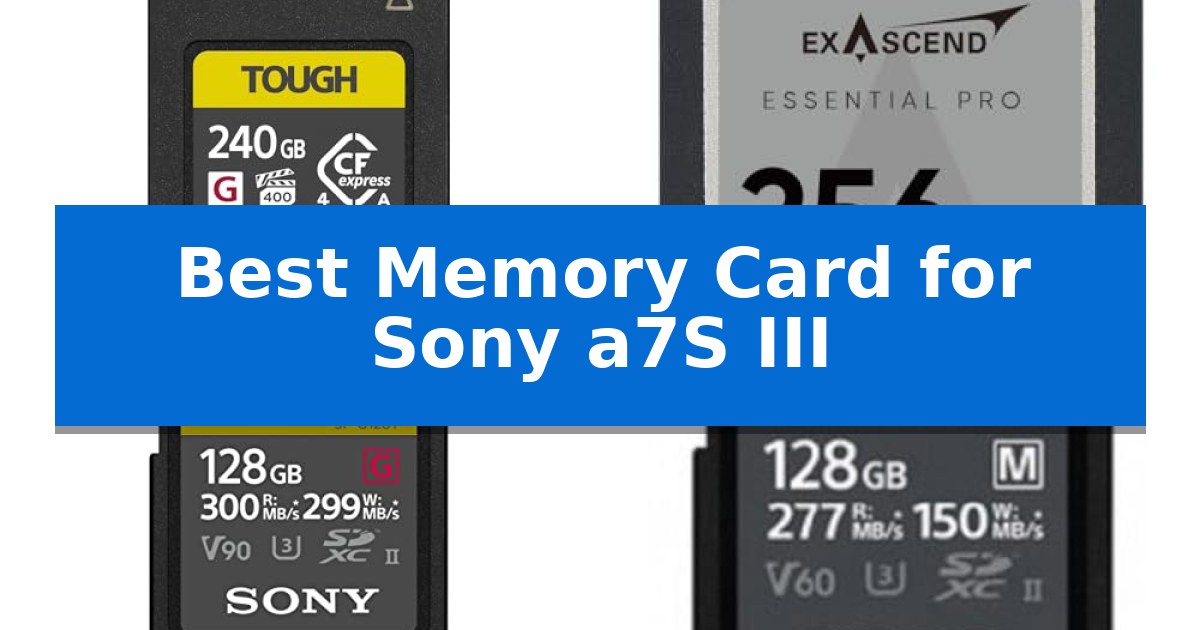
Selecting the right storage media for your camera is essential to maintaining the high-bitrate performance required for professional video production. The Best Memory Card for Sony a7S III must handle demanding data streams without dropping frames or overheating during extended recording sessions.
Whether you prioritize the extreme speed of CFexpress Type A cards for 4K/8K workflows or the versatile compatibility of UHS-II SD cards for everyday shooting, your choice directly impacts your camera's reliability. This guide evaluates top-tier options to help you match your storage to your specific production needs.
You may also want to compare Best Memory Card for Sony a7S II, Best Memory Card for Sony a7R III, and Best Memory Card for Sony a7R II.
Best Memory Card for Sony a7S III
Quick Comparison
| Product | Best For | Key Strength | Score |
|---|---|---|---|
| Sony CEA-G Series CFexpress Type A | Best Overall | VPG400 certification ensures reliable, high-bitrate video recording. | 4.9 |
| Exascend Essential Pro CFexpress Type A | Advanced Thermal Management | VPG400-certified for reliable 8K RAW recording. | 4.6 |
| Sony TOUGH-G SDXC UHS-II | Rugged Reliability for Professionals | One-piece molded construction offers extreme bend strength. | 4.8 |
| Sony TOUGH-M SDXC UHS-II | Balanced Speed and Durability | 18x stronger than standard UHS-II cards for enhanced physical durability. | 4.7 |
| Lexar SILVER PRO SDXC UHS-II | Efficient High-Speed Workflow | Blazing-fast transfer speeds up to 280MB/s read for efficient workflow. | 4.8 |
How We Chose
- Interface and Camera Compatibility
- Sustained Write Speeds for High-Bitrate Video
- Thermal Management and Stability
- Physical Durability and Build Quality
- Data Transfer Efficiency
1 Sony CEA-G Series CFexpress Type A — Unlocks Maximum Video Bitrates
Reliable high-bitrate recording for the Sony a7S III requires a storage medium capable of sustaining intense data demands without thermal throttling. The Sony CEA-G Series CFexpress Type A Memory Card CEA-G240T is engineered specifically to meet these requirements, utilizing PCIe Gen 4 technology to achieve read speeds up to 1800MB/s and write speeds up to 1700MB/s.
This card is built for professional workflows, featuring VPG400 certification which guarantees stable, high-bitrate video capture. Whether you are shooting in 4K or 8K, the card maintains consistent performance, preventing dropped frames during intensive write operations. The inclusion of enhanced heat dissipation technology ensures the card remains stable even during prolonged recording sessions.
Durability is a core design focus, with the card featuring a reinforced Tough construction. This physical design provides added resilience against the rigors of field production, making it a dependable choice for demanding environments. Its compact form factor is precision-engineered to fit the specific CFexpress Type A slots found in Sony Alpha cameras.
Choosing the right storage involves balancing capacity with the need for sustained throughput. By prioritizing stable high-bitrate recording and thermal management, this card minimizes the risk of data bottlenecks. It serves as a specialized tool for creators who require consistent, high-speed performance for their most critical video projects.
Best for: Professional videographers and creators using the Sony a7S III who require VPG400-certified, sustained high-bitrate recording for 4K/8K workflows.
Skip if: Casual shooters or photographers who do not require the extreme write speeds and thermal management of CFexpress Type A media, as more affordable SD card options may suffice.
PROS
- VPG400 certification ensures reliable, high-bitrate video recording.
- PCIe Gen 4 technology provides ultra-fast read and write speeds.
- Enhanced heat dissipation maintains stable performance during long shoots.
- Reinforced Tough construction offers increased physical durability.
CONS
- Higher cost compared to standard SD memory cards.
- Proprietary format limited to specific CFexpress Type A compatible devices.
2 Exascend Essential Pro CFexpress Type A — Advanced Thermal Management
The Exascend Essential Pro CFexpress Type A is engineered to meet the high-bandwidth requirements of professional cinematography, specifically supporting 8K RAW recording at 120 FPS. This card leverages VPG400-certification to ensure consistent write performance, preventing dropped frames during intensive data capture on high-resolution camera systems.
Performance is managed through proprietary SmartStream technology, which dynamically scales CPU frequency to optimize energy efficiency during operation. This is complemented by SuperCruise technology, a sustained performance-enhancing algorithm designed to handle critical memory tasks without compromising stability. These features ensure the card maintains its rated write speeds of up to 1,650 MB/s during demanding production workflows.
Thermal management is a priority for the Exascend Essential Pro CFexpress Type A, which incorporates trademark Adaptive Thermal Control technology. This system is designed to maintain stable performance even when the card is subjected to thermally demanding environments, protecting both the hardware and the integrity of the recorded data.
Compatibility is broad across the Sony ecosystem, including the a1, a7S III, A7 IV, FX3, and FX6. With read speeds reaching up to 1,800 MB/s, the card facilitates rapid offloading of large files to post-production workstations, streamlining the transition from set to edit.
Best for: Professional filmmakers and photographers using Sony camera systems who require sustained high-bitrate recording and reliable thermal management.
Skip if: Users who do not require the specific VPG400 performance tier or those using camera bodies that do not support the CFexpress Type A standard.
PROS
- VPG400-certified for reliable 8K RAW recording.
- Adaptive Thermal Control prevents performance throttling in hot environments.
- SmartStream technology optimizes power efficiency during high-load tasks.
- High-speed data transfer with read speeds up to 1,800 MB/s.
CONS
- Premium pricing associated with high-performance CFexpress Type A media.
3 Sony TOUGH-G SDXC UHS-II — Rugged Reliability for Professionals
The Sony TOUGH-G series SDXC UHS-II Card 128GB distinguishes itself through a unique one-piece molded construction that provides the world's highest level of bend strength, rated 18 times greater than the standard SD specification. This monolithic design eliminates traditional ribbing and the fragile write-protection switch, creating a sealed, durable housing that is IPX8 waterproof and IP6X dustproof.
Engineered for high-demand workflows, this card supports fast file transfers with read speeds up to 300 MB/s and write speeds up to 299 MB/s. These specifications make it a capable choice for 4K video recording and continuous burst mode shooting, ensuring data is captured and cleared efficiently. The card is fully UHS-II, Class 10, and U3 compliant, providing the necessary throughput for high-bitrate video formats.
Versatility is maintained through backward compatibility with UHS-I equipment, though users should note that performance will be limited to 95 MB/s read and 90 MB/s write speeds in non-UHS-II devices. The card is built to operate across a wide temperature range, from -13℉ to +185℉, allowing for reliable use in diverse environmental conditions.
With a 128GB capacity, this storage medium offers a balance of space and speed for professional photographers and videographers. The absence of a write-protection switch removes a common point of failure, reinforcing the card's focus on structural integrity and long-term reliability in the field.
Best for: Professional photographers and videographers requiring high-speed, durable storage for 4K recording and burst shooting.
Skip if: Users who prefer a physical write-protection switch or those using older equipment that cannot leverage UHS-II performance benefits.
PROS
- One-piece molded construction offers extreme bend strength.
- IPX8 waterproof and IP6X dustproof rating for environmental protection.
- High-speed performance with 300 MB/s read and 299 MB/s write speeds.
- Ribless, switchless design eliminates common physical failure points.
CONS
- No physical write-protection switch may be a limitation for some workflows.
- UHS-I compatibility results in significantly reduced transfer speeds.
4 Sony TOUGH-M SDXC UHS-II — Balanced Speed and Durability
Reliability in the field is paramount when capturing high-bitrate footage, and the Sony TOUGH-M series SDXC UHS-II Card 128GB is engineered to withstand demanding environments. Featuring a specialized Toughness design, this card is rated to be 18x stronger than standard UHS-II cards, providing a robust physical foundation for your data. This structural integrity is essential for photographers and videographers who frequently operate in unpredictable outdoor conditions where equipment is prone to accidental drops or physical stress.
For videographers using the Sony a7S III, this card offers a balance of speed and resilience. It supports 4K video recording and delivers read speeds up to 277MB/s alongside write speeds up to 150MB/s. These specifications ensure efficient data transfer from the camera to your post-production workflow, allowing for faster offloading of large video files. The card is designed to handle the data throughput required for high-quality video capture while maintaining consistent performance.
Beyond internal performance, the card is built for environmental protection. It carries an IPX8 waterproof and IPX6 dustproof rating, which helps protect stored media from accidental exposure to the elements during outdoor shoots. This level of environmental sealing provides peace of mind when shooting in rain, near water, or in dusty environments. This durability is backed by a five-year limited warranty, reflecting the manufacturer's commitment to the card's long-term reliability.
While the card provides high-speed capabilities suitable for many recording modes, it is important to verify that your specific bitrate settings align with the card's V60 class rating. This ensures consistent performance during long-form recording sessions. Users should confirm their camera's required write speed for specific codecs to ensure this card meets their workflow demands.
Best for: Photographers and videographers who prioritize physical durability and reliable data protection in challenging outdoor environments.
Skip if: Users who require the absolute fastest write speeds for high-frame-rate RAW video recording may need a V90-rated card instead.
PROS
- 18x stronger than standard UHS-II cards for enhanced physical durability.
- IPX8 waterproof and IPX6 dustproof ratings for environmental protection.
- Reliable 4K video recording support.
- Includes a five-year limited warranty.
CONS
- V60 speed class may not meet the requirements for the highest bitrate recording modes on all cameras.
5 Lexar SILVER PRO SDXC UHS-II — Efficient High-Speed Workflow
Capturing high-resolution video requires storage that can keep pace with the demanding bitrate of the Sony a7S III, and the Lexar 128GB 2-Pack SILVER PRO SD Card is engineered to meet these requirements. By utilizing the UHS-II interface, this card supports the sustained data rates necessary for 4K UHD and Full-HD recording, ensuring your footage remains free from dropped frames or buffering during long takes.
Beyond its recording capabilities, the Lexar SILVER PRO SDXC UHS-II significantly reduces downtime during post-production. With blazing-fast transfer speeds of up to 280MB/s read and 120MB/s write, offloading large video files and high-resolution photo bursts to your workstation happens in seconds rather than minutes. This efficiency is a critical asset for creators managing tight deadlines.
The design prioritizes both reliability and versatility. These cards are rigorously tested for performance across various mirrorless cameras and are backwards-compatible with UHS-I devices, allowing them to function seamlessly even if you use older hardware or standard card readers. The inclusion of a lifetime limited warranty and access to the free Lexar Recovery Tool provides long-term peace of mind for your data.
Choosing this 2-pack offers a practical advantage for professional workflows, providing redundant storage or the ability to swap cards quickly in the field. While these cards excel at high-speed capture, they are specifically optimized for users who require a balance of high-capacity storage and rapid file offloading to maintain a consistent creative pace.
Best for: Professional videographers and photographers using the Sony a7S III who require reliable, high-speed storage for 4K recording and rapid file transfers.
Skip if: Users who do not require UHS-II speeds or those who prefer a single, higher-capacity card rather than a 2-pack configuration.
PROS
- Blazing-fast transfer speeds up to 280MB/s read for efficient workflow.
- UHS-II interface ensures stable 4K UHD and Full-HD video capture.
- Backwards-compatible with UHS-I devices for broad hardware support.
- Includes a lifetime limited warranty and data recovery software.
CONS
- 2-pack configuration may not suit users looking for a single high-capacity card.
- Performance benefits are optimized for UHS-II compatible slots.
Best Memory Card for Sony a7S III Buying Guide
Understanding Card Interfaces
The Sony a7S III supports two distinct card types: CFexpress Type A and UHS-II SDXC. CFexpress Type A is necessary for accessing the camera's highest-bitrate recording modes, offering significantly faster data throughput than traditional SD cards.
Conversely, UHS-II SDXC cards provide a more cost-effective solution for standard 4K recording and photography. Understanding which format your specific project requires is the first step in optimizing your camera's performance.
Sustained Write Performance
For video, sustained write speed is more critical than peak burst speeds. A card must maintain a consistent data rate to prevent the camera's buffer from filling up, which would otherwise lead to interrupted recordings.
Look for VPG400 certification or similar ratings, which guarantee a minimum sustained write speed. This ensures that your camera can handle high-resolution, high-frame-rate footage without dropping frames.
Thermal Management
High-bitrate recording generates significant heat, which can cause some memory cards to throttle performance or fail entirely. Cards featuring advanced thermal management or reinforced construction are better equipped to dissipate heat during long shoots.
If you frequently record in hot environments or perform long-form interviews, prioritizing a card with robust heat dissipation technology is a vital safeguard for your footage.
Durability and Reliability
Professional field work often exposes gear to harsh conditions. Many modern cards now feature one-piece molded construction and IPX8-rated waterproofing to protect against drops, dust, and moisture.
Choosing a card with rugged build quality minimizes the risk of physical damage to the internal components, providing peace of mind when working in unpredictable outdoor locations.
Workflow Efficiency
The speed of your memory card also dictates how quickly you can offload footage to your computer. High-speed cards with fast read capabilities drastically reduce the time spent waiting for large files to transfer during post-production.
Investing in cards that support next-gen PCIe Gen 4 technology or high-speed UHS-II standards can significantly accelerate your entire editing workflow, allowing for faster turnaround times.
Frequently Asked Questions
Do I need a CFexpress Type A card for all video modes?
No, CFexpress Type A is only required for specific high-bitrate recording modes. Many standard 4K formats can be recorded on high-speed UHS-II SD cards.
What does VPG400 certification mean?
VPG400 stands for Video Performance Guarantee 400, ensuring a minimum sustained write speed of 400MB/s, which is essential for stable high-bitrate video capture.
Are UHS-II cards compatible with older SD slots?
Yes, UHS-II cards are backward compatible with UHS-I equipment, though they will operate at the slower speeds of the older interface.
How does thermal management affect recording?
Effective thermal management prevents the card from overheating, which helps maintain consistent write speeds and prevents recording failures during long sessions.
Is a rugged card necessary for studio work?
While rugged cards are ideal for field use, their durability features also provide an extra layer of protection against accidental drops or spills in a studio environment.
Conclusion: Our Top Pick
For users demanding the highest level of performance, the Sony CEA-G Series CFexpress Type A stands out as the most reliable choice. Its integration of PCIe Gen 4 technology and VPG400 certification ensures that you can utilize the full potential of your camera's high-bitrate recording capabilities without the risk of dropped frames.
While other options like the Exascend Essential Pro offer excellent thermal management for specific use cases, the Sony CEA-G Series remains the benchmark for consistent, high-speed performance. It is the ideal investment for professionals who require a dependable, high-capacity solution for demanding 4K and 8K workflows.