
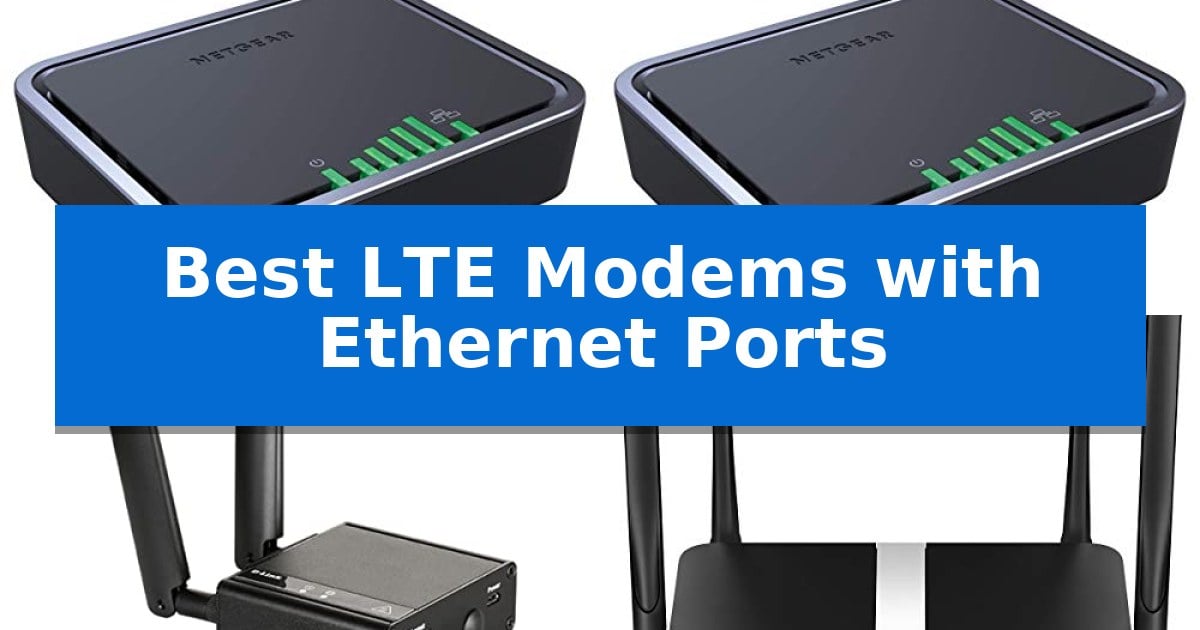
Finding a dependable internet connection in remote areas or ensuring your business stays online during broadband outages is a common challenge. Best LTE Modems with Ethernet Ports provide a robust solution by converting cellular signals into a wired connection, allowing you to integrate mobile data seamlessly into your existing network infrastructure.
Whether you need a primary connection for a rural home or a failover system for critical business operations, these devices offer the flexibility and stability required for modern connectivity. We have analyzed the current market to help you identify the right hardware for your specific networking needs.
You may also want to compare Best LTE Modem for Raspberry Pi, Best LTE Laptops, and Best LTE Hunting Cameras.
Best LTE Modems with Ethernet Ports
Quick Comparison
| Product | Best For | Key Strength | Score |
|---|---|---|---|
| NETGEAR LB2120 4G LTE Modem | Best Overall | Automatic 4G LTE failover for continuous connectivity. | 4.9 |
| NETGEAR LB1120 4G LTE Modem | Best for Rural Internet Access | Ethernet connectivity allows for easy integration with existing home routers. | 4.8 |
| D-Link DWM-311 4G LTE Modem | Durable Choice for Industrial Use | Industrial-grade durability with a zinc-plated steel case and wide temperature tolerance. | 4.4 |
| Cudy LT500 4G LTE Router | Flexible Setup for Home Networks | Versatile connectivity with support for Cellular, WISP, and standard Wi-Fi router modes. | 4.3 |
| Peplink MAX BR1 Mini LTE Router | Secure Option for Telemetry | Strict security compliance via the exclusion of Wi-Fi and GPS. | 4.9 |
How We Chose
- Carrier compatibility and support for local LTE bands.
- Data throughput capabilities and fallback support for 3G networks.
- Physical interface options, specifically the number and speed of Ethernet ports.
- Environmental durability and mounting options for industrial or remote use.
- Security features and management capabilities for professional or home network integration.
1 NETGEAR LB2120 4G LTE Modem — Reliable Wired Broadband Failover
Maintaining a consistent network connection requires a reliable failover solution, especially when primary broadband services are prone to interruptions. The NETGEAR 4G LTE Modem with Two Gigabit Ethernet Ports (LB2120) serves as a dedicated bridge, providing an automatic 4G LTE connection that ensures your local network stays active even when your main internet source fails.
Designed for versatility, this modem features two built-in Gigabit WAN ports, allowing for a straightforward connection to your existing router, switch, or computer. It supports 4G LTE speeds up to 150 Mbps for downloads and 50 Mbps for uploads, with built-in 4G to 3G fallback support to maintain connectivity in areas with varying signal strength.
The hardware is optimized for flexibility in deployment. It includes two TS-9 connectors, which allow users to attach optional 4G/3G antennas to improve signal reception in challenging environments. Measuring just 4.7 inches in length and 3.9 inches in width, the compact chassis fits easily into existing hardware setups without requiring significant shelf space.
Compatibility is focused on the U.S. market, working with any GSM carrier, including AT&T and T-Mobile. It is important to note that this device is not compatible with Verizon or Sprint networks. By acting as a secondary gateway, it provides a practical way to safeguard your home or office against unexpected broadband outages.
Best for: Users requiring a reliable, automatic 4G LTE failover connection for their existing wired network equipment.
Skip if: Users who rely on Verizon or Sprint networks, as this device is not compatible with those carriers.
PROS
- Automatic 4G LTE failover for continuous connectivity.
- Two Gigabit WAN ports for easy integration with routers or switches.
- TS-9 antenna connectors to improve signal performance.
- Compact design that fits easily into small spaces.
CONS
- Incompatible with Verizon and Sprint networks.
- Limited to U.S. carrier use only.
2 NETGEAR LB1120 4G LTE Modem — Best for Rural Internet Access
Reliable connectivity in areas lacking robust broadband infrastructure is often a challenge, and the NETGEAR 4G LTE Broadband Modem (LB1120) addresses this by providing a dedicated bridge to cellular networks. By functioning as a primary internet gateway, this device allows users to bypass traditional cable or fiber limitations in rural or underserved locations.
The NETGEAR LB1120 4G LTE Modem is designed for straightforward integration into existing home networks. It features an Ethernet port that connects directly to a Wi-Fi router, enabling the distribution of the LTE-sourced connection to all wired and wireless devices in the home. This setup effectively turns a cellular signal into a localized network hub.
Flexibility is a core component of its design, as the unit is an unlocked device compatible with various Micro-SIM cards. It supports LTE Category 4 connectivity across bands 2, 4, 5, and 12, as well as 3G UMTS bands 2 and 5, providing a range of frequency support for different service environments.
Measuring just 4.7 by 3.9 by 1.2 inches and weighing only 0.4 pounds, the modem maintains a compact footprint that fits easily into small spaces. Its design prioritizes utility for those who require a consistent, hardware-based solution for their primary internet connection needs.
Best for: Rural or remote households needing to convert a cellular LTE signal into a wired or Wi-Fi network for multiple devices.
Skip if: Users who have access to high-speed fiber or cable broadband, or those located in areas with poor cellular signal strength.
PROS
- Ethernet connectivity allows for easy integration with existing home routers.
- Unlocked SIM slot provides flexibility to choose different mobile service providers.
- Compact, lightweight design ensures easy placement in any home environment.
- Serves as a reliable primary connection in regions without standard broadband.
CONS
- Limited to LTE Category 4 speeds, which may not match modern fiber performance.
- Signal dependency means connectivity is restricted by local cellular tower coverage.
3 D-Link DWM-311 4G LTE Modem — Durable Choice for Industrial Use
The D-Link DWM-311 4G LTE Modem is engineered for industrial-grade reliability, featuring a zinc-plated steel case that resists corrosion and allows for operation in harsh environments ranging from -30 to 60 °C. This compact device is designed for seamless integration into M2M applications, including vending machines, ATMs, and digital signage, where consistent connectivity is a requirement.
Equipped with a 10/100/1000Mbps Ethernet port, this modem provides high-speed local network connectivity while utilizing a micro-SIM 3FF slot to access 4G LTE networks. It is an unlocked, carrier-certified solution compatible with major providers like Verizon, AT&T, and T-Mobile, offering flexibility for various deployment scenarios.
For professional environments, the unit supports remote centralized management through the optional D-ECS cloud platform. This system enables zero-touch deployment, automated failure detection, and scheduled firmware upgrades, which simplifies the maintenance of large-scale network nodes across smart retail or industrial factory settings.
The device is built for versatility, supporting wall or DIN-rail mounting to suit constrained spaces. While it offers robust features for remote monitoring and industrial durability, users should note that it relies on a micro-USB connector for power, which may require specific power management planning in permanent installations.
Best for: Industrial and M2M applications requiring a durable, remotely managed 4G LTE bridge for remote sites or backup connectivity.
Skip if: Users seeking a consumer-grade Wi-Fi hotspot or a battery-powered portable modem will find this wired, industrial-focused bridge unsuitable for their needs.
PROS
- Industrial-grade durability with a zinc-plated steel case and wide temperature tolerance.
- Carrier-certified and unlocked for compatibility with major networks.
- Remote management capabilities via the D-ECS platform for large-scale deployments.
- Compact form factor supporting flexible wall or DIN-rail mounting.
CONS
- Limited to micro-USB power, which may be less convenient than standard barrel-jack industrial power supplies.
- Requires optional cloud platform for advanced management features like zero-touch deployment.
4 Cudy LT500 4G LTE Router — Flexible Setup for Home Networks
Reliable network connectivity in remote or temporary locations often requires hardware that bridges cellular signals with standard wired infrastructure. The Cudy LT500 4G LTE Router addresses this need by integrating a Nano SIM slot for Cat 4 LTE connectivity, capable of download speeds up to 150 Mbps, directly into a versatile networking hub.
Designed for flexibility, this device functions as a cellular router, standard Wi-Fi router, or WISP bridge. It features four 10/100 Mbps Ethernet ports, one of which is configurable as a WAN/LAN interface, allowing for direct wired connections to computers, printers, or local switches. This hardware configuration ensures that users can maintain a stable internet connection even when traditional broadband is unavailable.
The router supports AC1200 Dual-Band Wi-Fi, providing 867 Mbps on the 5 GHz band and 300 Mbps on 2.4 GHz. With integrated MU-MIMO and beamforming technology, it is engineered to support up to 128 connected devices, with 40 recommended for optimal performance. Coverage extends up to 427 feet in open spaces, making it suitable for medium-sized environments or temporary setups like RVs.
Security and management are handled through built-in VPN client and server support, including protocols such as WireGuard, OpenVPN, and IPsec. Users can manage the network remotely via the Cudy App or cloud control. Furthermore, the device supports Cudy Mesh for network expansion and includes WAN/WISP/4G failover capabilities to ensure continuous uptime by automatically switching between connection sources.
Best for: Users needing a flexible, multi-mode cellular router for home, RV, or temporary setups that require both Wi-Fi and wired Ethernet connectivity.
Skip if: Users requiring Gigabit Ethernet speeds or high-speed 5G cellular connectivity will find the 10/100 Mbps ports and Cat 4 LTE limitations insufficient.
PROS
- Versatile connectivity with support for Cellular, WISP, and standard Wi-Fi router modes.
- Integrated VPN support including WireGuard and OpenVPN for secure remote access.
- Flexible failover options that automatically switch between WAN, WISP, and 4G sources.
- Easy remote management via the Cudy App and cloud-based control interface.
CONS
- Limited Ethernet speed restricted to 10/100 Mbps ports.
- Cat 4 LTE hardware limits maximum cellular download speeds to 150 Mbps.
5 Peplink MAX BR1 Mini LTE Router — Secure Option for Telemetry
The Peplink Cellular Router MAX BR1 Mini Core is engineered for specialized telemetry and remote connectivity, featuring a low-profile form factor and Class 1 Division 2 certified roughness to withstand demanding operating environments. By intentionally excluding Wi-Fi and GPS interfaces, this device minimizes its attack surface, prioritizing strict security compliance for sensitive industrial or teleoperation deployments.
Equipped with a CAT-4 embedded cellular modem and redundant SIM slots, the router provides reliable connectivity across a wide range of LTE and 3G bands, including support for major US carriers like AT&T, FirstNet, T-Mobile, and Verizon. It delivers a 300 Mbps router throughput and is capable of supporting 1 to 60 users, making it a robust choice for localized network management where wired infrastructure is unavailable.
The hardware interface includes 3x 10/100/1000M Ethernet LAN ports. With the addition of a PrimeCare or one-off feature pack license, the third LAN port can be reconfigured as a Gigabit Ethernet WAN port, offering flexibility for failover or primary connection setups. This modular approach to port configuration ensures the device adapts to specific network architecture requirements.
Designed for long-term operation, the unit functions within a wide operating temperature range, ensuring stability in environments where standard consumer hardware might fail. Its combination of high-speed cellular data rates—up to 150 Mbps downlink and 50 Mbps uplink—and secure, hardened design makes it a focused solution for professional telemetry applications.
Best for: Industrial telemetry and secure remote connectivity applications requiring reliable LTE failover and hardened hardware.
Skip if: Users who require built-in Wi-Fi, GPS tracking, or a consumer-grade router with a simple plug-and-play interface.
PROS
- Strict security compliance via the exclusion of Wi-Fi and GPS.
- Class 1 Division 2 certification for use in hazardous or rugged environments.
- Redundant SIM slots for improved network uptime.
- Configurable Ethernet ports for flexible WAN/LAN deployment.
CONS
- No integrated Wi-Fi or GPS capabilities.
- Requires additional licensing to unlock WAN port functionality.
Best LTE Modems with Ethernet Ports Buying Guide
Understanding LTE Categories and Speed
The LTE category of a modem determines its maximum theoretical download and upload speeds. Most standard industrial and home modems fall into Category 4, which typically supports up to 150 Mbps download and 50 Mbps upload speeds. This is generally sufficient for standard web browsing, email, and moderate media streaming.
When selecting a device, ensure the category matches your bandwidth requirements. While higher categories exist, they often require specific carrier support and signal conditions to reach their potential, making Cat 4 a reliable baseline for most stable, long-term installations.
The Importance of Ethernet Connectivity
The inclusion of an Ethernet port is what distinguishes these modems from simple USB dongles. A Gigabit Ethernet port allows you to connect the modem directly to a high-performance router, switch, or computer, ensuring that the cellular signal is distributed effectively throughout your local network.
For failover applications, look for models with dedicated WAN ports. This allows your router to automatically switch from your primary wired broadband to the LTE modem the moment a service interruption is detected, maintaining continuous uptime for your connected devices.
Carrier Compatibility and SIM Requirements
Not all LTE modems are compatible with every carrier. It is essential to verify that the device supports the specific frequency bands used by your service provider in your area. Some devices are locked to specific carriers, while others are unlocked and allow for greater flexibility.
Always check the SIM card size requirements, as modern modems may use Nano-SIM or Micro-SIM slots. Using an incompatible SIM size or a carrier that does not support the modem's radio bands will result in poor performance or a complete lack of connectivity.
Environmental Considerations and Durability
If you are installing a modem in an industrial setting, such as a vending machine, remote kiosk, or outdoor enclosure, the physical build quality is paramount. Look for devices with metal housings and wide operating temperature ranges to ensure they can withstand harsh conditions.
Mounting options, such as DIN-rail or wall-mount capabilities, can significantly simplify the installation process. A device designed for industrial use will often include features that prevent corrosion and ensure stable operation in environments where consumer-grade equipment might fail.
Security and Remote Management
For business or telemetry applications, security is a non-negotiable requirement. Features such as VPN support, firewall configuration, and the ability to disable unnecessary interfaces help reduce the attack surface and protect your network from unauthorized access.
Remote management platforms allow administrators to monitor network status, perform firmware updates, and troubleshoot issues without needing to be physically present at the site. This is particularly valuable for large-scale deployments where manual maintenance is impractical.
Frequently Asked Questions
Can I use these modems with any cellular carrier?
Compatibility depends on the specific model and the frequency bands it supports. Always check the manufacturer's specifications to ensure the device is compatible with the bands used by your preferred carrier.
What is the difference between a modem and a router?
A modem converts the cellular signal into a data stream, while a router distributes that data to multiple devices. Some products in this list are combination units that act as both, while others are dedicated modems intended to be paired with an existing router.
Do these modems require an external antenna?
Many models include internal antennas, but some provide external connectors (such as TS-9 or SMA) to allow for the attachment of high-gain antennas. This is highly recommended if you are in an area with weak cellular signal strength.
Are these devices suitable for home use?
Yes, many of these modems are designed for home use, especially in rural areas where traditional cable or fiber broadband is unavailable. They can provide a stable primary connection for your home network.
How do I set up a failover connection?
To set up a failover, you typically connect the LTE modem to the WAN port of your primary router. You then configure your router's settings to prioritize your main connection and automatically switch to the LTE modem when the primary connection goes down.
Conclusion: Our Top Pick
Choosing the right LTE modem depends heavily on your specific environment, whether you are securing a remote industrial site or ensuring your home office stays connected during outages. The NETGEAR LB2120 4G LTE Modem stands out as a versatile choice for those needing a reliable failover solution, thanks to its dual Gigabit Ethernet ports and simple integration with existing routers.
While this device excels in providing a stable backup, always verify your local carrier's band support before purchasing. If your needs involve specialized industrial telemetry or extreme environmental conditions, consider the more ruggedized options listed above to ensure long-term performance and durability.