
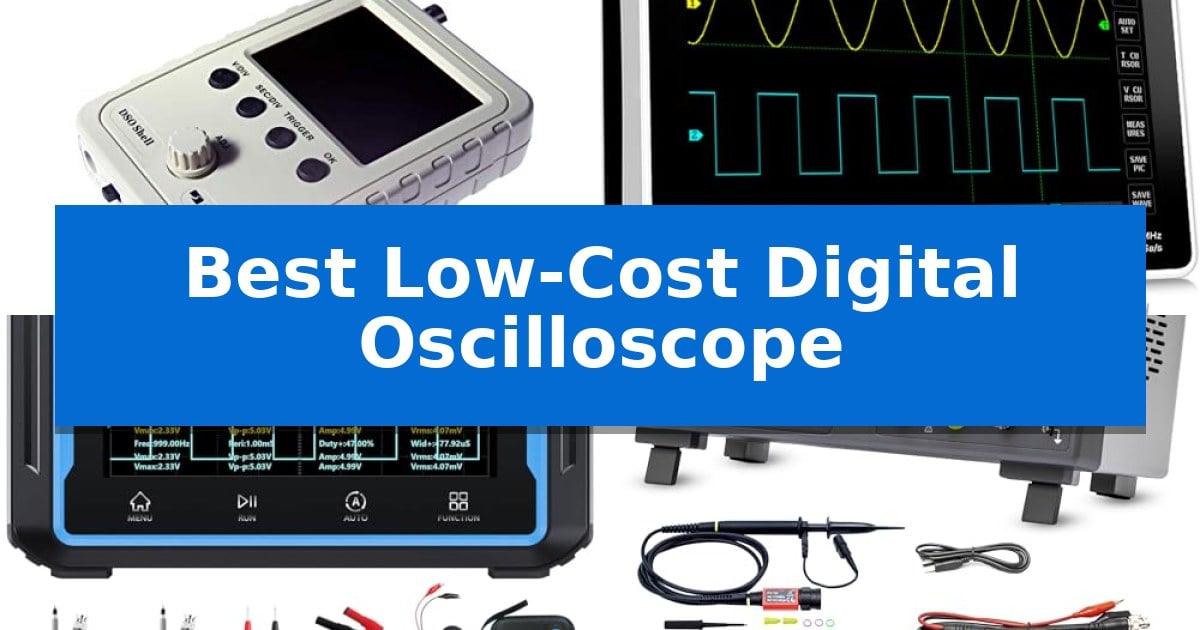
Finding the right diagnostic equipment for electronics projects does not have to break your budget. Whether you are troubleshooting circuit boards or analyzing periodic signals, selecting the Best Low-Cost Digital Oscilloscope requires balancing your specific bandwidth needs with the physical constraints of your workspace.
Our guide focuses on identifying reliable instruments that provide clear waveform visualization and essential trigger functions. By examining the trade-offs between portable, battery-operated units and stationary benchtop devices, we help you choose a tool that fits your technical requirements and your project bench.
You may also want to compare Best Low-Cost Digital Multimeters with Continuity, Best Low-Cost Digital Microscopes, and Best Low-Cost Digital Cameras.
Best Low-Cost Digital Oscilloscope
Quick Comparison
| Product | Best For | Key Strength | Score |
|---|---|---|---|
| JYETech DSO150 Portable Oscilloscope | Best Overall | Fully assembled design saves time and avoids complex setup. | 4.9 |
| FNIRSI 1013D Plus Oscilloscope | Best touchscreen portable value | Intuitive 7-inch capacitive touchscreen with gesture controls. | 4.7 |
| FNIRSI 2C53P 3-in-1 Oscilloscope | Versatile all-in-one diagnostic tool | 3-in-1 functionality combining an oscilloscope, multimeter, and signal generator. | 4.7 |
| Hantek DSO2C10 Digital Oscilloscope | Reliable benchtop performance | 100MHz bandwidth and 1GSa/s sampling rate for precise signal capture. | 4.7 |
| Siglent SDS1202X-E Digital Oscilloscope | High-precision hobbyist standard | High-speed sampling up to 1 GSa/s for accurate signal capture. | 4.5 |
How We Chose
- Bandwidth and sampling rate capabilities for signal accuracy.
- Display clarity and user interface responsiveness.
- Portability, including battery life and physical footprint.
- Integration of additional tools like multimeters or signal generators.
- Ease of setup and accessibility of probe connections.
1 JYETech DSO150 Portable Oscilloscope — Ultra-affordable entry-level choice
The NooElec JYETech DSO150 Portable Oscilloscope simplifies bench testing by arriving fully assembled with an included enclosure and a 1x/10x BNC probe, allowing users to begin signal analysis immediately upon connecting a power source. This compact device features a 2.4-inch color TFT LCD that provides a clear visual interface for monitoring waveforms in a portable form factor.
Engineered as an evolution of the DSO138, the DSO150 incorporates significant refinements in its internal structure, mechanics, and overall operation. It is designed to be highly accessible for hobbyists and technicians who require a functional, low-cost digital storage oscilloscope without the complexity of building a kit from scratch.
Power management is straightforward, utilizing a standard 5.5mm/2.1mm DC power jack that accepts a 9V supply. For added flexibility in various project environments, the mainboard also includes an alternative 2-pin connector with 0.1-inch pitch, ensuring compatibility with diverse power sources while maintaining a strict operating limit of no more than 10V.
While this unit offers a practical entry point into digital signal observation, users must ensure they have a compatible 9V power supply on hand, as it is not included in the package. Its compact dimensions and integrated design make it a suitable tool for those who prioritize portability and ease of use in their electronics workspace.
Best for: Electronics hobbyists and students who need a pre-assembled, portable, and budget-friendly tool for basic signal monitoring.
Skip if: Professionals requiring high-bandwidth performance, advanced triggering, or multi-channel analysis will find the single-channel, entry-level capabilities of this device insufficient.
PROS
- Fully assembled design saves time and avoids complex setup.
- Includes essential 1x/10x BNC probe and protective enclosure.
- Clear 2.4-inch color TFT LCD for easy waveform viewing.
- Flexible power options via DC jack or 2-pin connector.
CONS
- Power supply not included in the package.
- Strict 10V maximum input voltage limitation for power.
2 FNIRSI 1013D Plus Oscilloscope — Best touchscreen portable value
Navigating circuit diagnostics and automotive repairs requires a reliable visual reference, and the FNIRSI 1013D Plus Oscilloscope simplifies this with a responsive 7-inch capacitive touchscreen. This interface allows for intuitive gesture-based operation, enabling users to zoom, move, and inspect waveforms directly on the high-contrast display without relying on complex physical knobs or background scale calculations.
Engineered for versatility, this 2-channel oscilloscope delivers a 1 GSa/s sampling rate and 100 MHz bandwidth, making it suitable for both periodic analog signals and aperiodic digital signals. The device includes a built-in high-voltage protection module capable of tolerating continuous voltages up to 400V, which is particularly beneficial for automotive and circuit repair environments where voltage spikes can occur.
Portability is a core design focus, as the unit features an ultra-thin profile and an integrated 6000 mAh lithium battery that provides up to 4 hours of continuous operation. For documentation and analysis, the Waveform Image Manager utilizes 1 GB of internal storage, allowing users to save and browse up to 1000 screenshots and waveform data sets directly on the device.
Advanced diagnostic capabilities are supported through specialized modes, including Lissajous graphic display for comparing signal phase and frequency, as well as an FFT viewing function for estimating harmonic content. These features provide a comprehensive toolset for engineers and technicians seeking a compact, all-in-one solution for signal analysis.
Best for: Technicians and hobbyists needing a portable, touchscreen-based oscilloscope for automotive and general circuit troubleshooting.
Skip if: Users requiring advanced laboratory-grade signal processing, deep memory buffers, or specialized PC-based analysis software may find this standalone unit limiting.
PROS
- Intuitive 7-inch capacitive touchscreen with gesture controls.
- Integrated 6000 mAh battery for portable field use.
- High-voltage protection up to 400V for safer circuit testing.
- Built-in 1 GB storage for waveform and screenshot management.
CONS
- Limited battery life of 4 hours may require frequent recharging during long sessions.
- Standalone interface lacks the advanced connectivity options found in PC-tethered bench models.
3 FNIRSI 2C53P 3-in-1 Oscilloscope — Versatile all-in-one diagnostic tool
The FNIRSI 2C53P 3-in-1 Oscilloscope integrates a 50MHz, 2-channel digital oscilloscope, a 19999-count multimeter, and a 10MHz DDS signal generator into a single handheld device. This combination allows for versatile diagnostic work, supported by a 4.3-inch IPS touchscreen that provides a 480*272 resolution for clear signal visualization.
Engineered for efficiency, the device features a one-key AUTO function to simplify measurement processes for both periodic analog and non-periodic digital signals. The hardware architecture, utilizing an FPGA+MCU+ADC structure, ensures reliable waveform capture. Users can utilize the X-Y mode for phase, amplitude, and frequency comparisons, or employ FFT spectrum analysis to assess harmonic content.
Designed for portability and field use, the unit is powered by a built-in 4000 mAh lithium battery, which provides approximately 4 hours of operation. It supports charging via a Type-C interface, facilitating convenient power management during extended diagnostic sessions.
The FNIRSI 2C53P 3-in-1 Oscilloscope includes waveform preservation and export capabilities, allowing for detailed post-analysis of captured data. With its compact dimensions of roughly 8cm x 3cm x 2cm, it serves as a space-saving solution for technicians who require multiple testing instruments in a single, portable form factor.
Best for: Technicians and hobbyists who need a compact, all-in-one tool for basic signal analysis, voltage measurement, and waveform generation.
Skip if: Users requiring high-bandwidth professional analysis, deep memory depth, or advanced protocol decoding will find the 50MHz bandwidth and feature set insufficient for complex engineering tasks.
PROS
- 3-in-1 functionality combining an oscilloscope, multimeter, and signal generator.
- 4.3-inch IPS touchscreen for intuitive navigation and clear signal display.
- 4000 mAh battery providing approximately 4 hours of portable operation.
- One-key AUTO measurement for simplified signal analysis.
CONS
- 50MHz bandwidth limits the device to lower-frequency signal analysis.
- Handheld form factor may lack the physical connectivity options of larger benchtop units.
4 Hantek DSO2C10 Digital Oscilloscope — Reliable benchtop performance
The Hantek DSO2C10 Digital Oscilloscope serves as a specialized, cost-effective benchtop instrument designed for engineers and students requiring reliable signal analysis. With a 100MHz bandwidth and a 1GSa/s sampling rate, this device provides the necessary technical headroom for monitoring signals in fields such as embedded systems, communication, and research.
Equipped with 8M memory depth, the unit allows for extended capture of waveform data, which is essential for detailed debugging. The interface supports 14 kinds of trigger modes and includes 5 kinds of serial protocol triggers and decodes, enabling users to isolate and analyze complex data streams efficiently. Additionally, the inclusion of arbitrary waveform output functionality expands its utility beyond standard signal observation.
The design prioritizes practical utility in a laboratory or workshop environment. Weighing approximately 4.2 pounds and measuring roughly 12.6 inches in length, it maintains a compact footprint on crowded workbenches. The package includes high-voltage probes, ensuring the instrument is ready for immediate use in commissioning tasks across aerospace or national defense applications.
While it offers a robust feature set for its class, users should note that this is an economy-focused model. It is best suited for those who need a dedicated, functional tool for educational or professional development without the premium cost associated with high-end, multi-channel laboratory systems.
Best for: Students and engineers seeking a capable, budget-friendly oscilloscope for embedded system debugging and general signal analysis.
Skip if: Professionals requiring advanced multi-channel analysis, extreme bandwidth, or specialized high-end laboratory features beyond the 2-channel capability provided.
PROS
- 100MHz bandwidth and 1GSa/s sampling rate for precise signal capture.
- Includes 5 types of serial protocol triggers and decodes for versatile debugging.
- 8M memory depth allows for deep analysis of captured waveforms.
- Compact, cost-effective design suitable for limited workspace environments.
CONS
- Limited to 2 channels, which may restrict complex multi-signal monitoring.
- Positioned as an economy instrument, lacking some advanced features found in high-end laboratory equipment.
5 Siglent SDS1202X-E Digital Oscilloscope — High-precision hobbyist standard
The Siglent SDS1202X-E Digital Oscilloscope is built for precision, offering a real-time sampling rate up to 1 GSa/s that provides the resolution necessary for detailed signal analysis. This 2-channel device is designed to handle complex tasks, featuring a record length up to 14 Mpts which allows for capturing longer signal sequences without sacrificing detail. This large memory buffer is particularly useful for engineers who need to zoom into specific events within a long data stream to identify transient anomalies.
Engineered for versatility, this model includes standard serial bus triggering and decoding capabilities. It supports a wide array of protocols including IIC, SPI, UART, RS232, CAN, and LIN, making it a practical choice for engineers and hobbyists working with embedded systems and communication interfaces. By automating the decoding process, the device saves time during the debugging of digital communication lines, allowing users to view protocol data directly on the screen rather than manually interpreting bitstreams.
The unit is housed in a compact form factor measuring 15 by 10 by 17 inches and weighs approximately 5.5 pounds. Its design prioritizes functionality, providing a stable platform for benchtop testing while maintaining a footprint that fits well in crowded workspaces. This portability makes it an effective tool for those who need to move between different testing stations or maintain a clean, organized electronics workbench.
While it offers robust technical specifications, users should note that this is a 2-channel instrument. Those requiring simultaneous monitoring of four or more signals may find the channel count limiting for their specific application needs, such as complex multi-rail power sequencing or high-speed parallel bus debugging.
Best for: Engineers and electronics hobbyists who require reliable serial bus decoding and high-speed sampling in a compact, two-channel benchtop format.
Skip if: You require a four-channel oscilloscope for complex multi-signal debugging or high-bandwidth applications beyond the capabilities of this 2-channel model.
PROS
- High-speed sampling up to 1 GSa/s for accurate signal capture.
- Extensive serial bus support including IIC, SPI, UART, RS232, CAN, and LIN.
- Large 14 Mpts record length for detailed waveform analysis.
- Compact, space-saving design suitable for home or professional benches.
CONS
- Limited to 2 channels, which may restrict complex multi-signal monitoring.
Best Low-Cost Digital Oscilloscope Buying Guide
Understanding Bandwidth Requirements
Bandwidth is the most critical specification for any oscilloscope, as it determines the maximum frequency the device can accurately capture. For basic hobbyist work, such as checking low-speed serial communications or audio signals, a lower bandwidth is often sufficient.
However, if you are working with high-speed digital logic or complex automotive sensors, you will need higher bandwidth to avoid signal distortion. Always match the bandwidth to the highest frequency component of the signals you intend to measure to ensure reliable data.
Sampling Rate and Signal Fidelity
The sampling rate defines how often the oscilloscope captures the signal per second. A higher sampling rate allows the device to reconstruct waveforms with greater precision, preventing aliasing and ensuring that fast transients are not missed during analysis.
When comparing models, look for a sampling rate that is at least five to ten times higher than the frequency of the signals you are testing. This ratio provides the necessary resolution to view the shape of the waveform clearly on the screen.
Portability vs. Benchtop Stability
Portable oscilloscopes offer significant advantages for field work or cramped workspaces where a bulky unit would be impractical. These devices often feature integrated batteries and compact designs, allowing for quick measurements without being tethered to a power outlet.
Conversely, benchtop models typically provide more robust connectivity, larger displays, and advanced triggering modes. If your work remains stationary, a benchtop oscilloscope often offers better long-term value and more comprehensive diagnostic features.
Display and Interface Usability
The quality of the TFT LCD display directly impacts your ability to interpret data. A high-resolution screen with good contrast makes it easier to distinguish between overlapping signals and read measurement values without eye strain.
Touchscreen interfaces have become increasingly common in modern, low-cost units. While they can speed up navigation and menu access, ensure the touch sensitivity is responsive enough to allow for precise adjustments and cursor placement during complex analysis.
Multi-Functionality and Integration
Some modern diagnostic tools combine an oscilloscope with a multimeter and a signal generator in a single chassis. This 3-in-1 approach is highly efficient for users with limited bench space, as it reduces the number of separate devices required for standard testing.
Before choosing an all-in-one unit, consider whether the integrated features meet your specific needs. While versatility is a major benefit, ensure that the performance of each individual function is adequate for your primary diagnostic tasks.
Frequently Asked Questions
What is the difference between a portable and a benchtop oscilloscope?
Portable oscilloscopes are designed for mobility, often including built-in batteries and compact form factors. Benchtop models are larger, usually require a constant power connection, and typically offer more advanced features and larger screens.
How much bandwidth do I actually need?
Your bandwidth needs depend on the frequency of the signals you are measuring. For simple audio or low-frequency projects, 20-50MHz is often enough. For digital logic or high-speed communication, 100MHz or higher is recommended.
Can I use a low-cost oscilloscope for automotive repair?
Yes, many modern portable oscilloscopes are suitable for automotive diagnostics. Look for models with high voltage protection and sufficient sampling rates to capture sensor data and ignition signals accurately.
What does the sampling rate tell me?
The sampling rate indicates how many times per second the oscilloscope samples the incoming signal. A higher rate is essential for capturing fast-changing signals without losing detail or introducing errors.
Are all-in-one oscilloscopes as good as standalone units?
All-in-one units are excellent for space-saving and convenience. While they may not always match the specialized performance of high-end standalone lab equipment, they are usually more than capable for general hobbyist and field diagnostic tasks.
Conclusion: Our Top Pick
Selecting the right diagnostic tool depends on your specific workspace and the complexity of your projects. For those prioritizing portability and extreme value, the JYETech DSO150 Portable Oscilloscope stands out as an excellent entry-level choice that provides essential waveform visualization in a compact, pre-assembled package.
While it is ideal for basic testing, users requiring advanced features like multi-channel analysis or higher bandwidth should consider the more robust benchtop or multi-function options listed in this guide. Always ensure your chosen device meets the frequency requirements of your specific applications to get the most out of your investment.