
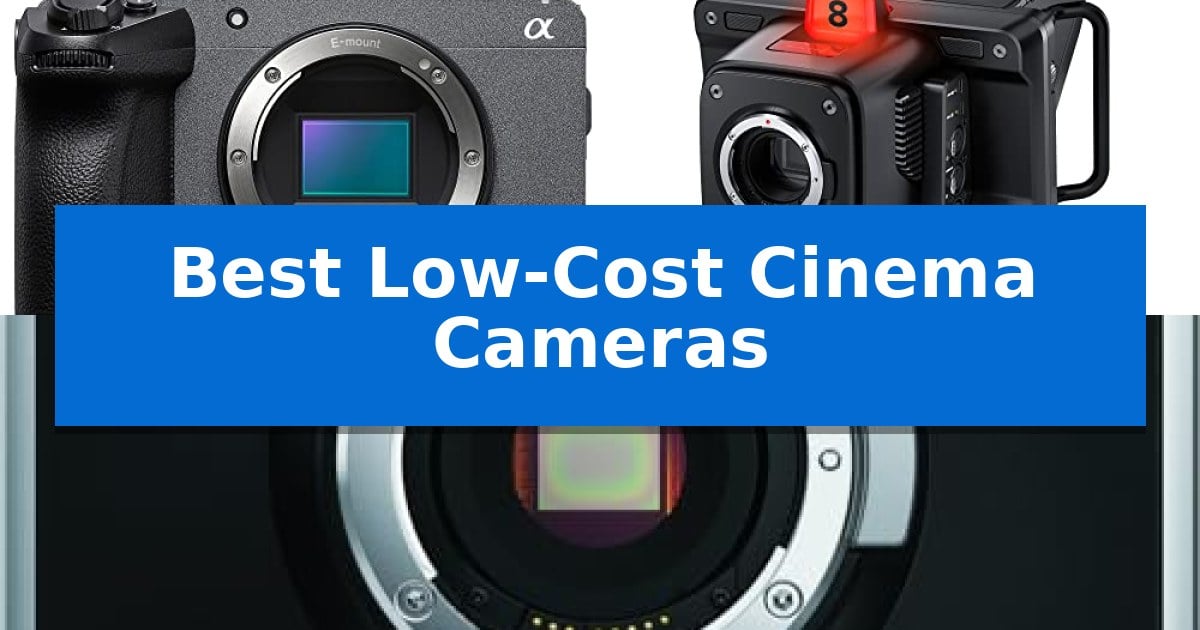
Finding the right gear for independent filmmaking often involves balancing high-end image quality with strict budgetary constraints. The Best Low-Cost Cinema Cameras provide the essential tools for capturing professional-grade footage without the prohibitive costs associated with traditional broadcast equipment.
Whether you are producing live content or crafting narrative projects, selecting a camera that aligns with your specific workflow is vital. We have analyzed three distinct models to help you identify which device offers the sensor capabilities, connectivity options, and creative control necessary for your next production.
You may also want to compare Best Low-Cost Car Subwoofers, Best Low-Cost Cameras Under $100, and Best Low-Cost Cameras for Photography.
Best Low-Cost Cinema Cameras
Quick Comparison
| Product | Best For | Key Strength | Score |
|---|---|---|---|
| Sony FX30 Cinema Camera | Best Overall | S-Cinetone provides a professional cinematic look without complex grading. | 4.9 |
| Blackmagic Design Studio Camera 6K Pro | Broadcast Ready Production | Direct integration with ATEM switchers for seamless live production. | 4.8 |
| Blackmagic Design Cinema Camera | High Dynamic Range Capture | 13-stop dynamic range for superior highlight and shadow detail. | 4.8 |
How We Chose
- Sensor format and dynamic range capabilities for versatile lighting conditions.
- Lens mount compatibility and the availability of electronic control for optics.
- Integrated production features such as internal recording, LUT support, and broadcast connectivity.
- Physical design and ergonomic factors that influence ease of use on set.
- Input and output flexibility for integration with existing production hardware.
1 Sony FX30 Cinema Camera — Cinematic Super 35 Sensor
The Sony Cinema Line FX30 Super 35 Camera provides a dedicated entry point into professional-grade cinematography by utilizing a 20.1 MP Exmor R APS-C sensor that delivers a wide dynamic range. This camera is built for those who require a cinematic look straight out of the device, featuring S-Cinetone technology that minimizes the need for extensive color grading in post-production.
Designed for versatility in varied lighting environments, the unit incorporates Dual Base ISO and a 14+ stop range, which helps maintain image quality while reducing noise. Creators can optimize their workflow using Flexible ISO, Cine EI Quick, and Cine EI Log shooting modes, ensuring that technical parameters remain consistent across different production requirements.
Practicality for professional setups is addressed through the ability to apply User LUTs directly to the LCD display and HDMI output. These LUTs can also be embedded into clips, allowing for a consistent monitoring experience on set. Weighing approximately 2.7 pounds, the camera maintains a compact form factor suitable for handheld operation or integration into larger cinema rigs.
This system is a specialized tool for filmmakers prioritizing high-latitude image capture and efficient color management. By focusing on core cinema features rather than general-purpose photography, it serves as a robust foundation for those building a dedicated video production kit.
Best for: Filmmakers and content creators who require a dedicated Super 35 cinema camera with professional color science and advanced log shooting capabilities.
Skip if: Photographers who need a hybrid device primarily for high-resolution still photography or users who prefer a lightweight, pocketable camera without cinema-specific rigging requirements.
PROS
- S-Cinetone provides a professional cinematic look without complex grading.
- Dual Base ISO and 14+ stop dynamic range for low-noise performance.
- User LUT support for consistent monitoring and embedded color profiles.
CONS
- Cinema-focused design lacks features optimized for still photography.
- Weight of 2.7 pounds may require stabilization for extended handheld use.
2 Blackmagic Design Studio Camera 6K Pro — Broadcast Ready Production
The Blackmagic Design Studio Camera 6K Pro is engineered specifically for live production environments, featuring a miniaturized carbon composite body that integrates seamlessly into professional broadcast workflows. This camera provides a 6K sensor with a dual native ISO of 400 and 3200, allowing for flexibility in varying lighting conditions, while its 13 stops of dynamic range ensure high-quality image capture for television, sports, and conference presentations.
Designed for direct integration with ATEM switchers, the unit includes powerful broadcast connections such as 12G-SDI input and output, HDMI 2.0 output, and 10G Ethernet. The inclusion of built-in 2, 4, and 6-stop neutral density (ND) filters allows operators to quickly adjust to changing light without swapping lenses, while the EF lens mount provides compatibility with a wide range of professional optics.
Usability is enhanced by a large 7-inch HDR LCD screen equipped with a sunshade, providing clear monitoring in bright studio or outdoor settings. The camera supports Blackmagic RAW recording directly to USB disks via its dual USB 3.1 ports, and it features built-in talkback, tally, and remote camera control capabilities to streamline communication between the camera operator and the switcher.
This system is a comprehensive broadcast solution, including a 15mm LWS tripod mount, universal power supply with international adapters, and a turret dust cap. While it offers extensive connectivity including XLR audio inputs and outputs, users should ensure their existing infrastructure supports 12G-SDI or 10G Ethernet to fully leverage the camera's professional-grade output and control features.
Best for: Professional live production environments such as broadcast news, sports, and studio television shows requiring direct ATEM switcher integration.
Skip if: Users seeking a general-purpose handheld cinema camera for run-and-gun filmmaking, as this model is specifically optimized for studio-based live production workflows.
PROS
- Direct integration with ATEM switchers for seamless live production.
- Built-in ND filters (2, 4, and 6-stop) for rapid light management.
- Extensive connectivity including 12G-SDI, 10G Ethernet, and XLR audio.
- Large 7-inch HDR LCD with included sunshade for clear monitoring.
CONS
- Heavy and specialized form factor designed primarily for tripod-mounted studio use.
- Requires specific infrastructure like 12G-SDI or 10G Ethernet for full feature utilization.
3 Blackmagic Design Cinema Camera — High Dynamic Range Capture
The Blackmagic Design Cinema Camera with EF Mount is built around a 2.5K sensor housed in a durable machined aluminum chassis, providing a foundation for high-resolution digital cinematography. This camera is engineered to capture a 13-stop dynamic range, which allows for significant detail preservation in both deep shadows and bright highlights, ensuring that high-contrast scenes remain balanced.
A primary advantage of this model is its EF and ZE compatible lens mount, which grants users access to a wide array of optics from manufacturers like Canon and Zeiss. This design choice enables full electronic control of your lens, allowing for precise adjustments to suit various creative styles. The ability to swap lenses makes this a versatile tool for different shooting environments.
The camera records into 12-bit DNG files, a format that retains substantial image data for post-production flexibility. By handling indoor shots while simultaneously maintaining detail in images captured through windows, the system addresses common exposure challenges faced in mixed-lighting conditions. Its compact form factor, measuring approximately 6.85 inches in length, keeps the setup manageable for various production scales.
Choosing this camera involves balancing its specialized feature set against its specific operational requirements. It is a dedicated tool for those who prioritize raw image data and lens flexibility over automated consumer-grade features. The interchangeable optics system ensures that the camera can adapt to the specific visual requirements of a project, provided the user has the necessary lens inventory.
Best for: Creators who require high dynamic range and the flexibility of interchangeable EF or ZE mount lenses for professional-style cinematography.
Skip if: Users who prefer a lightweight, all-in-one camera with integrated zoom lenses or automated point-and-shoot functionality.
PROS
- 13-stop dynamic range for superior highlight and shadow detail.
- EF and ZE lens mount compatibility for professional optics.
- 12-bit DNG recording for high-quality raw data capture.
- Machined aluminum chassis for a robust build quality.
CONS
- Manual lens dependency requires additional investment in glass.
- Professional-focused workflow necessitates post-production processing.
Best Low-Cost Cinema Cameras Buying Guide
Understanding Sensor Formats
The sensor is the heart of any cinema camera, determining the overall aesthetic and low-light performance. Many affordable options utilize Super 35mm sensors, which offer a classic cinematic look that is widely compatible with a vast range of professional lenses.
Choosing between sensor sizes often involves a trade-off between depth-of-field control and light sensitivity. Larger sensors generally provide better performance in dim environments, while smaller formats can offer greater depth of field, which is often preferred for specific broadcast or studio applications.
Lens Mount Compatibility
The lens mount dictates which optics you can attach to your camera, directly impacting your creative options. Systems featuring common mounts like the EF mount allow filmmakers to leverage a massive ecosystem of existing glass, often reducing the total cost of ownership.
Ensure that your chosen camera supports electronic communication if you require autofocus or iris control from the camera body. Some cinema-focused cameras prioritize manual operation, which is standard for narrative work but may require additional adapters for specific lens types.
Dynamic Range and Color Science
Dynamic range refers to the camera's ability to capture detail in both the brightest highlights and the deepest shadows simultaneously. A camera with a high stop count allows for more flexibility during color grading, ensuring that your footage retains a natural look even in high-contrast scenes.
Look for cameras that offer internal log profiles or specific color science, such as S-Cinetone, which can provide a polished look straight out of the camera. This feature is particularly useful for projects with tight turnarounds where extensive post-production grading is not feasible.
Connectivity for Live Production
If your work involves live streaming or studio environments, connectivity is just as important as image quality. Features like 12G-SDI and HDMI 2.0 outputs are essential for sending high-resolution signals to switchers, monitors, or external recorders.
Consider whether the camera supports features like talkback or tally lights, which are standard in professional broadcast settings. These tools facilitate communication between the camera operator and the director, streamlining the production process in multi-camera setups.
Recording Media and Codecs
The format in which your camera records data affects both image quality and storage requirements. High-bitrate codecs or raw formats like Blackmagic RAW offer the most flexibility for color correction but require faster, more expensive storage media.
Evaluate the camera's ability to record to external USB disks or standard SD cards. This can significantly reduce the cost of your storage workflow, allowing you to focus your budget on lenses and lighting rather than proprietary media.
Frequently Asked Questions
What is the primary advantage of a Super 35mm sensor?
A Super 35mm sensor provides a cinematic field of view and depth of field that is highly sought after for narrative filmmaking, offering a balance between light sensitivity and image detail.
Do I need a camera with internal ND filters?
Internal neutral density (ND) filters are highly recommended for outdoor shooting, as they allow you to maintain a wide aperture and specific shutter speed without overexposing your image in bright light.
Can I use my existing DSLR lenses on these cinema cameras?
Many cinema cameras use standard mounts like EF, which are compatible with many DSLR lenses. However, you should check for electronic compatibility if you require features like autofocus or electronic aperture control.
What is the benefit of Dual Base ISO?
Dual Base ISO allows the camera to maintain high image quality and low noise levels at two different sensitivity settings, providing greater flexibility when shooting in varying lighting conditions.
Is raw recording necessary for all projects?
Raw recording is ideal for projects requiring extensive color grading or visual effects. For standard broadcast or web content, high-quality compressed formats are often sufficient and easier to manage in post-production.
Conclusion: Our Top Pick
Selecting the right camera depends heavily on whether your primary focus is narrative filmmaking or live broadcast production. For those prioritizing a balance of cinematic image quality and compact design, the Sony FX30 Cinema Camera stands out as a versatile choice for many independent creators.
The Sony FX30 Cinema Camera offers a robust Super 35mm sensor and advanced color science that simplifies the grading process. While other options in this list excel in specific broadcast environments, this model provides the most well-rounded feature set for general cinematic production.