
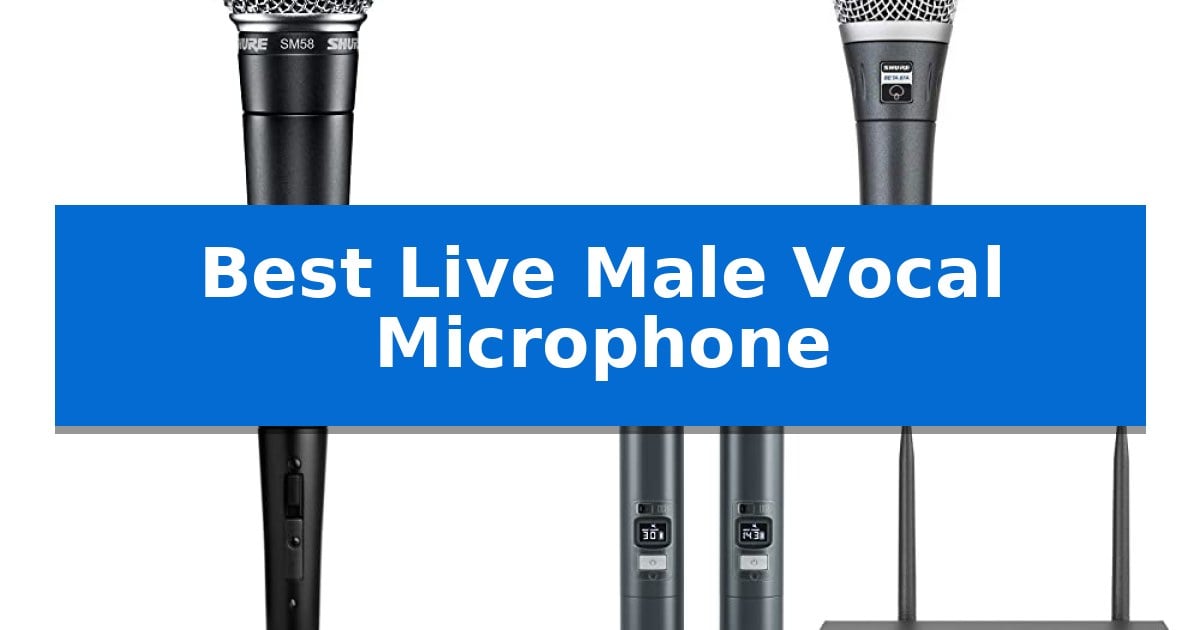
Finding the right microphone for live male vocals requires balancing tonal warmth with the ability to cut through a dense stage mix. Whether you are performing in an intimate acoustic setting or a high-volume concert venue, the Best Live Male Vocal Microphone must provide consistent clarity while resisting feedback.
Selecting the ideal model depends on your specific vocal range, the surrounding stage noise, and your preference for dynamic or condenser technology. We have evaluated five distinct microphones to help you identify which tool best supports your performance style and technical requirements.
You may also want to compare Best Live Instrument Microphone, Best Live Hi-Hat Microphones, and Best Live Guitar Microphones.
Best Live Male Vocal Microphone
Quick Comparison
| Product | Best For | Key Strength | Score |
|---|---|---|---|
| Shure SM58 Dynamic Vocal Microphone | Best Overall | Rugged metal construction built for touring demands. | 4.9 |
| Shure BETA 87A Condenser Vocal Microphone | Studio-Grade Clarity for Live Stages | Supercardioid polar pattern provides excellent gain-before-feedback. | 4.9 |
| Shure SM58S Dynamic Vocal Microphone | Convenient Control with On-Off Switch | Integrated on/off switch for immediate signal control. | 4.3 |
| Phenyx Pro Dual UHF Wireless System | Reliable Cordless Freedom for Performers | Auto Scan technology for rapid frequency synchronization and interference reduction. | 4.4 |
| Pyle PDMIC59 Dynamic Vocal Microphone | Budget-Friendly Choice for Live Gigs | Cardioid pickup pattern minimizes feedback and off-axis noise. | 4.6 |
How We Chose
- Frequency response characteristics and midrange presence for vocal clarity.
- Polar pattern consistency to maximize gain-before-feedback.
- Build quality and durability for touring and frequent handling.
- Integrated noise control, including pop filters and shock-mounting.
- Connectivity and power requirements for stage integration.
1 Shure SM58 Dynamic Vocal Microphone — The Industry Standard for Live Vocals
Achieving professional vocal presence in live environments requires equipment capable of isolating the performer's voice while maintaining sonic integrity. The Shure SM58 Pro XLR Dynamic Vocal Microphone is engineered with a finely tuned frequency response that provides a subtle midrange lift, ensuring vocals remain warm and articulate even when competing with a dense mix.
Designed for consistent performance across diverse settings, this microphone utilizes a precision cardioid pickup pattern. This design focuses tightly on the source, effectively minimizing background noise and feedback, which is essential for maintaining clarity in high-volume live venues or busy recording spaces.
The physical construction reflects its status as a standard for touring professionals. It features a rugged metal construction and an integrated pop protection system, consisting of a refined spherical grille and a built-in filter. These elements work together to reduce plosives, breath, and wind noise without requiring external accessories.
Reliability is central to its design, supported by a reinforced stand adapter that ensures stability during extended use. As a dynamic microphone, it requires no external power, making it a versatile choice for a wide range of live performance, podcasting, and broadcast applications.
Best for: Performers and broadcasters seeking a durable, feedback-resistant microphone for live vocal reinforcement.
Skip if: Users requiring a condenser microphone's high-frequency sensitivity for delicate studio recording or those needing built-in USB connectivity.
PROS
- Rugged metal construction built for touring demands.
- Integrated pop filter reduces plosives without extra hardware.
- Cardioid pickup pattern provides excellent feedback rejection.
- Finely tuned frequency response enhances vocal presence.
CONS
- XLR-only output requires an external audio interface or mixer.
2 Shure BETA 87A Condenser Vocal Microphone — Studio-Grade Clarity for Live Stages
Achieving studio-grade clarity on a busy stage requires a microphone that can isolate a performer's voice while maintaining a natural, detailed presence. The Shure BETA 87A Condenser Vocal Microphone is engineered for this exact purpose, utilizing a supercardioid polar pattern to deliver exceptional gain-before-feedback. This design choice ensures that the microphone remains focused on the vocalist, effectively rejecting unwanted sound from stage monitors and loud environments.
Designed for professional live performance, the Shure BETA 87A features a smooth frequency response with a gradual presence rise, which helps vocals cut through a dense live mix with crisp definition. To maintain balance when a singer is positioned close to the mic, the unit incorporates an electronic low-frequency roll-off to compensate for the proximity effect. A built-in pop filter further refines the output by minimizing breath and wind noise, ensuring a clean signal.
Durability and handling are critical for live gear, and this microphone addresses these needs with an advanced cartridge shock-mount system. This internal mechanism absorbs mechanical shock and significantly reduces handling noise, allowing for expressive movement during performances. With a wide 117 dB dynamic range and low distortion, the microphone captures vocal nuances with high fidelity.
As a condenser microphone, the Shure BETA 87A requires phantom power to operate. It is compatible with standard mixers, audio interfaces, and other microphone inputs that can supply the necessary power. The package includes an A25D mic clip and a storage bag, providing a complete, ready-to-use solution for vocalists who prioritize sound quality in high-pressure stage settings.
Best for: Professional vocalists who require studio-grade clarity and high feedback rejection in demanding live stage environments.
Skip if: Users who do not have access to phantom power or those who prefer the rugged, battery-free simplicity of a dynamic microphone for casual use.
PROS
- Supercardioid polar pattern provides excellent gain-before-feedback.
- Advanced cartridge shock-mount minimizes handling noise.
- Electronic low-frequency roll-off manages proximity effect for balanced sound.
- Studio-grade clarity with a gradual presence rise for vocal definition.
CONS
- Requires phantom power to function, limiting compatibility with some basic equipment.
- Condenser design is more sensitive to mechanical impact than standard dynamic alternatives.
3 Shure SM58S Dynamic Vocal Microphone — Convenient Control with On-Off Switch
Managing audio transitions during a live performance requires reliable hardware that can handle the rigors of the stage. The Shure SM58S Pro XLR Dynamic Vocal Microphone simplifies this process with an integrated on/off switch, allowing performers to mute the signal instantly without needing to adjust the mixer or disconnect cables.
Engineered for vocal clarity, the Shure SM58S features a tuned frequency response that emphasizes the presence of vocals, helping them cut through dense live mixes. Its cardioid polar pattern is essential for stage environments, as it focuses on capturing sound from the front while effectively rejecting off-axis noise from monitors, instruments, and the surrounding crowd.
Durability is a core design principle for this microphone, which incorporates a hardened grille and internal filtering to minimize the impact of plosives and breath noise. These features ensure that the audio remains clean and controlled, even during high-energy performances where close-mic technique is required.
Whether used in a professional touring venue or a local rehearsal space, this microphone provides consistent performance. The inclusion of the on/off switch makes it particularly useful for speakers and presenters who need to manage their own audio output during events, offering a practical, hands-on solution for live sound management.
Best for: Performers and presenters who need an integrated on/off switch for quick, independent control of their microphone signal during live sets.
Skip if: Users who require a microphone without a switch to prevent accidental muting or those seeking a specialized studio condenser microphone for high-frequency detail.
PROS
- Integrated on/off switch for immediate signal control.
- Cardioid polar pattern effectively isolates vocals from background noise.
- Hardened grille design reduces plosives and handling noise.
- Tuned frequency response optimized for vocal clarity.
CONS
- On/off switch may be prone to accidental activation during intense movement.
4 Phenyx Pro Dual UHF Wireless System — Reliable Cordless Freedom for Performers
Achieving clear, professional audio during live performances requires a system that prioritizes signal stability and sound fidelity. The Phenyx Pro Dual UHF Wireless System addresses these needs by utilizing Auto Scan technology, which automatically identifies the least-interference frequency to ensure a reliable connection across its 328 ft line-of-sight range.
This system features 2×100 selectable UHF frequencies, allowing for the simultaneous operation of up to 16 transmitters without cross-channel interference. By employing PLL frequency synthesized technology, the microphones maintain consistent transmission quality, effectively minimizing dropouts and providing robust feedback rejection during vocal use.
The audio profile is defined by a specially tuned EQ that emphasizes fuller low frequencies and bright highs, supported by a cardioid polar pattern that isolates the performer's voice while rejecting ambient stage noise. The durable metal construction of both the receiver and the handheld microphones provides a professional feel while ensuring longevity in demanding environments like churches, weddings, or DJ gigs.
Usability is enhanced through practical design choices, including a mute function for quick control and a replaceable microphone head design that simplifies maintenance. The system includes all necessary components for immediate setup, such as anti-rolling rings and a 6.5 mm to 3.5 mm adapter, making it a versatile solution for various live sound applications.
Best for: Performers and event hosts requiring a reliable, multi-channel wireless microphone setup for live vocals and public speaking.
Skip if: Users who require a digital wireless system with specific encryption protocols or those who need a bodypack transmitter for hands-free operation.
PROS
- Auto Scan technology for rapid frequency synchronization and interference reduction.
- Durable metal construction for both the receiver and handheld transmitters.
- Cardioid polar pattern ensures precise sound pickup and ambient noise rejection.
- 16-transmitter support allows for complex, multi-set operations.
CONS
- Fixed dynamic microphone heads may not offer the sonic versatility of swappable capsules found in high-end professional systems.
5 Pyle PDMIC59 Dynamic Vocal Microphone — Budget-Friendly Choice for Live Gigs
Reliable audio capture in live environments often depends on the microphone's ability to isolate the source signal. The Pyle Professional Dynamic Vocal Microphone utilizes a cardioid pickup pattern to focus on the vocalist while effectively shunning off-axis sound, which minimizes background noise and feedback during stage performances.
Engineered for durability, this dynamic microphone features a rugged, all-metal construction with a zinc die-cast case and a steel mesh windscreen equipped with an anti-dent ring. These design choices ensure the unit can withstand the rigors of frequent gigging and studio use while remaining resistant to moisture.
The Pyle PDMIC59 delivers a transparent sound profile through its ultra-wide frequency response and includes an integrated pop filter to reduce breath and plosive noises. It is designed for versatility, functioning well for both vocal applications and recording amplified instruments like guitar cabinets.
This package simplifies setup by including a professional grade 15 ft. XLR-to-1/4'' audio cable, allowing for immediate connection to standard mixing boards or amplifiers. The inclusion of an on/off switch provides users with convenient control directly from the handheld unit during live sets.
Best for: Live vocal performances and instrument recording where feedback rejection and rugged build quality are required.
Skip if: Users requiring a condenser microphone for high-sensitivity studio recording or those needing balanced XLR-to-XLR connectivity without the included 1/4'' adapter cable.
PROS
- Cardioid pickup pattern minimizes feedback and off-axis noise.
- Rugged all-metal construction provides long-term reliability.
- Includes 15ft XLR-to-1/4'' cable for immediate plug-and-play use.
- Integrated pop filter reduces breath noise for clearer vocals.
CONS
- Fixed 1/4'' connection may require an adapter for professional XLR-only interfaces.
Best Live Male Vocal Microphone Buying Guide
Dynamic vs. Condenser Microphones
Dynamic microphones are the industry standard for live performance due to their rugged construction and ability to handle high sound pressure levels. They are generally less sensitive to ambient stage noise, making them ideal for loud environments where feedback is a constant concern.
Condenser microphones offer a more detailed, studio-grade frequency response and higher sensitivity. While they require phantom power to operate, they are excellent for vocalists who need a crisp, articulate sound that captures subtle nuances, provided the stage environment is controlled.
Understanding Polar Patterns
The cardioid polar pattern is the most common choice for live vocals because it focuses on sound directly in front of the capsule while rejecting noise from the rear. This design is essential for isolating the singer from nearby monitors and instruments.
Supercardioid patterns provide an even tighter pickup area, offering superior rejection of off-axis sound. This is particularly useful in high-volume settings where you need to maximize gain before feedback occurs, though it requires the vocalist to maintain consistent mic technique.
Frequency Response and Presence
A microphone's frequency response determines how it colors the sound. Many vocal mics feature a midrange presence lift, which helps the voice cut through a mix without needing heavy equalization.
Look for models with a balanced low-frequency response to manage the proximity effect—the boost in bass that occurs when singing very close to the mic. Some professional models include electronic roll-off to keep the sound balanced and natural.
Durability and Handling
Live performance is demanding, and your microphone must withstand accidental drops, moisture, and constant transport. Rugged metal construction and reinforced grilles are vital for long-term reliability.
Internal shock-mount systems are equally important, as they minimize handling noise and mechanical vibrations that can travel through the mic stand or the singer’s hand during a performance.
Connectivity and Control
Consider whether you need an on/off switch for quick muting between songs or during presentations. While convenient, ensure the switch is robust enough to prevent accidental activation during a performance.
For those requiring mobility, wireless systems offer freedom on stage. Look for models with auto-scan features and multiple selectable frequencies to ensure a stable, interference-free connection in crowded RF environments.
Frequently Asked Questions
Do I need phantom power for all vocal microphones?
No, only condenser microphones require phantom power. Dynamic microphones are passive and do not require external power to operate.
What is the benefit of a supercardioid pattern?
A supercardioid pattern offers a narrower pickup angle than a standard cardioid, providing better isolation from stage noise and higher gain before feedback.
How do I reduce plosive sounds?
Using a microphone with an integrated pop filter or a spherical grille helps reduce plosives (the 'p' and 'b' sounds). Proper mic technique, such as singing slightly off-axis, also helps.
Are wireless microphones as reliable as wired ones?
Modern UHF wireless systems with auto-scan and frequency selection are highly reliable, though they require battery management and a clear line of sight to the receiver.
Can I use a studio condenser mic on stage?
While possible, studio condenser mics are often too sensitive and prone to feedback in live settings. It is better to use a dedicated live condenser mic designed with feedback rejection in mind.
Conclusion: Our Top Pick
When choosing the right tool for your performance, the Shure SM58 Dynamic Vocal Microphone remains the most reliable choice for most live applications. Its legendary durability and tuned frequency response ensure that your vocals remain clear and present in virtually any live mix.
While other options like the BETA 87A offer enhanced detail for specific needs, the SM58's consistent performance and feedback rejection make it the most versatile and dependable option for male vocalists on stage.