
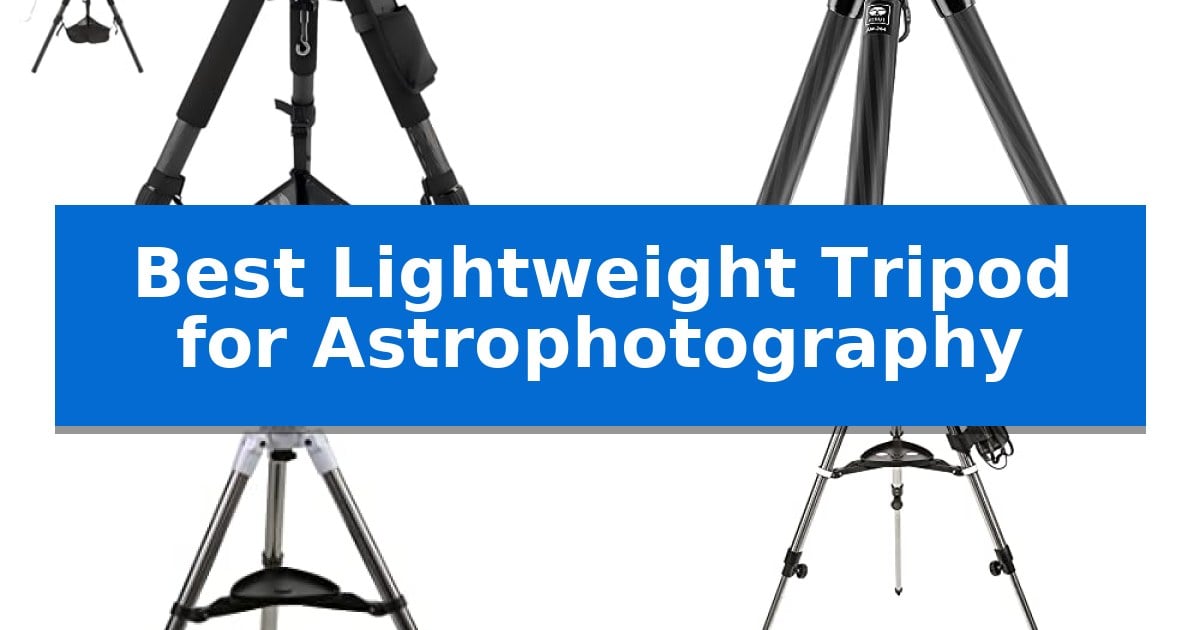
Capturing the night sky requires equipment that remains perfectly still during long exposures. Finding the Best Lightweight Tripod for Astrophotography is a balancing act between portability for remote locations and the structural rigidity needed to support heavy equatorial mounts and camera gear without vibration.
Whether you are trekking to a dark-sky site or setting up in your backyard, your support system must handle the weight of your tracking hardware while remaining easy to transport. We have evaluated several specialized tripods and mounts to help you identify the right foundation for your astrophotography setup.
You may also want to compare Best Lightweight Travel Tripods for DSLR, Best Lightweight Travel Tripods for Backpacking, and Best Lightweight Travel Tripods.
Best Lightweight Tripod for Astrophotography
Quick Comparison
| Product | Best For | Key Strength | Score |
|---|---|---|---|
| CAMINSTARRY Carbon Fiber Equatorial Tripod | Best Overall | High 50kg / 110lb load capacity for heavy equatorial mounts. | 4.9 |
| Sirui AM-284 Carbon Fiber Tripod | Lightweight Carbon Fiber Build | 10x carbon fiber construction provides a high strength-to-weight ratio. | 4.6 |
| Sky-Watcher Star Adventurer GTI Mount Kit | Portable GoTo Tracking System | Full GoTo tracking capability for automated object locating. | 4.4 |
| Explore Scientific iEXOS-100-2 Equatorial Mount | App-Controlled Precision Tracking | Eight-CPU PMC-Eight system for high-speed processing and responsiveness. | 4.7 |
| Sky-Watcher Star Adventurer Tripod | Dedicated Portable Stargazing Support | Dedicated compatibility with Star Adventurer GTi, AZ-GT series, and AZ5 mounts. | 4.6 |
How We Chose
- Load Capacity: Ensuring the tripod can safely support the combined weight of your mount, camera, and lens without sagging.
- Vibration Damping: Evaluating materials like carbon fiber that minimize micro-movements during long-exposure shots.
- Portability: Assessing folded length and total weight for ease of transport to remote stargazing locations.
- Mount Compatibility: Checking for standard mounting interfaces and center-axis flexibility for equatorial tracking systems.
- Field Stability: Reviewing included accessories like spiked feet or sandbag hooks that enhance stability on uneven outdoor terrain.
1 CAMINSTARRY Carbon Fiber Equatorial Tripod — High Load Capacity for Heavy Gear
Capturing deep-sky objects requires a foundation that minimizes vibration while remaining portable enough for remote dark-sky locations. The CAMINSTARRY Carbon Fiber Equatorial Tripod addresses this by utilizing 10-layer diamond-shaped carbon fiber construction, which provides high hardness and rigidity while keeping the total weight to just 1.9kg / 4.19lb.
Designed specifically for astrophotography, this tripod supports a substantial load capacity of up to 50kg / 110lb. The 4.0cm / 1.57in large diameter leg tubes are engineered for effective shock absorption, a critical requirement for maintaining stability during the long-exposure imaging sessions essential for clear, sharp results.
Usability in the field is enhanced by a two-section quick-assembly design that allows for rapid setup, reaching a working height of 77cm / 30.32in. When packed, the tripod collapses to 51.5cm / 20.28in, meeting aerospace portable standards for easy transport in checked or carry-on luggage.
The tripod includes a multi-functional center axis that supports both forward and reverse installation, allowing users to lower the center of gravity for improved balance with heavy equatorial mounts. Safety features like the middle frame anti-dropout plate prevent accidental equipment slippage, while included ground stakes and sandbags ensure stability on uneven terrain.
Best for: Astrophotographers who need a high-capacity, vibration-dampening support system that remains lightweight for travel.
Skip if: Users who require a taller working height or a multi-section leg design for uneven terrain adjustment beyond the two-section configuration.
PROS
- High 50kg / 110lb load capacity for heavy equatorial mounts.
- Lightweight 1.9kg carbon fiber construction for portability.
- Large 4.0cm leg diameter provides superior vibration damping.
- Quick-assembly design for rapid field deployment.
CONS
- Two-section design offers limited height adjustment compared to multi-section alternatives.
2 Sirui AM-284 Carbon Fiber Tripod — Lightweight Carbon Fiber Build
The Sirui AM-284 Carbon Fiber Tripod is engineered for photographers who require a lightweight yet rigid platform for long-exposure work. Constructed from 10x carbon fiber, this tripod weighs only 2.69lbs (1.22kg), making it a practical choice for carrying into remote, dark-sky locations where every ounce counts.
Stability is managed through a maximum tube diameter of 29.4mm, which supports a maximum load capacity of 33.1lbs (15kg). This capacity ensures that heavy DSLR or mirrorless setups remain secure during the long shutter speeds necessary for capturing celestial bodies. The 4-section column legs utilize twist locking for rapid deployment and height adjustments ranging from 3.2 inches to 47.2 inches.
For varied terrain, the tripod features flexible leg angle adjustment with a semi-automatic pull button, allowing for fixed settings at 22, 55, and 85 degrees. This versatility is essential when setting up on uneven ground. The system includes removable rubber feet that can be swapped for the included steel spiked feet, providing a firmer anchor on soft or slippery surfaces.
The design prioritizes portability without sacrificing the structural integrity required for precision photography. By utilizing carbon fiber, the Sirui AM-284 Carbon Fiber Tripod minimizes vibrations, a critical factor for maintaining image sharpness during astrophotography sessions.
Best for: Photographers needing a lightweight, high-capacity carbon fiber tripod for travel and outdoor astrophotography.
Skip if: Users who require a significantly taller working height than 47.2 inches or those who prefer lever-style leg locks over twist locks.
PROS
- 10x carbon fiber construction provides a high strength-to-weight ratio.
- 33.1lbs load capacity supports heavy camera and lens combinations.
- Included steel spiked feet enhance stability on outdoor terrain.
- Lightweight 2.69lbs design is ideal for long-distance transport.
CONS
- 47.2-inch maximum height may be limiting for taller photographers.
- Twist locking mechanism requires manual tightening compared to quick-release lever systems.
3 Sky-Watcher Star Adventurer GTI Mount Kit — Portable GoTo Tracking System
Capturing deep-sky objects requires precision tracking to compensate for the Earth's rotation, and the Sky-Watcher Star Adventurer GTI Mount Kit provides a dedicated solution for portable setups. This system includes a full GoTo mount head and a tripod with a pier extension, offering a stable foundation for long-exposure photography without the bulk of traditional observatory-grade equipment.
The mount is engineered for convenience, featuring built-in Wi-Fi that allows for wireless control, which is essential for maintaining alignment during remote operation. To assist with accurate orientation, the unit includes a built-in polar scope with an illuminator, ensuring that users can achieve precise polar alignment even in low-light conditions.
Designed for versatility in the field, the kit comes with a counterweight bar and necessary counterweights to balance various camera and lens configurations. The inclusion of the pier extension provides additional clearance, preventing the camera or lens from striking the tripod legs during tracking, which is a common challenge when imaging near the zenith.
While this mount offers advanced tracking capabilities, it is a specialized tool. The total system weight of approximately 26 pounds reflects its robust construction, making it a substantial piece of gear for those prioritizing stability over extreme minimalism during travel.
Best for: Astrophotographers who need a portable, motorized GoTo tracking system for long-exposure imaging.
Skip if: Users seeking an ultra-lightweight, non-motorized tripod for basic landscape or daylight photography.
PROS
- Full GoTo tracking capability for automated object locating.
- Built-in Wi-Fi for convenient wireless control.
- Pier extension included for improved equipment clearance.
- Integrated polar scope with illuminator for precise alignment.
CONS
- Substantial weight of 26 pounds may limit extreme portability.
4 Explore Scientific iEXOS-100-2 Equatorial Mount — App-Controlled Precision Tracking
Achieving precise celestial tracking requires a system capable of managing complex movements with high efficiency. The Explore Scientific iEXOS-100-2 Equatorial Mount addresses this through an integrated PMC-Eight system, which utilizes eight independent CPUs to handle specific processing tasks. This architecture is designed to provide superior responsiveness and fast timing intervals, moving beyond the limitations of standard single-processor mounts.
For astrophotographers, the mount features clutched dual-axis worm gears paired with quiet precision stepper motor belt drives. This design allows for smooth, manual repositioning and precise balancing of your telescope setup. To assist with setup, the unit includes a polar alignment sight hole through the RA axis and dedicated altitude control, facilitating alignment without the immediate need for a separate polar scope.
Operation is managed through the ExploreStars app, which is compatible with Apple, Android, and Windows tablets. This interface simplifies the GOTO process, enabling users to navigate to tens of thousands of celestial objects. The system is built to provide a reliable foundation for tracking, focusing on efficiency and ease of use for those focused on long-exposure imaging.
While this mount provides advanced electronic control, it is a specialized piece of equipment that requires a stable base and proper balancing to function effectively. It is best suited for users who prioritize app-based navigation and multi-processor efficiency in their astrophotography workflow.
Best for: Astrophotographers who prioritize app-integrated GOTO navigation and multi-processor tracking efficiency.
Skip if: Users who prefer a traditional manual-only mount or those who do not use tablet-based control systems.
PROS
- Eight-CPU PMC-Eight system for high-speed processing and responsiveness.
- Intuitive ExploreStars app for streamlined navigation and alignment.
- Clutched dual-axis worm gears allow for smooth, precise manual balancing.
- Polar alignment sight hole simplifies setup without requiring extra accessories.
CONS
- Requires tablet connectivity for full operation of the GOTO system.
- Learning curve associated with the specialized PMC-Eight software interface.
5 Sky-Watcher Star Adventurer Tripod — Dedicated Portable Stargazing Support
Stability is the foundation of clear, long-exposure night photography, and the Sky-Watcher Star Adventurer Tripod is engineered specifically to provide a dedicated, portable platform for your imaging gear. Weighing in at 4.9 pounds, this tripod balances portability with the structural requirements needed to support specialized mounts in the field.
Designed for seamless integration, this tripod is fully compatible with the Star Adventurer GTi, AZ-GT series, and AZ5 mounts. By utilizing a dedicated accessory rather than a generic camera tripod, you ensure that your mount head remains secure and properly aligned, which is essential for tracking celestial objects during extended exposures.
The build focuses on a balance of size and utility, featuring a height of 36 inches. This provides a functional working elevation for most stargazing setups while maintaining a compact form factor for transport to remote, dark-sky locations. It is a straightforward, purpose-built tool that eliminates the guesswork often associated with finding a compatible base for your specific mount.
Backed by a Two-Year Limited Warranty, this accessory is built to withstand the rigors of outdoor use. It serves as a reliable, manufacturer-verified foundation for your astrophotography rig, ensuring that your equipment remains stable throughout your session.
Best for: Stargazers and photographers using Sky-Watcher Star Adventurer GTi, AZ-GT, or AZ5 mounts who need a dedicated, reliable, and portable support system.
Skip if: Users who require a standard tripod for general-purpose photography or those who need a significantly taller or heavier-duty setup for larger, non-compatible telescope mounts.
PROS
- Dedicated compatibility with Star Adventurer GTi, AZ-GT series, and AZ5 mounts.
- Portable design weighing only 4.9 pounds for easier field transport.
- Two-Year Limited Warranty provides long-term support for the equipment.
- Purpose-built stability specifically for astrophotography mount requirements.
CONS
- Fixed height of 36 inches may not suit all user preferences or uneven terrain.
- Limited utility as it is designed specifically for a narrow range of Sky-Watcher mounts.
Best Lightweight Tripod for Astrophotography Buying Guide
Understanding Load Capacity
In astrophotography, your tripod must handle more than just the weight of your camera. You must account for the equatorial mount, counterweights, and heavy telephoto lenses. A tripod that is rated for 15kg might be sufficient for a standard camera, but a dedicated astrophotography tripod often requires higher thresholds to ensure the entire system remains rigid.
Always check the manufacturer's maximum load rating against your total gear weight. It is generally recommended to keep your total equipment weight well below the tripod's maximum capacity to prevent vibration-induced blur during long exposures.
Carbon Fiber vs. Aluminum
For most photographers, carbon fiber is the preferred material due to its superior strength-to-weight ratio. It is significantly lighter than aluminum, making it easier to carry on long hikes, and it offers natural vibration-damping properties that help dissipate energy from wind or minor movements.
While aluminum tripods are often more affordable, they are heavier and can be more susceptible to temperature-related expansion or contraction. If you frequently travel to cold, high-altitude locations, the thermal stability of carbon fiber is a distinct advantage.
Stability and Ground Contact
A tripod is only as stable as its connection to the ground. Look for models that include interchangeable feet, such as rubber pads for hard surfaces and steel spikes for grass, dirt, or sand. These ensure your mount stays anchored regardless of the terrain.
Many astrophotography-specific tripods also include a center hook or a middle frame plate. These allow you to hang a sandbag or your camera bag to lower the center of gravity, which is essential for maintaining stability in windy conditions.
Portability and Setup Speed
Astrophotography often involves setting up in the dark. A quick-assembly design with reliable leg locks is crucial. You want a tripod that can be deployed quickly without fiddling with complex mechanisms that might fail or become difficult to operate in cold weather.
Consider the folded length if you plan to travel by air or hike long distances. A tripod that fits inside a standard carry-on or attaches securely to a backpack will see more use than a bulky, cumbersome unit.
Mount Compatibility
Ensure your tripod has a standard 3/8-inch mounting screw or a compatible base for your equatorial mount. Some tripods feature a multi-functional center axis that can be reversed, allowing you to mount your gear closer to the ground for added stability.
If you are using a specialized tracking mount like a Star Adventurer, verify that the tripod is compatible with the specific pier extension or mounting plate required for your device to ensure proper polar alignment.
Frequently Asked Questions
Why is carbon fiber better for astrophotography?
Carbon fiber is preferred because it is lightweight for transport and provides excellent vibration damping, which is critical for preventing blur in long-exposure star images.
How much load capacity do I need?
You should calculate the total weight of your camera, lens, equatorial mount, and counterweights. Your tripod's load capacity should ideally exceed this total weight by a significant margin to ensure maximum stability.
Can I use a standard camera tripod for astrophotography?
You can, provided it meets the weight requirements and is stable enough. However, dedicated astrophotography tripods often include features like spiked feet and higher load tolerances specifically designed for heavy tracking mounts.
How do I keep my tripod stable in the wind?
Use a tripod with a center hook to hang a weight, such as a sandbag or your camera bag. This lowers the center of gravity and helps prevent the tripod from swaying in gusts.
What is the benefit of a reversible center axis?
A reversible center axis allows you to mount your equipment lower to the ground, which can improve stability and provide more flexibility for specific shooting angles.
Conclusion: Our Top Pick
Selecting the right support is essential for clear, sharp images of the night sky. The CAMINSTARRY Carbon Fiber Equatorial Tripod stands out as our top recommendation due to its impressive 50kg load capacity and specialized design for heavy equatorial mounts. Its 10-layer carbon fiber construction provides the necessary rigidity to minimize vibrations while remaining light enough for field use.
While other options offer great portability for smaller setups, the CAMINSTARRY provides the most robust foundation for serious astrophotographers using heavier gear. Its inclusion of professional accessories like ground stakes and a middle frame anti-dropout plate ensures that your valuable equipment remains secure even in challenging outdoor environments.