
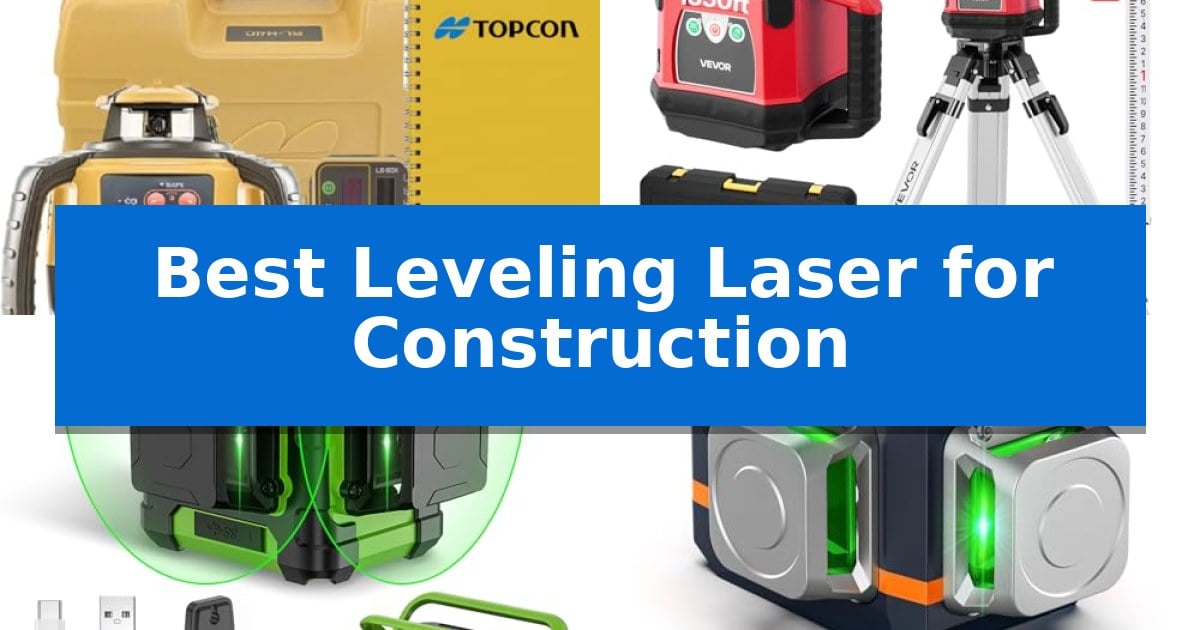
Achieving perfect horizontal and vertical alignment is essential for any professional build, yet manual leveling methods are often time-consuming and prone to error. Selecting the Best Leveling Laser for Construction means finding a tool that balances high-accuracy projection with the rugged durability required for active job sites.
Whether you are grading a large outdoor plot or installing interior fixtures, the right laser level streamlines your workflow and ensures structural precision. This guide evaluates five distinct models, focusing on their specific capabilities, range, and mounting versatility to help you choose the ideal instrument for your next project.
You may also want to compare Best Level 2 EV Charging Station, Best Level 2 Electric Car Charger, and Best Level 1 Electric Car Charger.
Best Leveling Laser for Construction
Quick Comparison
| Product | Best For | Key Strength | Score |
|---|---|---|---|
| Topcon RL-H5A Self-Leveling Construction Laser | Best Overall | 800-meter operating range for large job sites. | 4.9 |
| VEVOR Rotary Laser Level Kit | Longest Range for Outdoor Grading | Extensive 1650 ft working range with receiver included | 4.7 |
| Huepar 360 Self-Leveling Green Laser | Full-Room 3D Alignment Coverage | 3×360° laser coverage for comprehensive room alignment. | 4.8 |
| CIGMAN 360 Self-Leveling Laser Level | Remote-Controlled Precision Alignment | 12 ultra-bright green laser lines for full 360-degree coverage. | 4.9 |
| Klein Tools 93CPLG Compact Laser Level | Compact Design for Tight Spaces | Three 360-degree green laser planes for superior visibility. | 4.5 |
How We Chose
- Working range and distance accuracy for both indoor and outdoor applications.
- Self-leveling speed and the presence of manual mode for angled alignment.
- Environmental protection ratings, such as IP54 or IP66, for dust and water resistance.
- Mounting versatility, including tripod compatibility and magnetic bracket strength.
- Power management, focusing on rechargeable battery life and charging convenience.
1 Topcon RL-H5A Self-Leveling Construction Laser — Best for Large-Scale Job Sites
Precision on a job site requires equipment that minimizes downtime, and the Topcon RL-H5A Self-Leveling Construction Laser addresses this with its rapid electronic self-leveling system. By simply pressing the power button, the unit automatically levels itself, allowing operators to begin grading or excavation tasks in seconds. If the device is bumped or disturbed during operation, it automatically relevels to maintain accuracy within ±10 arc seconds.
Designed for expansive environments, this instrument provides a working range of up to 800 meters in diameter. This long-range capability ensures that large-scale grading and general construction projects remain consistent across the entire site. The included LS-80 Receiver and sensor holder facilitate precise elevation readings even at these extended distances, helping to maintain strict grade control.
Durability is a core component of the unit's design, featuring an IP66 rating. This certification confirms the laser is built to withstand harsh job site conditions, including heavy dust exposure and moisture from sudden showers or torrential rainfall. The robust housing protects the internal components, ensuring the tool remains operational in challenging weather.
The complete kit provides the essential components for immediate deployment, including the laser unit, the receiver, a sensor holder, and a dedicated carry case for secure transport. This all-in-one package is configured to support immediate setup for professional construction workflows, balancing high-accuracy leveling with the ruggedness required for outdoor environments.
Best for: Large-scale grading and general construction projects that require long-range accuracy and weather-resistant durability.
Skip if: Indoor residential projects or small-scale tasks where a shorter-range, compact, or multi-line laser would be more maneuverable and cost-effective.
PROS
- 800-meter operating range for large job sites.
- IP66-rated construction for dust and water resistance.
- Electronic self-leveling with automatic recovery if disturbed.
- Complete kit includes receiver and carry case.
CONS
- Large physical footprint may be cumbersome for smaller, confined workspaces.
2 VEVOR Rotary Laser Level Kit — Longest Range for Outdoor Grading
Precision site-wide leveling requires a tool that balances range with ease of setup, and the VEVOR Rotary Laser Level Kit addresses this by offering a substantial 1650 ft working distance when paired with the included receiver. This kit is built for extensive construction environments, providing the reach necessary for large-scale grading and alignment tasks without needing to reposition the device frequently.
The unit features a 360-degree rotating scan with ±5° self-leveling capability, ensuring accuracy across a wide area. Operators can adjust the device to specific needs using variable speeds of 0, 60, 120, 300, and 600 rpm, alongside selectable scan angles ranging from 0 to 180 degrees. For manual alignment requirements, the device includes a dedicated manual mode.
Usability is enhanced by the inclusion of a remote control effective up to 65 ft, allowing for quick adjustments from a distance. The system is powered by four 1.2V NiMH rechargeable cells, which provide between 8 and 12 hours of operation per charge, minimizing downtime on the jobsite. The standard 5/8 inch mounting thread ensures compatibility with most professional-grade tripods.
Designed for the rigors of construction, the VEVOR Rotary Laser Level Kit features an IP54 waterproof and dustproof rating, protecting the internal components from debris and moisture. The entire kit, including the tripod, grade rod, and laser glasses, is housed in a tough hard case to keep equipment organized and secure during transport between sites.
Best for: Construction professionals and contractors requiring long-range, 360-degree leveling for large-scale outdoor grading and site alignment.
Skip if: Users working exclusively in small, indoor residential spaces where a compact point or line laser would be more portable and cost-effective.
PROS
- Extensive 1650 ft working range with receiver included
- Versatile 360-degree rotation with adjustable scan angles and speeds
- Durable IP54-rated housing for jobsite reliability
- Includes comprehensive accessory kit with tripod and grade rod
CONS
- Requires rechargeable NiMH battery management for long-term operation
- Large footprint due to the included heavy-duty tripod and case
3 Huepar 360 Self-Leveling Green Laser — Full-Room 3D Alignment Coverage
Achieving precise alignment across a job site requires a tool capable of comprehensive coverage, and the Huepar 360 Self-Leveling Green Laser delivers this through its 3×360° laser configuration. By projecting one horizontal and two vertical 360° lines, this device allows for full-room layout tasks, making it a practical choice for construction professionals and DIY enthusiasts alike.
The Huepar 360 Self-Leveling Green Laser features a self-leveling mode that activates within a 3° range, ensuring accuracy of ±1/9" at 33 feet. For projects requiring specific angles, the manual mode allows users to lock the pendulum and position the laser as needed. The unit is powered by a rechargeable battery with a Type-C charging port, providing approximately 8 hours of continuous operation.
Versatility in mounting is provided by a 1/4"-20 thread on the base, compatible with standard tripods. The included 360° magnetic bracket further expands placement options, allowing the laser to be secured to metallic surfaces or mounted via nail holes. An Outdoor Pulse Mode is available to extend the working range up to 200 feet when paired with a compatible laser detector, assisting with visibility in brighter environments.
To maintain the integrity of the device, the manufacturer recommends avoiding use near highly reflective surfaces like mirrors or glossy tiles, which can cause light scattering. The kit includes a hard carry case for protection during transport, and the product is backed by a 5-year warranty on the device, reflecting a commitment to long-term utility in demanding work environments.
Best for: Construction professionals and home renovators needing full-room, multi-plane alignment with flexible mounting options.
Skip if: Users working primarily in environments with high concentrations of reflective surfaces like mirrors or polished glass, where laser line clarity may be compromised.
PROS
- 3×360° laser coverage for comprehensive room alignment.
- Rechargeable battery with convenient Type-C charging.
- Versatile mounting via magnetic bracket and tripod threads.
- Extended 5-year warranty on the device.
CONS
- Reflective surface sensitivity can cause multiple line artifacts.
- Requires separate detector for maximum 200-foot outdoor range.
4 CIGMAN 360 Self-Leveling Laser Level — Remote-Controlled Precision Alignment
Achieving precise alignment on a job site requires a tool that balances visibility with operational flexibility. The CIGMAN 360 Self-Leveling Laser Level utilizes 12 ultra-bright green laser lines to provide full 360-degree coverage, allowing for accurate horizontal and vertical leveling across ceilings, walls, and floors. This configuration is particularly effective for tasks like tiling, framing, and interior design where consistent reference lines are essential.
Designed for both convenience and durability, this Class II laser features an IP54-rated housing that resists dust and water ingress. Its compact footprint ensures it remains portable, while the included remote control allows users to adjust line visibility and brightness without disturbing the setup. The unit is powered by a 4000mAh rechargeable battery, which supports Type-C fast charging to minimize downtime during long construction projects.
The device offers versatile operational modes, including auto-leveling within ±4°, manual mode for angled layouts, and a pulse mode that extends the working range from 30m to 50m when paired with a laser receiver. Mounting is simplified through a standard 1/4" tripod thread, making it compatible with the provided magnetic L-bracket, mini tripod base, and various professional mounting accessories.
When selecting a leveling tool, consider the specific requirements of your workspace. The CIGMAN 360 Self-Leveling Laser Level provides a comprehensive solution for those needing high-visibility green beams and remote-controlled adjustments. While it is well-suited for a wide range of interior tasks, users requiring extreme outdoor range beyond 50m or specialized heavy-duty industrial mounting may need to evaluate additional accessories or higher-tier professional equipment.
Best for: DIY homeowners and contractors who need a versatile, remote-controlled 360-degree green laser for interior alignment and construction tasks.
Skip if: Users who require an operating range significantly greater than 50 meters or those who do not need the 360-degree line coverage for their specific projects.
PROS
- 12 ultra-bright green laser lines for full 360-degree coverage.
- Remote control functionality for convenient line adjustment.
- 4000mAh rechargeable battery with Type-C fast charging.
- IP54-rated durability against dust and water.
- Pulse mode extends working range up to 50m.
CONS
- Limited to 50m range even with pulse mode enabled.
- Requires separate laser receiver to achieve maximum working distance.
5 Klein Tools 93CPLG Compact Laser Level — Compact Design for Tight Spaces
Precision in alignment and layout is critical for professional site preparation, and the Klein Tools 93CPLG Compact Laser Level simplifies this with its three 360-degree green laser planes. These planes provide full-room coverage, allowing for simultaneous horizontal and vertical reference points that are significantly more visible than traditional red-beam alternatives.
Designed for versatility in tight quarters, this tool features a compact and lightweight chassis that fits easily into crowded workspaces. The unit includes a magnetic mount, which facilitates quick attachment to metal studs or surfaces, ensuring the laser remains stable during critical measurements.
For specialized tasks requiring non-level lines, the Tilt Mode allows the user to lock the internal pendulum, enabling the projection of angled lines for stairs or custom architectural features. This functionality is supported by an integrated rechargeable battery, which provides over 6 hours of continuous runtime for extended work sessions.
With an extended laser range of up to 100 feet, this device is suitable for both interior layout and larger room alignment. The combination of high-visibility green beams and robust mounting options makes it a practical solution for contractors needing reliable, hands-free leveling in a portable package.
Best for: Professionals and DIYers needing high-visibility, full-room 360-degree leveling in a compact, portable form factor.
Skip if: Users who require a removable battery system for field-swapping or those needing a range significantly exceeding 100 feet.
PROS
- Three 360-degree green laser planes for superior visibility.
- Compact and lightweight design for easy transport and use in tight spaces.
- Integrated rechargeable battery providing over 6 hours of runtime.
- Tilt Mode for angled layout applications.
CONS
- Non-removable battery limits field-swapping capabilities.
Best Leveling Laser for Construction Buying Guide
Understanding Laser Types
Construction lasers generally fall into two categories: rotary lasers and line lasers. Rotary lasers are designed for large-scale outdoor tasks like grading and excavation, as they project a 360-degree beam over long distances. They are typically paired with a receiver to detect the beam in bright sunlight.
Cross-line lasers are better suited for interior work, such as framing, tiling, and cabinetry. These tools project crisp, visible lines on walls and floors. While they have a shorter range than rotary models, they offer superior versatility for multi-plane alignment and are often more compact for tight spaces.
The Importance of Self-Leveling
A reliable self-leveling mechanism is non-negotiable for construction work. This feature uses internal motors or a pendulum system to automatically correct for minor tilts, ensuring your reference lines remain perfectly level. Most modern devices will flash or emit an alert if they are placed on a surface that exceeds their leveling range.
Many models also offer a manual or tilt mode. This allows you to lock the pendulum, enabling the laser to project lines at specific angles for tasks like installing stair railings or sloped drainage pipes. Always verify the tilt range of your chosen model to ensure it meets your specific project needs.
Durability and Site Conditions
Construction sites are harsh environments, and your equipment must be able to withstand dust, debris, and moisture. Look for an IP (Ingress Protection) rating on the product specifications. An IP54 rating provides basic protection against dust and splashing water, while an IP66 rating indicates a higher level of durability against heavy rain and dust ingress.
Beyond the internal electronics, consider the housing design. Impact-resistant materials and rubberized corners help protect the laser from accidental drops. A high-quality hard carry case is also essential for keeping the device calibrated and protected during transport between job sites.
Mounting and Versatility
How you position your laser is just as important as the beam quality. Most construction lasers feature a 1/4-inch or 5/8-inch mounting thread, making them compatible with standard tripods. Using a tripod is the most effective way to achieve stable, accurate elevations over long distances.
For interior work, a magnetic bracket is an invaluable accessory. It allows you to attach the laser to metal studs or door frames, providing hands-free operation. Look for brackets that offer fine-tuning knobs, which allow you to adjust the laser position with millimeter precision without moving the entire mount.
Power and Battery Life
Professional-grade lasers are increasingly moving toward rechargeable internal batteries or high-capacity NiMH cells. These options reduce the need for frequent battery swaps and provide more consistent power throughout the workday. USB-C charging has become a standard, allowing you to charge your tool using power banks or laptop ports.
When evaluating battery life, consider the number of laser planes you plan to run simultaneously. Operating multiple 360-degree lines will consume more power than a single cross-line mode. Always check the manufacturer's runtime estimates to ensure the device can last through your typical shift.
Frequently Asked Questions
What is the difference between red and green laser beams?
Green laser beams are significantly more visible to the human eye than red beams, especially in bright indoor lighting or over long distances. This makes green lasers the preferred choice for most modern construction tasks.
Do I need a receiver for my laser level?
A receiver is necessary if you are working outdoors in bright sunlight, as the laser beam may not be visible to the naked eye. Rotary lasers are almost always used with a receiver for grading and excavation.
Can I use a laser level on a non-level surface?
Yes, most self-leveling lasers have a compensation range of about 3 to 5 degrees. If the surface is more uneven than that, the laser will typically warn you. For steeper angles, you can use the manual mode.
How often should I calibrate my laser level?
It is good practice to check your laser's calibration before any major project. If the device has been dropped or subjected to extreme temperature changes, perform a simple field check to ensure the horizontal and vertical lines are accurate.
Are these lasers compatible with all tripods?
Most lasers use either 1/4-inch or 5/8-inch threads. Many models include adapters, but always verify the thread size of your tripod before purchasing to ensure a secure fit.
Conclusion: Our Top Pick
Choosing the right tool depends heavily on your specific construction environment. For large-scale outdoor projects requiring maximum range and durability, the Topcon RL-H5A Self-Leveling Construction Laser stands out as the most robust option, offering the reliability needed for heavy-duty grading and excavation.
If your work is primarily indoors, consider the specific mounting and beam requirements of your tasks. While the Topcon model excels in outdoor settings, ensure you have the necessary receiver if you plan to use it in bright light, and always store your laser in its protective case to maintain its precision over time.