
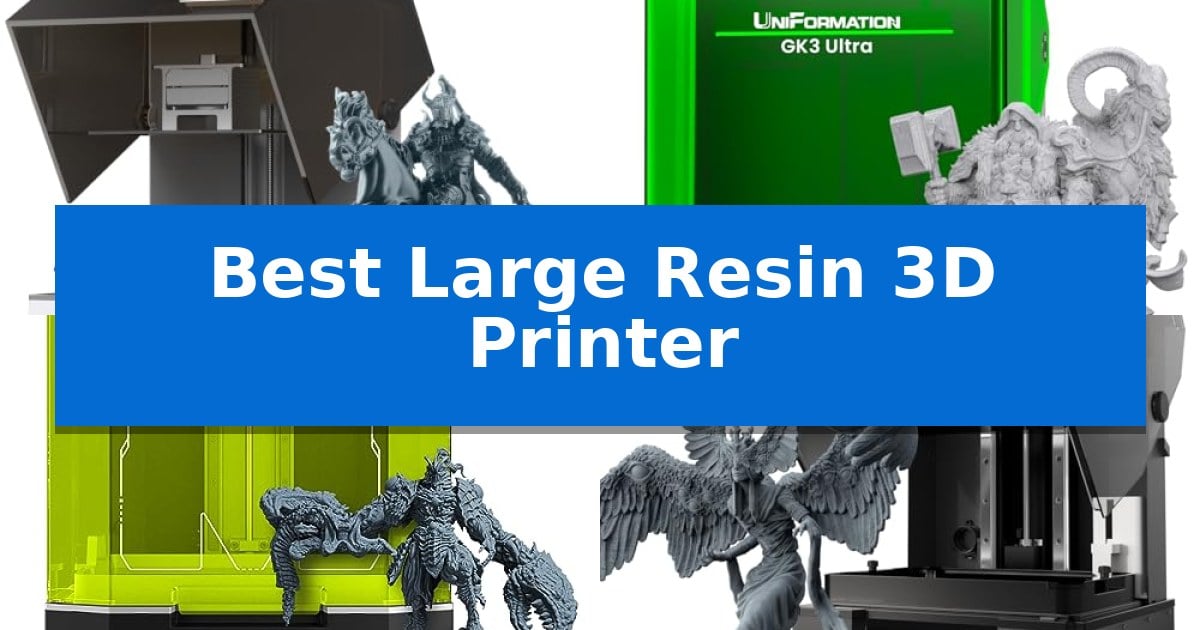
Finding the right Best Large Resin 3D Printer requires balancing massive build volume with the precision needed for complex, high-resolution parts. Whether you are scaling up a studio or producing oversized prototypes, the right machine must manage resin consistency and mechanical stability to ensure every batch succeeds without constant manual intervention.
We have analyzed the latest large-format resin systems to help you identify which machine aligns with your specific production goals. From automated resin management to high-resolution monochrome screens, these printers offer distinct advantages for creators who need to move beyond the limitations of standard desktop units.
Best Large Resin 3D Printer in 2026: Scale Your Production Capacity
Quick Comparison
| Product | Best For | Key Strength | Score |
|---|---|---|---|
| Anycubic Photon P1 Max Resin Printer | Best Overall | Massive 18.3L build volume for high-capacity batch production. | 4.9 |
| Uniformation GK3 Ultra Resin Printer | High-Capacity 16K Precision | 16K resolution for high-detail large-scale models. | 4.9 |
| Phrozen Sonic Mega 8K S Printer | Professional Studio Scale Efficiency | High-volume production capacity with a 33 x 18.5 x 30 cm build plate. | 4.4 |
| Anycubic Photon Mono M7 Max Printer | Fast Large-Format Output | Ultra-large build volume for printing sizable models in a single session. | 4.6 |
| Creality Halot-X1 Combo Resin Printer | Intelligent Automated Workflow | 16K resolution for professional-grade detail. | 4.9 |
How We Chose
- Build Volume and Capacity: We prioritized printers that offer sufficient dimensions for oversized models or high-density batch production.
- Resolution and Detail: We assessed the LCD screen resolution and pixel size to ensure that larger print areas do not sacrifice fine surface detail.
- Thermal and Resin Management: We looked for integrated heating and auto-refilling systems that maintain consistent material properties throughout long print cycles.
- Mechanical Stability: We evaluated the Z-axis architecture and motion control components that ensure precision and minimize layer lines across large surface areas.
- Workflow Automation: We considered features like auto-leveling and drip-management systems that reduce manual setup time and post-processing mess.
1 Anycubic Photon P1 Max Resin Printer — Massive Volume for Batch Production
Scaling up resin-based fabrication requires a machine capable of handling both size and precision, and the Anycubic Photon P1 Max Resin Printer addresses this with a massive 18.3L build volume. Measuring 285.5 214 300 mm, this large-format printer is engineered for high-volume batch production or oversized prototypes that would otherwise require multiple print cycles.
At the heart of the system is a 14-inch 12K monochrome screen, which provides a resolution of 11520 8640 pixels. By utilizing 24.824.8m square pixels, the machine is designed to minimize aliasing and jagged edges, resulting in high-detail surface finishes. This display technology is paired with a C7-grade ball screw and linear guide rail system, which ensures a repeat positioning accuracy of 0.01mm for consistent mechanical stability.
To maintain print quality across varying workshop conditions, the unit features a 1900ml intelligent heating resin tank. This thermal-controlled vat can reach temperatures up to 35C, which helps maintain optimal resin flow for high-viscosity materials and reduces the risk of failures caused by ambient temperature fluctuations.
Setup and calibration are streamlined through the Auto-Leveling 3.0 system. This feature incorporates factory calibration, self-check routines, and real-time force feedback to automatically adjust the build plate before each print, removing the need for manual leveling guesswork.
Best for: Professional users and creators requiring large-format, high-resolution batch production with automated leveling and thermal control.
Skip if: Users with limited workspace or those who only require small-scale, occasional printing will find the large footprint and high-capacity tank unnecessary.
PROS
- Massive 18.3L build volume for high-capacity batch production.
- 14-inch 12K monochrome screen for ultra-fine detail.
- Intelligent heating resin tank maintains stable temperatures up to 35C.
- Auto-Leveling 3.0 system simplifies calibration with real-time force feedback.
- C7-grade ball screws provide high repeat positioning accuracy of 0.01mm.
CONS
- Large physical footprint requires significant dedicated workspace.
- High-capacity 1.9L tank necessitates larger volumes of resin for operation.
2 Uniformation GK3 Ultra Resin Printer — High-Capacity 16K Precision
The Uniformation GK3 Ultra Resin Printer distinguishes itself with a substantial 11.8 x 6.3 x 11.8 inch build volume, providing a significant increase in capacity for professional studios and high-volume production environments. This large-format machine integrates a 16K resolution LCD screen with a 20 x 26μm pixel size, ensuring that large-scale models maintain sharp, intricate detail across the entire print area.
Engineered for consistent output, the device features an integrated KK60 module that enhances mechanical rigidity. This Z-axis architecture is designed to reduce visible layer lines and achieve a repeat positioning accuracy of ±0.003mm, supporting the structural requirements of industrial prototyping and complex part fabrication.
Workflow efficiency is a core focus of the design, highlighted by an automatic resin heating system that maintains the vat at 25°C to 30°C. This capability allows for reliable operation even in environments as cold as 0°C. Furthermore, the automatic resin feeder ensures continuous supply during long print jobs, while the quick-release vat and side-mounted drip hanger simplify maintenance and cleanup.
For users managing high-volume tasks, the inclusion of a built-in carbon filter helps manage the printing environment, while the robust build quality supports the demands of continuous, professional-grade resin printing. This model balances high-capacity output with precision-focused hardware, making it a specialized tool for those requiring both scale and detail.
Best for: Professional studios and businesses requiring high-volume, large-format resin printing with consistent precision.
Skip if: Users with limited workspace or those who only require small-scale printing may find the large footprint and specialized industrial features unnecessary.
PROS
- 16K resolution for high-detail large-scale models.
- Automatic resin heating for reliable cold-weather performance.
- Automatic resin feeder to prevent print failures from low levels.
- KK60 Z-axis module for enhanced mechanical stability.
CONS
- Large physical footprint requires significant dedicated workspace.
3 Phrozen Sonic Mega 8K S Printer — Professional Studio Scale Efficiency
Scaling production for high-volume commercial demands requires equipment that balances speed with precision. The Phrozen Sonic Mega 8K S Printer addresses this by offering a massive 33 x 18.5 x 30 cm build plate, capable of producing a batch of 80 miniatures in under 90 minutes. This capacity makes it a specialized tool for professional studios focused on maximizing output without sacrificing detail.
Engineered for efficiency, the system utilizes an advanced ACF (All-Cutter Fluoropolymer) film paired with TR300 High-Speed Resin. This combination is designed to reduce suction force during the printing process, enabling speeds up to 10 times faster than standard mid-size printers while maintaining high success rates during continuous production cycles.
The device features a 15-inch 8K Mono LCD screen that provides an XY resolution of 43µm. This level of fidelity ensures that complex internal geometries and fine textures are captured accurately, making the unit suitable for applications ranging from dental prototypes to high-end collectibles. The industrial-grade precision is maintained regardless of the large build volume.
Practical design elements enhance the workflow, such as the lift-up lid accessibility which minimizes the required vertical and lateral clearance, allowing for placement in constrained professional workspaces. Additionally, the built-in metal drip hanger facilitates a zero-waste workflow by allowing excess resin to flow back into the vat, aiding in cleaner post-processing and cost-effective resin recovery.
Best for: Professional studios and commercial users requiring high-volume production of detailed resin models with industrial-grade precision.
Skip if: Users with limited workspace or those who do not require large-scale batch production may find the footprint and capacity of this unit excessive for their needs.
PROS
- High-volume production capacity with a 33 x 18.5 x 30 cm build plate.
- 10x faster printing speeds enabled by ACF film and TR300 resin.
- 43µm XY resolution for industrial-grade detail.
- Space-saving lift-up lid design for compact workspace integration.
- Built-in metal drip hanger for efficient resin recovery.
CONS
- Large physical footprint may be challenging for smaller hobbyist workshops.
- High-speed performance is optimized specifically when using compatible TR300 resin.
4 Anycubic Photon Mono M7 Max Printer — Fast Large-Format Output
The Anycubic Photon Mono M7 Max Printer prioritizes high-throughput production through its expansive 11.73 x 6.46 x 11.81 inch build volume, allowing for large-scale models or batch printing without the need for manual splitting. This device is engineered for efficiency, utilizing a 13.6-inch 7K high-resolution screen that achieves a 46μm pixel size for detailed texture reproduction.
Performance is bolstered by advanced hardware integration, including Intelligent Release 2.0 and dynamic Light-off Compensation, which enable printing speeds reaching 60mm/h. To maintain consistent output, the system features an integrated resin vat with temperature control, ensuring the material remains at an optimal state for successful prints.
Operational reliability is addressed through a comprehensive 360° self-check system. This suite includes five distinct diagnostic tools, such as residual resin detection, failed print monitoring, and automated material management, which actively monitors and refills resin levels to minimize waste during extended print cycles.
Practical design elements further enhance the workflow, notably the inclusion of a suspension drip setting that angles the platform post-print to recover excess resin. With a 1300ml resin tank capacity and a convenient flip-top access design, the printer is configured to support demanding, high-volume project requirements.
Best for: Users requiring high-speed, large-format resin printing with automated resin management and monitoring features.
Skip if: Users with limited workspace or those who do not require the large 13.6-inch build volume and prefer a more compact, entry-level footprint.
PROS
- Ultra-large build volume for printing sizable models in a single session.
- Intelligent resin management system that automatically monitors and adds material.
- High-speed printing capabilities reaching up to 60mm/h.
- Integrated temperature control within the resin vat for consistent quality.
CONS
- Large physical footprint requires significant dedicated workspace.
- Complex maintenance due to the inclusion of multiple automated sensors and monitoring systems.
5 Creality Halot-X1 Combo Resin Printer — Intelligent Automated Workflow
Achieving professional-grade detail in large-scale prints requires precision hardware that minimizes mechanical variables. The Creality Halot-X1 Combo Resin 3D Printer distinguishes itself with a top-down movable optical system, where the dynamic optical module and resin vat move vertically while the build plate remains stationary, providing superior stability for large prints.
Equipped with a 10.1-inch 16K mono LCD, this printer achieves a pixel size of 14×19 μm, ensuring high-resolution output. The system is engineered for efficiency, featuring a 3X faster print speed of up to 170 mm/h. To maintain consistent results, the Intelligent AFU Resin Management System handles heating, parameter loading via RFID, and automated resin feeding and recycling.
Usability is enhanced through a fully assembled, auto-leveling design that eliminates manual calibration. The build plate utilizes a twist-to-release mechanism for easy model removal, while the high-temp NACF release film is designed to reduce release force and extend operational lifespan. For durability, the printer uses 92 independent light zones to reduce overexposure and prolong screen life.
The structural integrity is supported by dual linear rails and dual lead screws, achieving 0.01 mm positioning precision. Despite its large build volume of 211.68 × 118.37 × 200 mm, the unit features a space-saving design that is 20% smaller than comparable models, making it a practical choice for workshops where footprint is a consideration.
Best for: Professional users and creators who require high-resolution, large-format resin prints with automated resin management and high-speed throughput.
Skip if: Users who prefer a bottom-up printing architecture or those with limited workspace who do not require the specific high-speed and automated resin management features.
PROS
- 16K resolution for professional-grade detail.
- Intelligent AFU system for automated resin heating and management.
- Stationary build plate design for enhanced Z-axis stability.
- High-speed printing up to 170 mm/h.
CONS
- Specialized architecture requires adaptation if you are accustomed to traditional bottom-up resin printers.
Best Large Resin 3D Printer Buying Guide
Understanding Build Volume Requirements
The primary advantage of a large-format printer is the ability to print bigger parts in one piece, which eliminates the need for splitting and bonding. When selecting your machine, ensure the build volume dimensions match your largest intended projects, keeping in mind that larger volumes often require more resin and longer print times.
Consider whether your workflow involves single large prints or high-volume batch production. Printers with larger vats and automated resin feeding are essential for batch runs, as they prevent print failures caused by running out of material mid-cycle.
The Importance of Resolution at Scale
As build plates grow, maintaining high resolution becomes more challenging. A 12K or 16K monochrome screen is critical for large printers to keep the pixel size small enough that individual voxels are not visible on the finished model.
Check the XY-axis resolution (often measured in microns) to ensure it meets your quality standards. A smaller micron value indicates higher precision, which is vital for applications like dental modeling, jewelry, or intricate tabletop miniatures.
Thermal Control and Resin Consistency
Resin viscosity changes significantly with temperature, which can lead to inconsistent layer adhesion or print failures. A built-in heating system is a major benefit for users operating in cooler environments or those using high-viscosity specialty resins.
By maintaining a stable temperature, these heating systems ensure the resin flows evenly across the build plate, resulting in more reliable prints and fewer failed cycles during long-duration jobs.
Mechanical Rigidity and Z-Axis Precision
Large prints exert more force on the Z-axis during the peeling process. Look for printers that utilize dual linear rails or C7-grade ball screws, as these components provide the necessary stiffness to prevent wobbling or layer shifting.
A stable Z-axis architecture is the foundation of print accuracy. Without robust mechanical support, even the highest resolution screen will fail to produce clean, sharp results on tall or heavy models.
Streamlining Post-Processing
Large-format printing generates a significant amount of excess resin. Features such as built-in drip hangers or tilt-to-drain platforms are invaluable for keeping your workspace clean and maximizing resin recovery.
Automated systems that allow resin to flow back into the vat reduce waste and minimize the amount of manual cleaning required after each print, making your daily workflow significantly more efficient.
Frequently Asked Questions
Why is a heating system important for large resin printers?
Resin viscosity is highly temperature-dependent. A heating system keeps the resin at an optimal temperature, ensuring consistent flow and reducing the risk of print failures, especially in cooler workshop environments.
Does a larger build volume mean lower print quality?
Not necessarily, provided the printer uses a high-resolution screen (such as 12K or 16K) to maintain a small pixel size. High-quality optics and precise Z-axis motion are key to maintaining detail across a larger surface area.
What is the benefit of an automatic resin feeder?
An automatic resin feeder monitors the level in the vat and adds more material as needed. This is crucial for long, large-scale prints that might otherwise deplete the vat and cause a failure.
How do I ensure my large prints don't have visible layer lines?
Visible layer lines are often caused by mechanical instability. Choosing a printer with a rigid Z-axis, such as one using dual linear rails or ball screws, significantly improves surface smoothness.
Are these printers suitable for beginners?
While these machines offer advanced capabilities, they are designed for professional or high-volume use. Beginners should be prepared for a steeper learning curve regarding resin management, safety protocols, and post-processing techniques.
Conclusion: Our Top Pick
For those seeking the most robust solution for high-volume production, the Anycubic Photon P1 Max Resin Printer stands out as our top recommendation. Its combination of a massive 18.3L build volume, 12K high-resolution screen, and intelligent thermal control makes it exceptionally well-suited for both oversized prototypes and efficient batch manufacturing.
The inclusion of C7-grade ball screws and an auto-leveling system provides the mechanical reliability necessary for consistent, high-quality output. If your workflow demands a balance of scale, precision, and ease of use, this printer offers the most comprehensive feature set to support your production needs.