
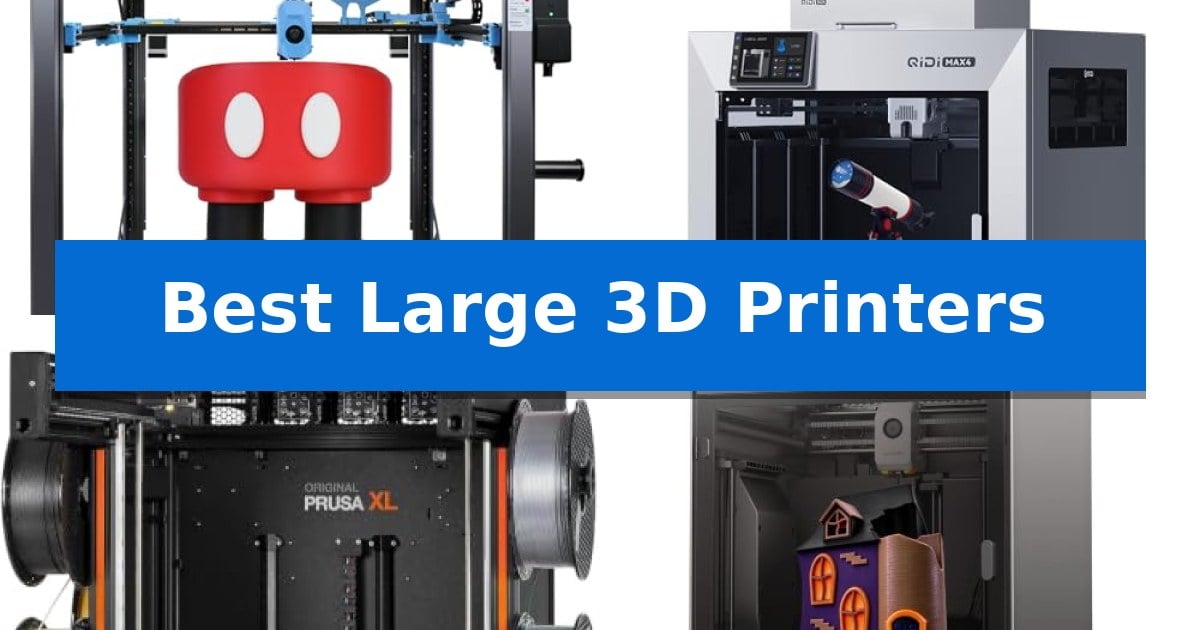
Finding the right machine for oversized projects requires balancing massive build volumes with the precision needed for complex geometries. Whether you are printing full-scale prototypes or industrial components, the Best Large 3D Printers must maintain structural integrity and consistent thermal control across expansive print beds.
Selecting a large-format system involves more than just measuring the build area; it requires evaluating how the printer handles high-speed motion, material variety, and first-layer adhesion. This guide examines top-tier options to help you determine which system fits your specific production requirements.
Best Large 3D Printers in 2026: Scale Your Industrial Prototyping
Quick Comparison
| Product | Best For | Key Strength | Score |
|---|---|---|---|
| Sovol SV08 Max 3D Printer | Best Overall | Massive 500x500x500mm build volume for large-scale projects. | 4.9 |
| QIDI Max4 Combo 3D Printer | Industrial Grade Large Build Area | Ultra-large 390×390×340mm build volume for printing large parts in one piece. | 4.4 |
| Original Prusa XL 3D Printer | Professional Multi-Tool Large Format | Five-tool multi-material system for advanced color and material combinations. | 4.6 |
| Anycubic Kobra S1 Max Combo | High Speed Large Scale Printing | Large 350x350x350mm build volume for single-piece printing. | 4.9 |
| Original Prusa CORE One L | Enclosed Design for Advanced Materials | Massive 11.8 x 11.8 x 12.99 inch build volume for large-scale projects. | 4.9 |
How We Chose
- Build volume capacity and footprint efficiency.
- Motion system stability and high-speed performance.
- Thermal management for advanced material compatibility.
- Automated leveling and calibration accuracy.
- Integration of monitoring and multi-material capabilities.
1 Sovol SV08 Max 3D Printer — Massive Volume for Large Prototypes
Tackling industrial-scale projects requires a machine capable of handling massive dimensions without sacrificing speed. The Sovol SV08 Max 3D Printer addresses this by offering a substantial 500x500x500mm build volume, allowing for the production of large-format prototypes, furniture components, and oversized collectibles in a single print run.
Engineered for high-performance output, this printer utilizes CoreXY kinematics to minimize moving mass and reduce vibration, which is essential for maintaining precision across such a large print area. It is capable of reaching speeds up to 700mm/s with 40,000 mm/s² acceleration, supported by a 50mm³/s high-flow nozzle that ensures consistent material extrusion during rapid movements.
Calibration and monitoring are streamlined through integrated technology. The Eddy Current Sensor provides contactless, high-speed bed leveling by scanning for surface deviations, ensuring a reliable first layer. For oversight, the unit features a 1280×720 HD camera that supports remote monitoring and time-lapse recording, with compatibility for cloud-based control via Obico.
The Sovol SV08 Max 3D Printer is designed for versatility with a 300°C high-temp nozzle, enabling the use of advanced filaments like ABS, ASA, PA, PC, and carbon-fiber composites. Users looking to further expand their material capabilities can utilize the reserved interface to install a separately purchased Heated Chamber module.
Best for: Professional makers and engineers who require a large-format build volume for industrial parts and full-scale prototypes.
Skip if: Users with limited workspace or those who primarily print small, simple objects that do not justify the footprint of a large-format machine.
PROS
- Massive 500x500x500mm build volume for large-scale projects.
- High-speed performance with 700mm/s capability and CoreXY kinematics.
- Advanced Eddy Current Sensor for automated, high-precision bed leveling.
- Wide material compatibility including high-temp filaments up to 300°C.
CONS
- Large physical footprint requires significant dedicated workspace.
- Heated Chamber module must be purchased separately to unlock full high-temp potential.
2 QIDI Max4 Combo 3D Printer — Industrial Grade Large Build Area
The QIDI Max4 Combo 3D Printer is engineered for large-scale production, offering a substantial 390×390×340mm build volume that allows for the creation of industrial parts and complex prototypes without the need for splitting designs. Its structural integrity is supported by dual Z lead screws and closed-loop motors on the X/Y axes, which facilitate high-speed printing up to 800mm/s while maintaining precise surface quality.
Designed for versatility, the printer features a 40mm³/s high-flow hotend equipped with a hardened steel nozzle. This setup supports a wide range of materials, from standard PLA and ABS to abrasive carbon fiber-reinforced nylon. The inclusion of a 65℃ active heated chamber ensures the necessary environment for high-temperature materials like PC and PPS-CF, while a full-surface silicone heated bed promotes consistent adhesion.
Operational intelligence is integrated through a built-in AI camera that monitors for printing abnormalities, such as spaghetti-like failures, and triggers an automatic pause to preserve materials. For users requiring multi-color or multi-material capabilities, the system is compatible with the QIDI BOX, which enables intelligent filament management, including real-time level monitoring and automatic pauses when filament is depleted.
The printer is a robust, industrial-grade solution that prioritizes stability and material flexibility. While it offers significant performance capabilities, potential users should note that the Polar Cooler system is not included with the base unit and must be purchased separately to fully optimize cooling for specific high-temperature applications.
Best for: Professionals and creators requiring a large build volume for industrial-grade materials and high-speed production.
Skip if: Users with limited workspace or those who do not require high-temperature material compatibility and large-format printing capabilities.
PROS
- Ultra-large 390×390×340mm build volume for printing large parts in one piece.
- High-speed performance reaching up to 800mm/s with closed-loop motor stability.
- Wide material compatibility including abrasive and high-temperature industrial filaments.
- Integrated AI monitoring to reduce material waste during failed prints.
CONS
- Polar Cooler system is sold separately and not included in the base package.
- Large physical footprint requires significant dedicated workspace.
3 Original Prusa XL 3D Printer — Professional Multi-Tool Large Format
Achieving consistent results in large-scale additive manufacturing often requires balancing speed with the flexibility to handle multiple materials. The Original Prusa XL 5-Toolhead Multi-Material Large-Format CoreXY 3D Printer addresses this by integrating a sophisticated five-tool multi-material system, allowing for complex, full-color visual models and functional prototypes within a single print job.
This machine features a substantial build volume of 14.17 x 14.17 x 14.17 inches, supported by a segmented heated bed system. This design uses intelligent heating zones to improve energy efficiency and minimize warping, ensuring reliable first-layer adhesion across the entire print surface. The CoreXY architecture is engineered to maintain precision and speed, even when the printer is executing frequent tool changes during intricate builds.
Workflow integration is a core focus, as the system is designed to work seamlessly with the existing Prusa software ecosystem and model libraries. To maintain optimized material efficiency, the printer employs smart tool management that reduces waste during transitions. The unit arrives with a Satin print sheet and a 1kg spool of Prusament PLA to facilitate immediate setup for professional prototyping environments.
While the printer is designed for industrial-grade performance, it remains accessible through a straightforward assembly process. Certain components, such as the LCD, extruder assembly, Wi-Fi antenna, and spool holder, are packed separately for safe transport and require quick installation. The package is backed by lifetime technical assistance and 24-hour professional support to ensure long-term operational reliability.
Best for: Professional environments and creators requiring high-volume, multi-material, or full-color large-format prototyping.
Skip if: Users with limited workspace or those who do not require multi-material capabilities may find the footprint and complexity of a five-tool system unnecessary.
PROS
- Five-tool multi-material system for advanced color and material combinations.
- Segmented heated bed reduces warping and improves energy efficiency.
- Large 14.17-inch cubic build volume suitable for industrial-scale parts.
- High-end CoreXY performance ensures precision during complex tool changes.
CONS
- Requires assembly of several components upon arrival due to shipping safety protocols.
- Large physical footprint necessitates a dedicated, spacious work area.
4 Anycubic Kobra S1 Max Combo — High Speed Large Scale Printing
Scaling up production requires a machine that balances raw volume with consistent precision. The Anycubic Kobra S1 Max Combo distinguishes itself with a massive 350x350x350mm build volume, enabling the fabrication of large-scale models in a single piece while maintaining the structural integrity required for professional-grade output.
Engineered for high-speed workflows, this printer utilizes a fully enclosed CoreXY system capable of reaching speeds up to 600mm/s. To ensure these speeds do not compromise quality, the unit incorporates active vibration compensation to mitigate ringing, alongside LeviQ 3.0 auto-leveling that dynamically adjusts for bed irregularities to guarantee a reliable first layer.
Versatility is a core component of its design, featuring a 65°C active chamber heating system and a 350°C hotend. This thermal management allows for the use of a wide range of filaments, including PLA, PETG, TPU, ABS, ASA, and PVA. The inclusion of hardened steel extruder gears and a nozzle provides the necessary wear resistance for abrasive materials, while the titanium alloy throat tube is specifically designed to minimize clogging.
For multi-material projects, the system includes the ACE 2 Pro, which facilitates seamless 4-color printing directly out of the box. Users can scale this capability by connecting up to four ACE 2 Pro units, allowing for a total of 16 colors. Smart safety features, such as filament runout detection and power-loss recovery, provide essential safeguards for long-duration prints, ensuring that large, complex projects remain protected from unexpected interruptions.
Best for: Professional makers and engineers requiring high-speed, large-format multi-color printing with diverse material compatibility.
Skip if: Users with limited workspace or those who only require small-scale, single-material printing will find the large footprint and multi-color system unnecessary.
PROS
- Large 350x350x350mm build volume for single-piece printing.
- High-speed CoreXY architecture supporting up to 600mm/s.
- Multi-color capability expandable up to 16 colors.
- Active chamber heating and high-temperature hotend for advanced materials.
CONS
- Large physical footprint requires significant dedicated workspace.
- Complex multi-unit setup needed to reach the 16-color maximum.
5 Original Prusa CORE One L — Enclosed Design for Advanced Materials
When scaling up production for industrial components or large architectural models, the Original Prusa CORE One L provides a substantial 11.8 x 11.8 x 12.99 inch build volume. This expansive workspace allows creators to print complex, full-scale geometries in a single pass, eliminating the structural trade-offs often associated with splitting parts into smaller, assemblable segments.
The printer is built around a high-rigidity CoreXY precision frame featuring a steel exoskeleton. This robust construction is essential for maintaining consistent dimensional accuracy during high-speed operations, ensuring that complex parts retain their intended tolerances and professional surface finish throughout the entire build process.
For those working with engineering-grade materials like ABS, ASA, PC, and Nylon, the actively heated 60°C chamber is a critical asset. By maintaining a stable, controlled environment, the printer significantly reduces the likelihood of warping and improves layer adhesion, which are common challenges when using high-performance filaments.
Workflow efficiency is prioritized through a true unpack and print experience. The system integrates automated sensors for leveling and print preparation, allowing users to move from setup to production in minutes. Furthermore, the offline-first platform ensures that the printer remains fully functional without cloud dependency, offering a secure, reliable architecture for long-term industrial use.
Best for: Professional users and creators who require a large, enclosed build volume for printing engineering-grade materials with high dimensional accuracy.
Skip if: Users who primarily print small, simple models using standard PLA or those who require an ultra-compact footprint for limited desk space.
PROS
- Massive 11.8 x 11.8 x 12.99 inch build volume for large-scale projects.
- Actively heated 60°C chamber for superior results with advanced materials.
- High-rigidity CoreXY frame ensures stability and precision at high speeds.
- Automated sensors for a fast, minimal-calibration setup process.
CONS
- Large physical footprint may require significant dedicated workspace.
- Heavy-duty construction results in a substantial unit weight.
Best Large 3D Printers Buying Guide
Understanding Build Volume and Footprint
The primary advantage of these machines is the ability to print large parts in one piece, eliminating the need for assembly and reducing potential failure points. However, a larger build volume necessitates a larger physical footprint, which can impact your workspace layout.
When choosing, consider the total dimensions of the printer, not just the print area. Ensure your workspace can accommodate the machine's full width and height while allowing enough clearance for maintenance and filament access.
Thermal Control and Material Versatility
Printing with engineering-grade materials like ABS, ASA, or PC requires stable thermal environments to prevent warping and layer separation. Look for printers with actively heated chambers or enclosed designs that maintain consistent temperatures throughout the entire print duration.
A higher maximum nozzle temperature is essential for handling abrasive or high-melting-point filaments. Ensure the hotend is rated for the specific materials your projects demand, such as carbon-fiber-reinforced composites.
Motion Systems and Print Speed
Large prints can take days to complete, making high-speed performance a critical factor for productivity. Systems utilizing CoreXY kinematics are generally preferred for their ability to maintain precision at high acceleration and velocity by minimizing moving mass.
Look for printers that incorporate vibration compensation or input shaping technology. These features are vital for reducing ringing and artifacts on the surface of large models, ensuring professional-grade finishes even at higher speeds.
Calibration and First-Layer Reliability
Achieving a perfect first layer is significantly more difficult on a large print bed due to potential surface deviations. Advanced contactless bed leveling systems, such as eddy current sensors, provide the precision required to compensate for minor irregularities across the entire surface.
Automated calibration routines save time and reduce the risk of print failure. A system that performs a comprehensive bed scan before every job ensures that your large-scale prints start with a solid foundation.
Monitoring and Workflow Integration
Long print times increase the risk of undetected failures. Built-in AI cameras and remote monitoring capabilities allow you to track progress and receive alerts, potentially saving hours of time and significant amounts of filament.
Consider how the printer integrates with your existing workflow. Features like multi-tool heads or multi-color systems can streamline the production of complex, multi-material prototypes, reducing the need for post-processing.
Frequently Asked Questions
What is the main benefit of a CoreXY motion system?
A CoreXY system reduces the moving mass of the print head, allowing for faster acceleration and higher print speeds without sacrificing precision or increasing vibration.
Why is an enclosed chamber important for large prints?
An enclosed chamber maintains a consistent ambient temperature, which is crucial for preventing warping and layer splitting when printing with materials like ABS, ASA, or Nylon.
How does an eddy current sensor improve leveling?
Eddy current sensors provide high-speed, contactless scanning of the print bed, detecting minute surface deviations to ensure a perfectly leveled first layer across the entire build area.
Can these printers handle carbon-fiber filaments?
Yes, many of these models feature hardened steel nozzles and high-flow hotends specifically designed to handle abrasive materials like carbon-fiber-reinforced filaments.
Do I need a heated chamber for all materials?
While not strictly necessary for basic materials like PLA, an actively heated chamber is highly recommended for engineering-grade filaments to ensure structural integrity and reduce warping.
Conclusion: Our Top Pick
When selecting from the Best Large 3D Printers, the Sovol SV08 Max 3D Printer stands out for its combination of massive build volume and high-speed CoreXY performance. Its ability to handle industrial-grade materials while offering advanced features like eddy current leveling makes it a versatile choice for demanding projects.
While other models offer specific advantages like multi-tool heads or active chamber heating, the SV08 Max provides a robust foundation for users who need to scale their production without sacrificing speed or precision. Always ensure your workspace can accommodate the physical dimensions of these large-format machines before finalizing your purchase.